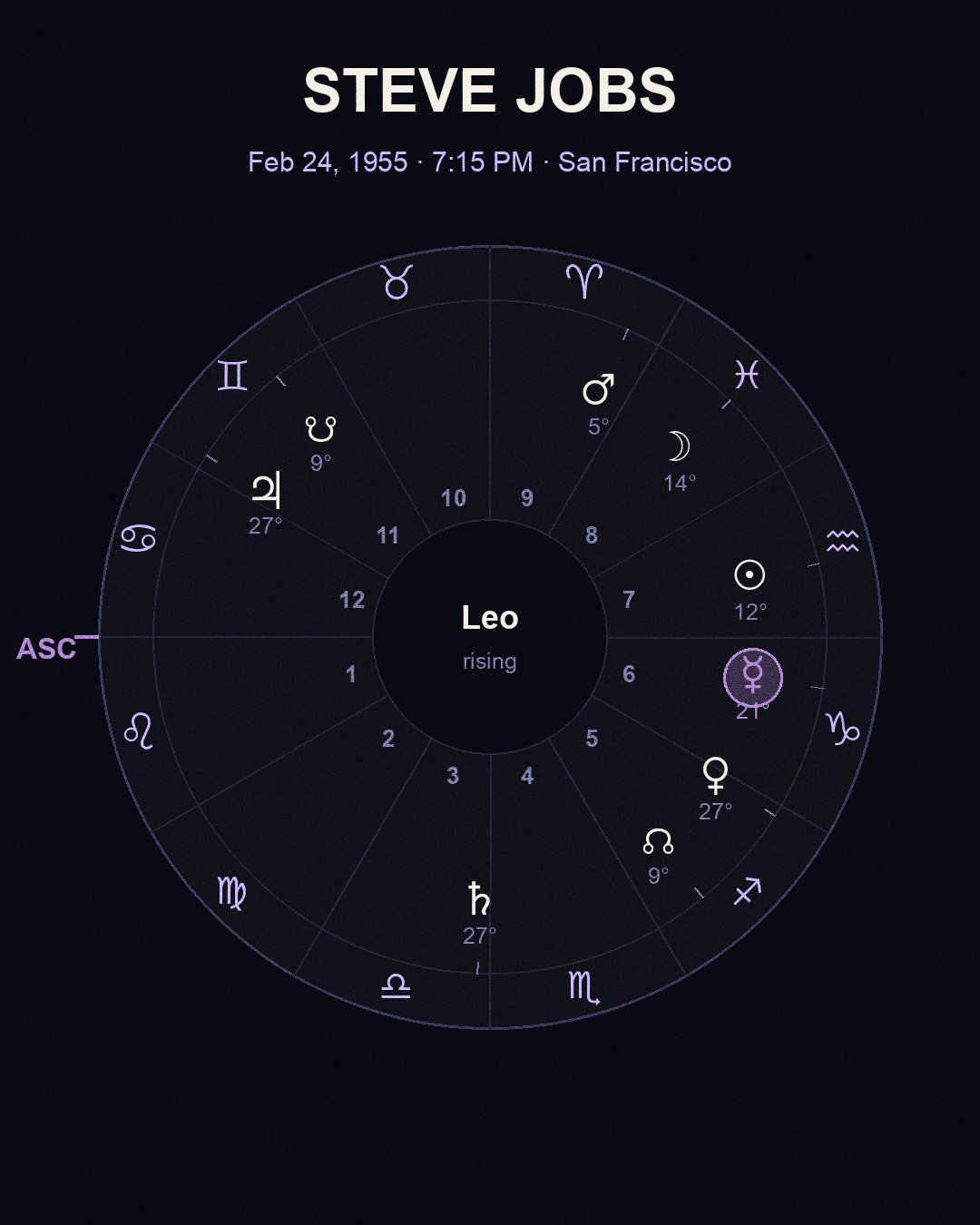
This is a chart that runs on machinery the world was never meant to see first. The lagna is Leo — sovereign, single-centred — but at 29°03′ it is the very last degree of the sign, a self already leaning out of itself, and its lord (the Sun) is thrown clear across the chart into the 7th, in Aquarius, in enemy relation to the Saturn that owns the ground under it. So the ruler of the self does not sit on a throne; it sits in the house of the other. What actually runs the chart are two grahas that are not the lagna lord at all: Mars, shadbala ratio 1.66, rank 1 of nine, own moolatrikona in the 9th — the dharma engine — and Jupiter, total shadbala 555.8 (highest of the seven), vargottama — the wisdom engine. Under both of them runs a permanent undertow: the Moon in the 8th, Pisces, shadbala 1.34, second-strongest, an inward, researching, privately intense emotional weather that colours everything and never surfaces. The saboteurs are named without ambiguity too: Mercury, ratio 0.86 — the only sub-minimum graha, retrograde, drik bala −10.62 — weak by strength, and Saturn, exalted at 1.43 but functionally malefic — heavy by function, dumping its full drishti on the two houses the chart most wants clean.
Birth data · birth-time quality: 1955-02-24 19:15 America/Los_Angeles (UTC 1955-02-25 03:15Z), San Francisco. Time source stated, provenance birth certificate (Astro-Databank AA / Rodden AA) — the strongest tier of birth-time evidence. That said, the lagna at 29°03′ Leo is a hair from the Virgo boundary; even AA data leaves this chart's most fragile point genuinely fragile, and a few minutes' error would flip the lagna to Virgo and re-key every whole-sign house. Every house- and lagna-dependent claim below carries that fence in its own paragraph. Deceased 2011-10-05; the timing layer is anchored at 1997-09-16 (his return to Apple) and reads a documented past, written in the past tense.
I.What actually carries weight here
Rank by shadbala ratio, straight from the dossier: Mars 1.66 > Saturn 1.43 > Jupiter 1.42 (highest by total virupas, 555.8) > Moon 1.34 > Sun 1.29 > Venus 1.00 > Mercury 0.86. That ordering is the spine of everything. The chart's engines are the top of it that also sit in the right houses: Mars, own-sign in its own trikona of dharma (the 9th), sole ruler of a kendra (4th Scorpio) and a trikona (9th Aries) and therefore the single yogakaraka; and Jupiter, vargottama (Gemini in both D1 and D9) and exalted in the D10, forming Gajakesari and a Kendra-Trikona raja yoga. Those two deliver.
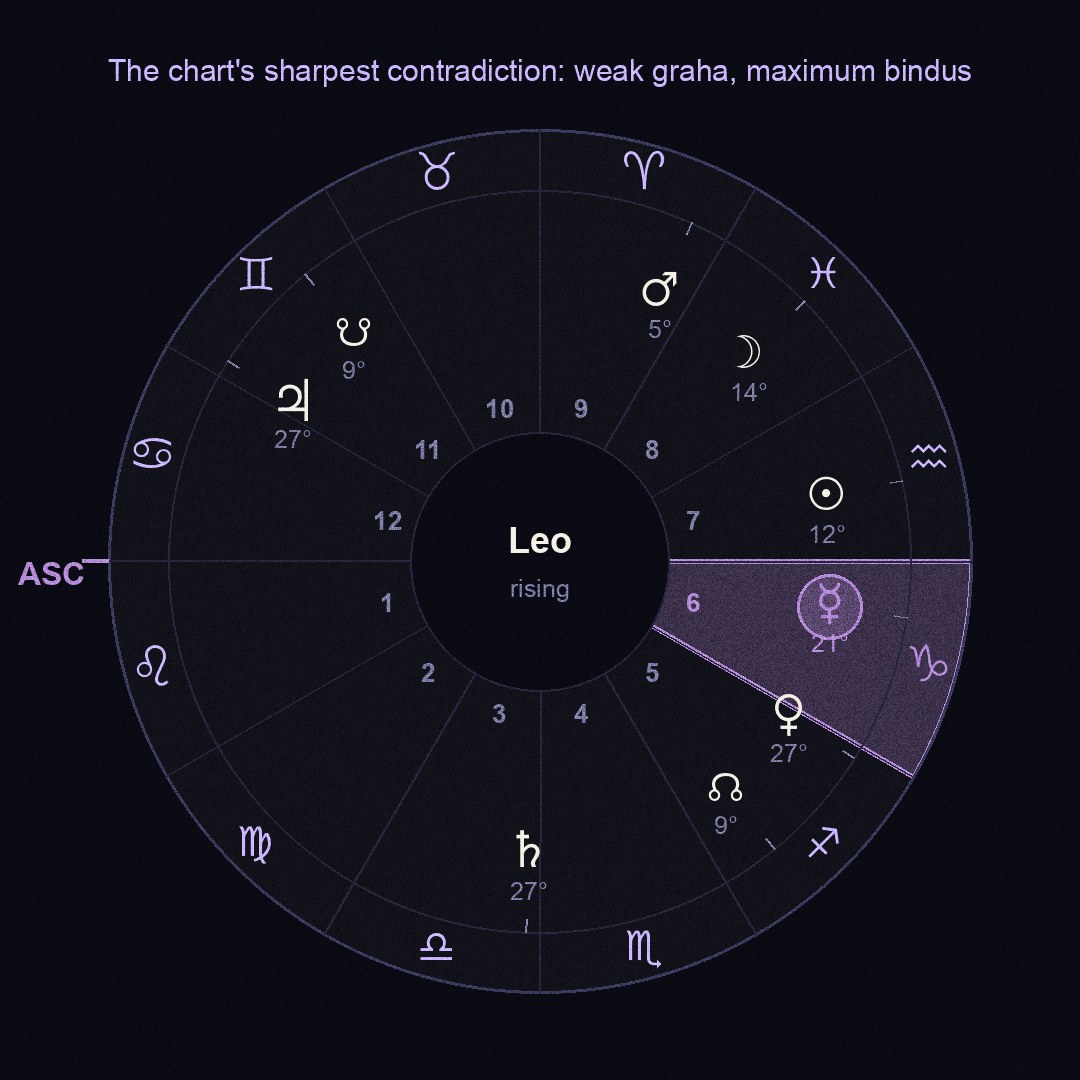
What is decorative or misleading if read naively: the Sun, which sounds load-bearing because it is the lagna lord and is genuinely strong (1.29), but is displaced into the 7th and aspects only its own empty 1st — strong daylight, seated among equals, not driving. Venus, the current mahadasha lord and the 10th (career) lord, is the weakest graha in the chart at exactly 1.00 (mrita avastha, just scraping its minimum) — which is the whole tragedy of the timing, because it runs the twenty-year prime. And Mercury is the chart's one real failure by strength (0.86, retrograde, drik −10.62) — except that its ashtakavarga flatly contradicts its shadbala, which is the most informative single object in the chart (Figure 6 below).
The ashtakavarga tells you where the ground is fertile and where it is hollow: Taurus (10th) 36 — the highest, and empty; Capricorn (6th) 35; Scorpio (4th) 33; Aquarius (7th) only 22 (second-lowest); Pisces (8th) 24; Cancer (12th) 21 (lowest). The two houses the life most invests in — the 7th of partnership and the 8th of the emotional undertow — are among the poorest-supported signs in the chart. Hold that: the domains that matter most here are precisely the ones the environment does not spontaneously reward.
II.The king seated among equals — the displaced lagna lord
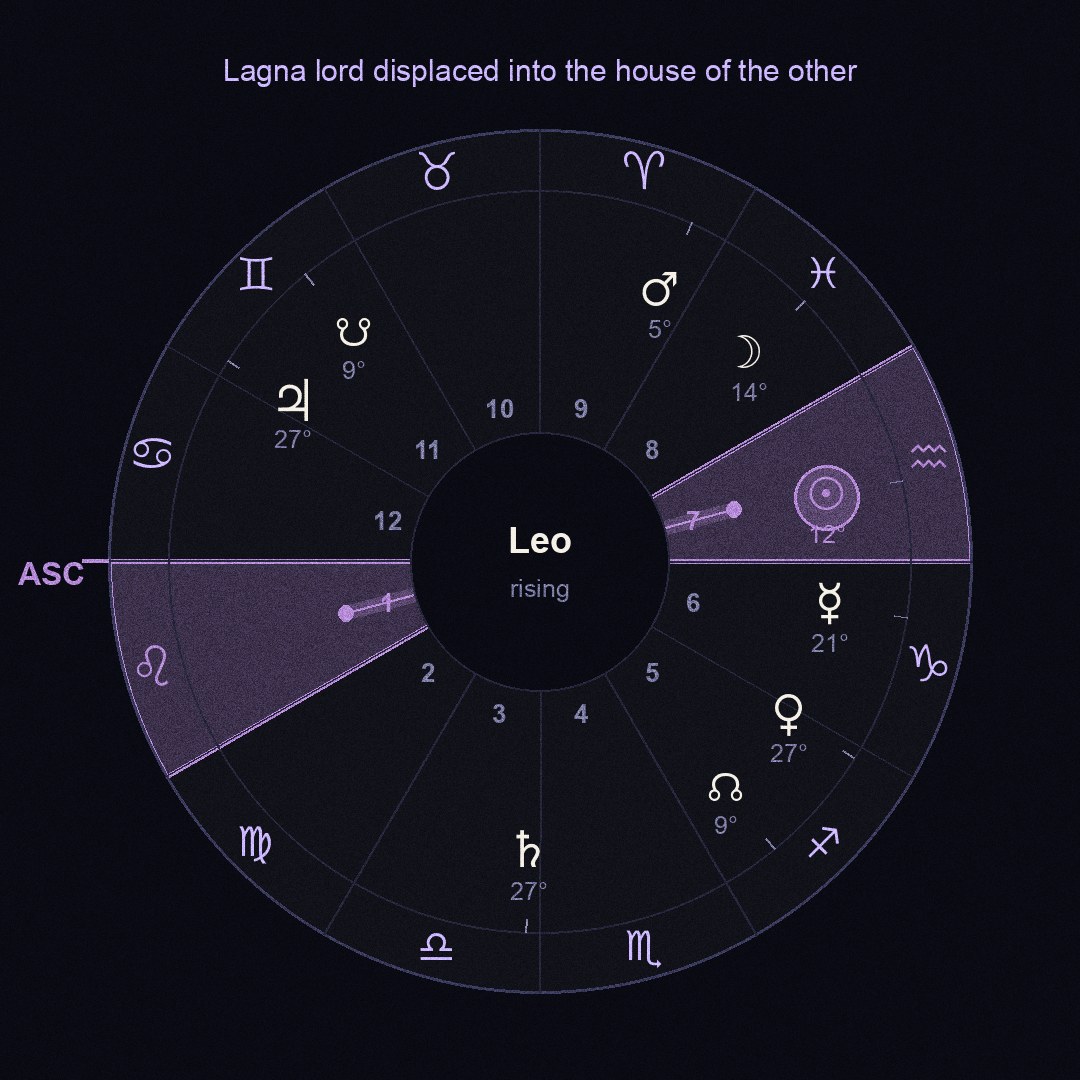
Start where the chart starts and refuses to cooperate. The lagna is 29°03′ Leo, Uttara Phalguni pada 1 (Sun-ruled), and its lord the Sun is in the 7th, Aquarius 12°31′, dignity none, adhisatru to its dispositor Saturn, in Shatabhisha pada 2 (Rahu), avastha yuva, shadbala 1.29 — and it aspects, of all houses, only the 1st, its own empty seat. So the ruler of the whole chart lives in the house of the other, in the sign that is Leo's polar opposite (Aquarius the collective against Leo the individual), in enemy relation to the Saturn that owns Aquarius. And the 7th it sits in carries only 22 SAV bindus, the second-lowest sign in the chart — the environment of partnership does not hand this person ease. The mechanism is precise: the ego's fuel comes from outside — from being needed, seen, partnered with, or placed inside a collective — more than from within, because the self's own ruler is quartered in the house of relationship and the sign of the network. Shatabhisha (the veil, the hundred healers, the reclusive boundary-crosser) tilts the register away from establishment pride and toward the reformer or outsider. The Sun's real strength (1.29) is what keeps this from effacing him; he is not a weak self, he is a strong self constituted through others. This is the chart's genuine fork — whether that resolves as the sincere reformer (favoured by the depth-loaded Moon and dharmic Mars) or the contrarian who insists on standing apart (favoured by the low-bindu, oppositional reading of the same Aquarian 7th) — and the chart, by its own account, only declares which at the Sun mahadasha of 2002–2008, after the anchor window. Fenced: this whole reading rests on the 29°03′ Leo lagna holding; a small time error dissolves it.
III.The dharma engine — Mars, yogakaraka in the 9th
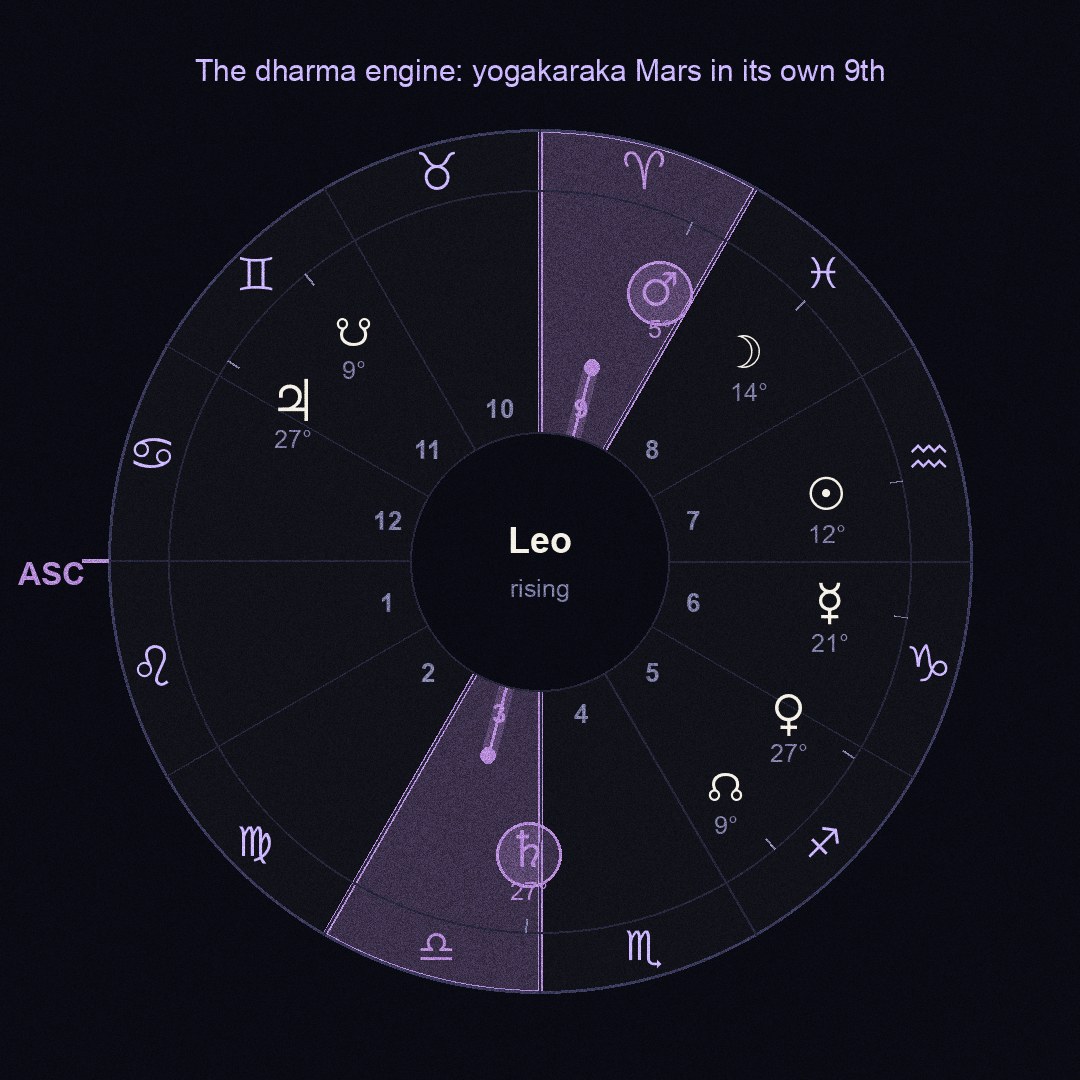
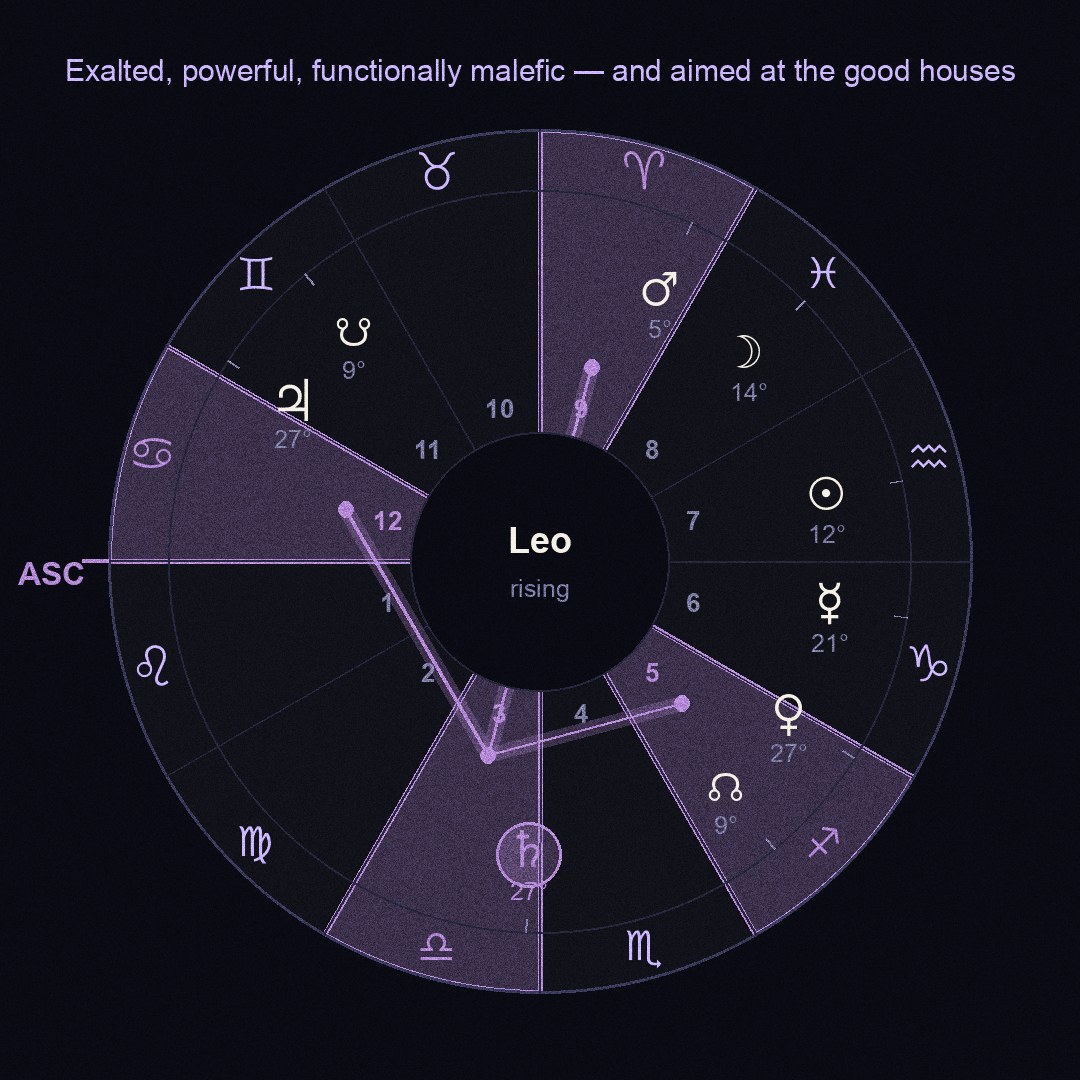
This is the strongest single testimony in the chart and the primary source of everything good in it. Mars in the 9th, Aries 5°51′, moolatrikona, dispositor of itself, shadbala 1.66 (rank 1), dig bala 42.59, cheshta 98.46 — and, as sole lord of both a kendra (4th) and a trikona (9th), the one unambiguous yogakaraka for a Leo lagna. It sits in the best house it could occupy, its own trikona of dharma, fortune, father and higher principle, at full functional and near-full computed strength; it forms Sunapha (alone in the 2nd from the Moon → self-generated resources) and a Kendra-Trikona raja yoga with exalted Saturn across the 7th/3rd axis. The one qualifier the chart is committed to is the bala avastha (band 1/5 — infant): the force is all present from the start but not yet ripe, so the authority and the fortune consolidate late, not in youth. This is why the whole life reads as earned-not-given: the load-bearing beam is principled, disciplined, even martial action in service of something larger — the courage put behind a cause — and its return is not a gambler's luck but the compounding interest on doing the hard right thing over decades. Ashwini pada 2 (Ketu) adds the pioneer's speed and a healer's initiative. The mutual aspect with exalted Saturn braces the raja yoga but also drags a functional malefic across the 9th — the fortune is real and it is heavy. Fenced only where the "ripens late" note rests on the avastha reading rather than on placement.
IV.The exalted disciplinarian — Saturn in the 3rd, staring at the fortunate houses
Saturn exalted in Libra, 3rd house, 27°56′, 7.93° from deep exaltation (20°), dispositor Venus adhimitra, shadbala 1.43, Vishakha pada 3, and it aspects the 5th, 9th, and 12th. In the 3rd — the upachaya of effort, and Saturn's home ground for sustained work — this is an immense capacity for endurance and disciplined grind; it is the reason others would call this person unbreakable, a late bloomer by design. But note where the three drishtis land: the 9th (Mars, the dharma engine) and the 5th (Venus and Rahu, the creative knot) — the chart's two best houses. And Saturn is functionally malefic here (6th + 7th lord — dusthana and maraka). Exalted-but-malefic aspect is not destruction; it is pressure, delay, seriousness imposed on exactly the domains the chart is otherwise gifted in. That is the toll booth on the road: nothing in the fortunate half of the chart comes lightly or early, because the strongest malefic in the chart is looking straight at both fortunate houses. On longevity, read strictly as terrain: the longevity karaka strong in an upachaya, plus a strong 8th-lord Jupiter, loads resilience and long endurance, not fragility — no verdict beyond that.
V.The submerged mind and its hidden gain — Moon in the 8th, Vimala Viparita
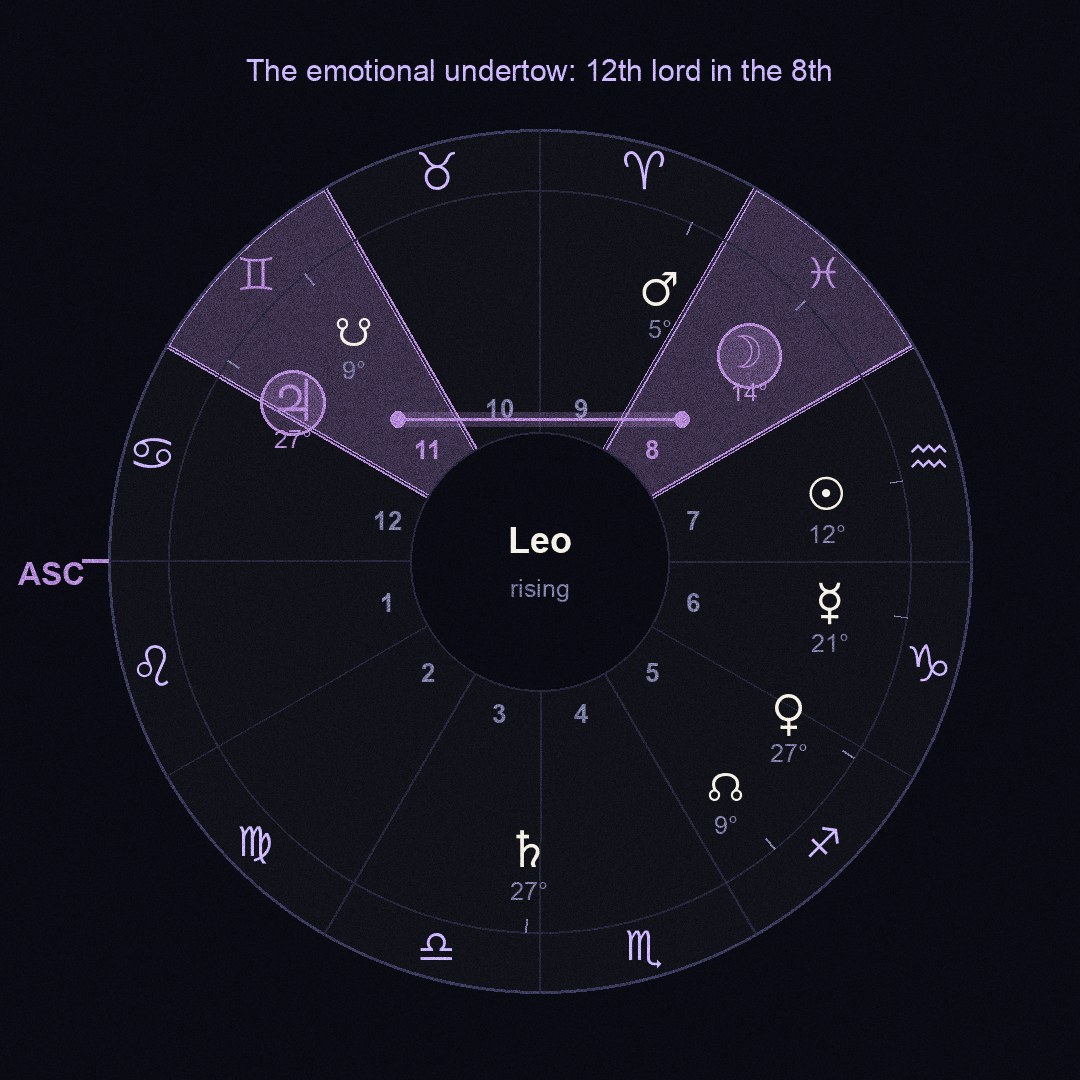
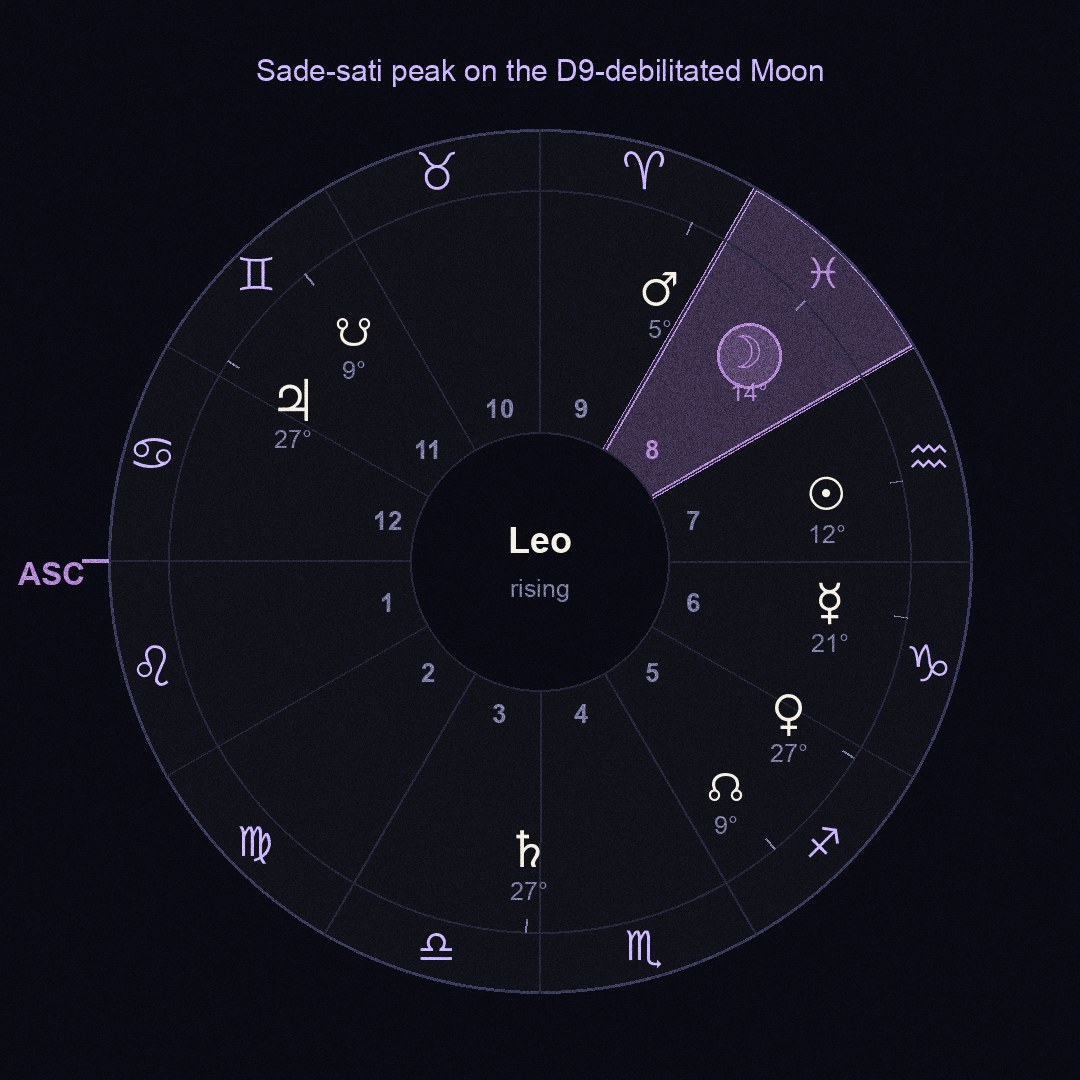
Moon (12th lord) in the 8th, Pisces 14°31′, Uttara Bhadrapada pada 4 — which is also the janma nakshatra (Saturn-ruled) — dispositor Jupiter (mitra), shadbala 1.34 (second-strongest). The mind lives in the house of depth, crisis, the occult, the hidden and other people's resources, in Pisces (dissolution, mysticism), in Saturn's still, reclusive, serpent-at-the-bottom Uttara Bhadrapada. Two yogas fire on it: Vimala Viparita (the 12th lord placed in the 8th) converts the "loss-in-a-pit" into viparita gain — good that arises through endings, detachment, and what others lose — and Gajakesari (Jupiter in a kendra, the 4th, from the Moon) hands the emotional body a wise protector. So the depth is productive: insight, resilience, and even material and reputational gain come precisely through comfort with crisis and the concealed. But two things pull down hard, and they are the reason this figure is quiet rather than triumphant: the 8th (Pisces) carries only 24 SAV bindus — the environment does not reward emotional exposure here — and in the D9 the Moon falls in Scorpio, debilitated. So the emotional body is strong and composed on the surface (1.34, visible competence in others' crises) but not underwritten at the root (Scorpio navamsa) — fulfilment and private contentment are the deliberate, unseen work, not a given. That D9 debility is varga-sensitive and birth-time-dependent; treat it as directional.
VI.The navamsa root of the emotional body — the Moon debilitated in D9
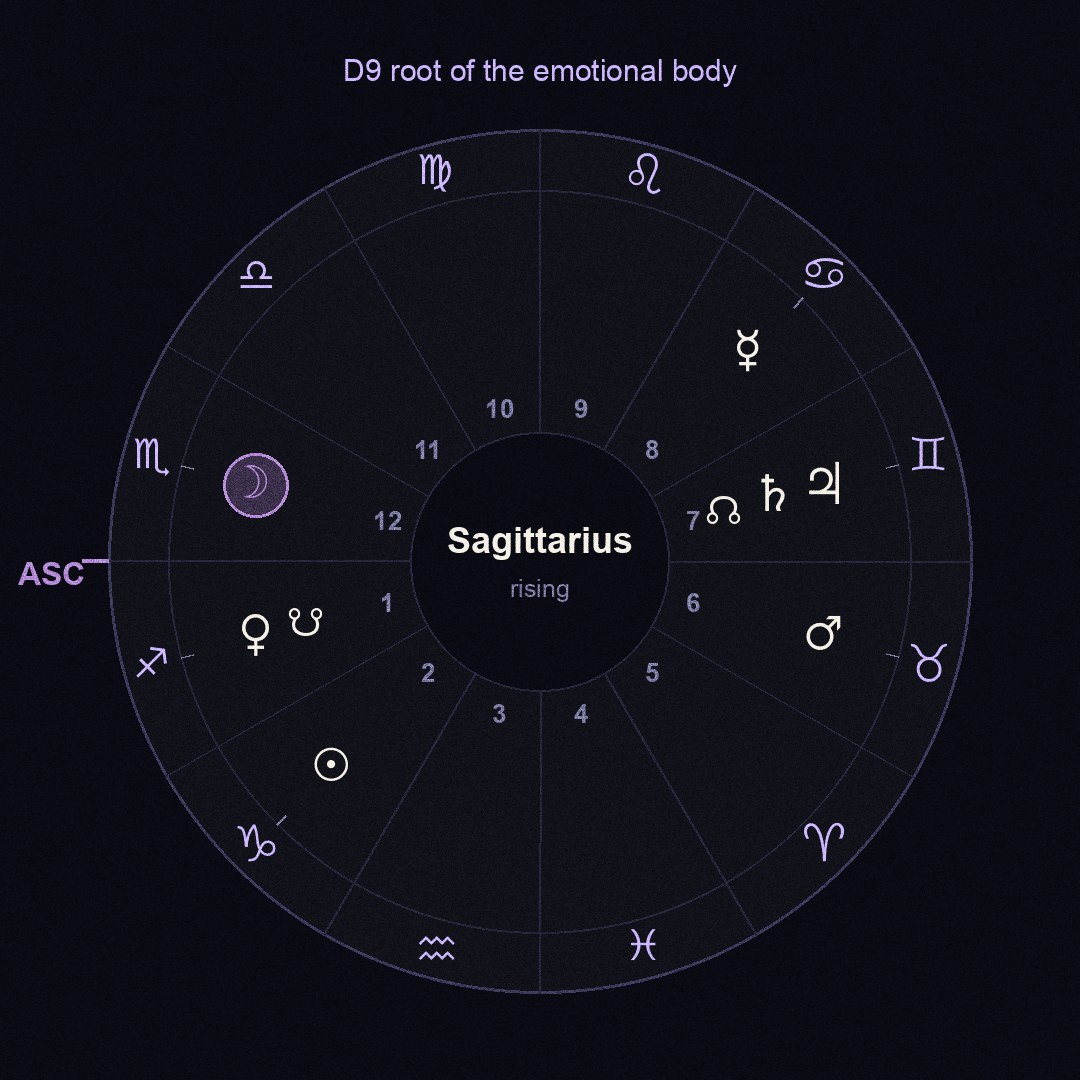
The claim above is a D9 claim, so it needs the D9 chart to show it honestly. In the navamsa the Moon is in Scorpio — its sign of debilitation. This is the chart's second great unaveraged contradiction: a Moon that is the second-strongest graha by shadbala (1.34) in the rasi but sits debilitated at the varga root. The reading follows the split — the surface competence is genuine and the world sees it; the inner contentment is not guaranteed by the chart and has to be built by hand. This is also the exact structure that sade sati would later press on (the timing section). Fenced: D9 placements move with the birth minute; directional, not fixed.
VII.The weak link and its buried strength — Mercury in the 6th
This is the single most informative object in the chart, because two rigorous measures point in opposite directions and neither is noise. By shadbala, Mercury is the chart's only failure: 0.86 (the sole sub-minimum graha), retrograde, dignity none in Capricorn 21°08′, drik bala −10.62 (net negative — heavy malefic aspect), functional malefic (2nd + 11th lord), in the 6th, Shravana pada 4. As a significator — speech, intellect, commerce, nerves — that is a genuine soft spot: inward (retrograde), self-doubting about words, learning by deep absorption (Shravana, the ear) rather than quick verbal fluency. But the ashtakavarga flatly contradicts it: Mercury's own bhinnashtakavarga in Capricorn is 8 — the maximum possible score, exactly in the sign it occupies, and Capricorn as a whole carries SAV 35 (second-highest). The resolution the synthesis commits to is by domain, not by averaging: the shadbala governs Mercury's self-expression (the weak part), the ashtakavarga governs the 6th-house results (the strong part). In the house of enemies, disease, competition, litigation and service, this person wins decisively — out-works rivals, outlasts opponents, recovers from setbacks. So the public register is understated, non-verbal, self-doubting about language; the private truth is that in any actual contest, he is very hard to beat. Which of the two registers dominates the lived biography the chart leaves open — biography, not the dossier, settles it.
VIII.The creative raja yoga under a malefic gaze — the 5th-house knot
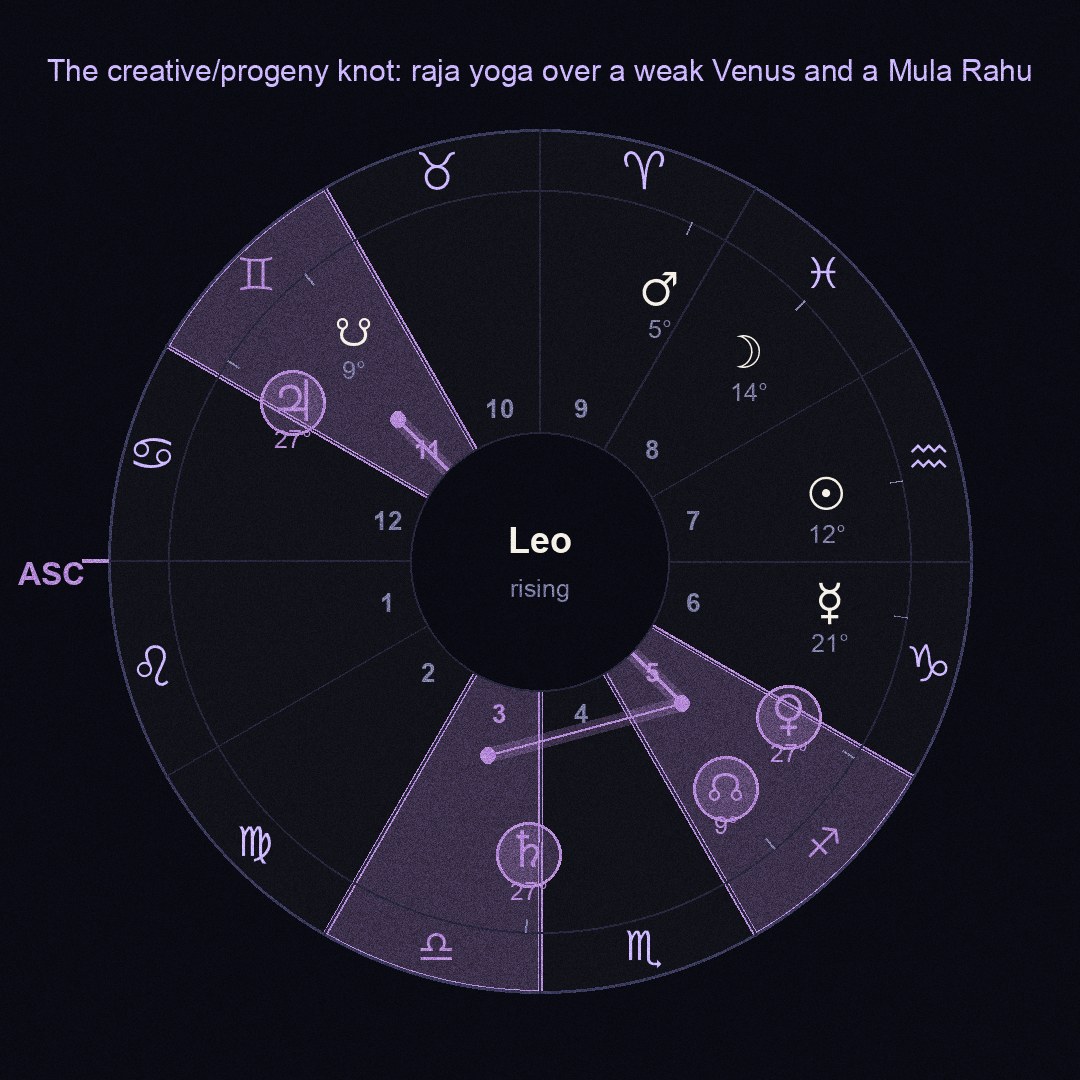
Venus + Rahu in the 5th, Sagittarius (Venus 27°56′, Uttara Ashadha pada 1; Rahu 9°16′, Mula pada 3). The 5th lord Jupiter is in the 11th, retrograde, mrita avastha, dignity none in Gemini, adhisatru to its dispositor Mercury — but vargottama and the highest total shadbala in the chart (555.8, ratio 1.42), and it casts its 7th drishti back onto Venus in the 5th, forming a Kendra-Trikona raja yoga (Venus 10th-lord × Jupiter 5th-lord, house pair 10th+5th) by mutual aspect. Sitting on top of that yoga are a weak Venus (mrita, ratio exactly 1.00 — the weakest graha), a Rahu in Mula (the root, the uprooter — obsessive, boundary-pushing, destabilising whatever the 5th produces), and exalted Saturn's malefic drishti staring in from the 3rd. The two grahas forming the raja yoga — Jupiter and Venus — are the chart's only two vargottama planets, which is the insurance that the yoga is real and not paper: the ability is confirmed at the root even while it presents weakly at the surface. So: genuine creative/intellectual distinction that reaches career (the 10th+5th link, consolidated through the 10th's SAV 36 and Jupiter's D10 exaltation), but arriving with a signature strangeness (Rahu-Mula), against a headwind of self-doubt and delay (weak Venus, Saturn's gaze), validated late. SENSITIVE — children, terrain not verdict: the 5th read as progeny is loaded and mixed — putrakaraka Jupiter strong-but-mrita and retrograde, Venus weak in the sign, Rahu occupying it, Saturn aspecting it — but Jupiter's strength and the vargottama support argue against barrenness and for difficulty-then-fruit. The chart genuinely does not settle delay-then-fruit versus sustained difficulty, and it does not decide whether the reference-date activation of this house was about creativity or children (the signature is identical for both). Left open on purpose.
IX.Ketu on the wisdom engine — the 11th-house detachment
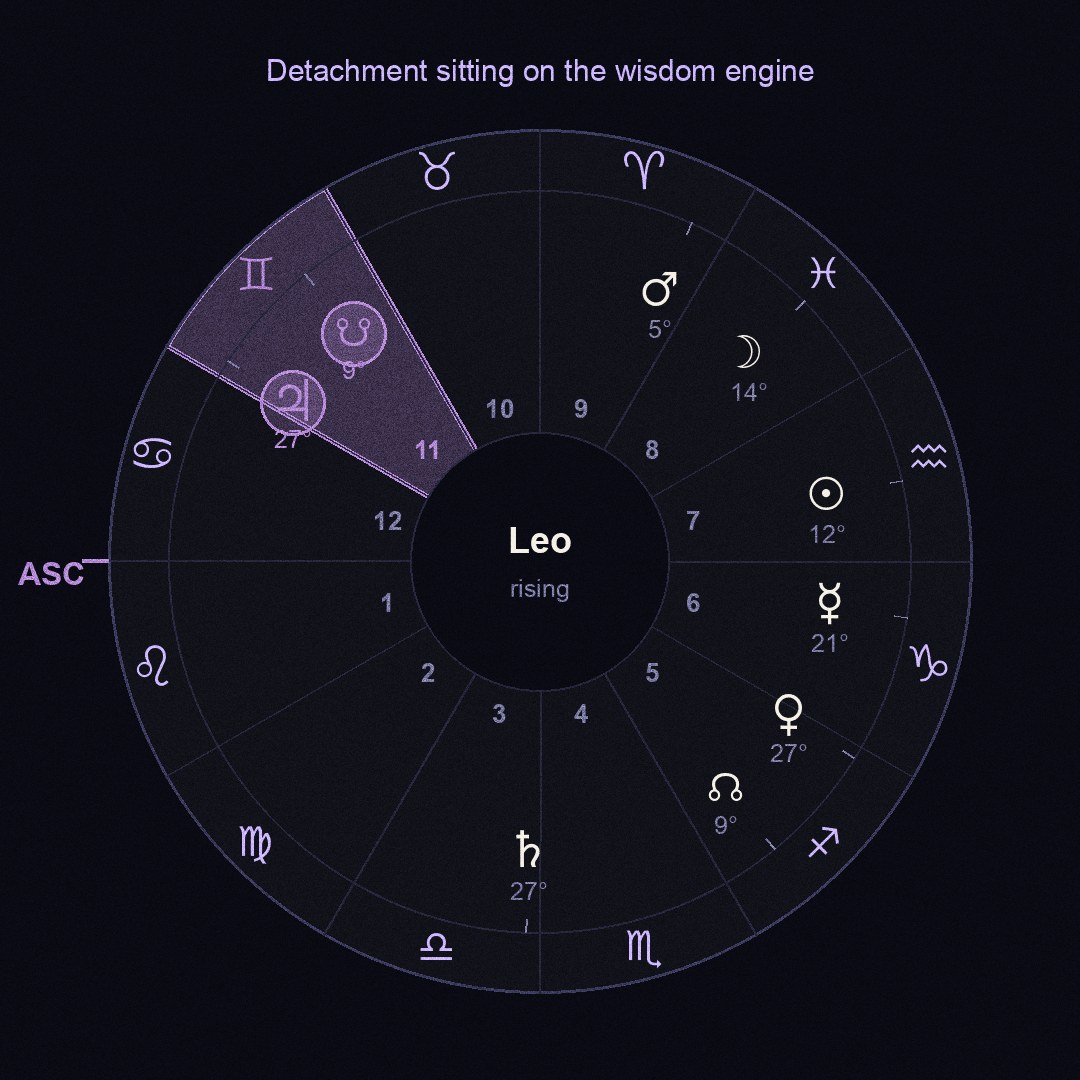
Ketu with Jupiter in the 11th, Gemini (Ketu 9°16′, Ardra pada 1; Jupiter 27°16′, Punarvasu pada 3). Ketu — detachment, past-life mastery, dissatisfaction — sits directly on the chart's second engine and its wisdom-karaka, in the house of gains, networks and ambition (Gemini SAV 28, moderate). The mechanism cuts two ways at once: Ketu deepens Jupiter's wisdom (mastery already present, worn lightly) while undercutting the appetite for the 11th's rewards — the gains, the wide circle, the accumulation. Ardra (the storm, Rahu-ruled) adds an edge of upheaval-driven insight. Combined with the 8th-house Moon and the whole depth signature, this bends the chart toward renunciation-within-success rather than acquisition: a person who could accumulate and quietly keeps declining to, who reaches the network and holds it loosely, in whom a teacher's or elder's detachment — the recurring "is this it?" — arrives early. Fenced by the locked nodal posture: this is a placement-and-nakshatra reading of Ketu, never a dignity or drishti claim (the dossier asserts none for the nodes).
X.The career field is fertile; its agent is weak — the D10 upgrade
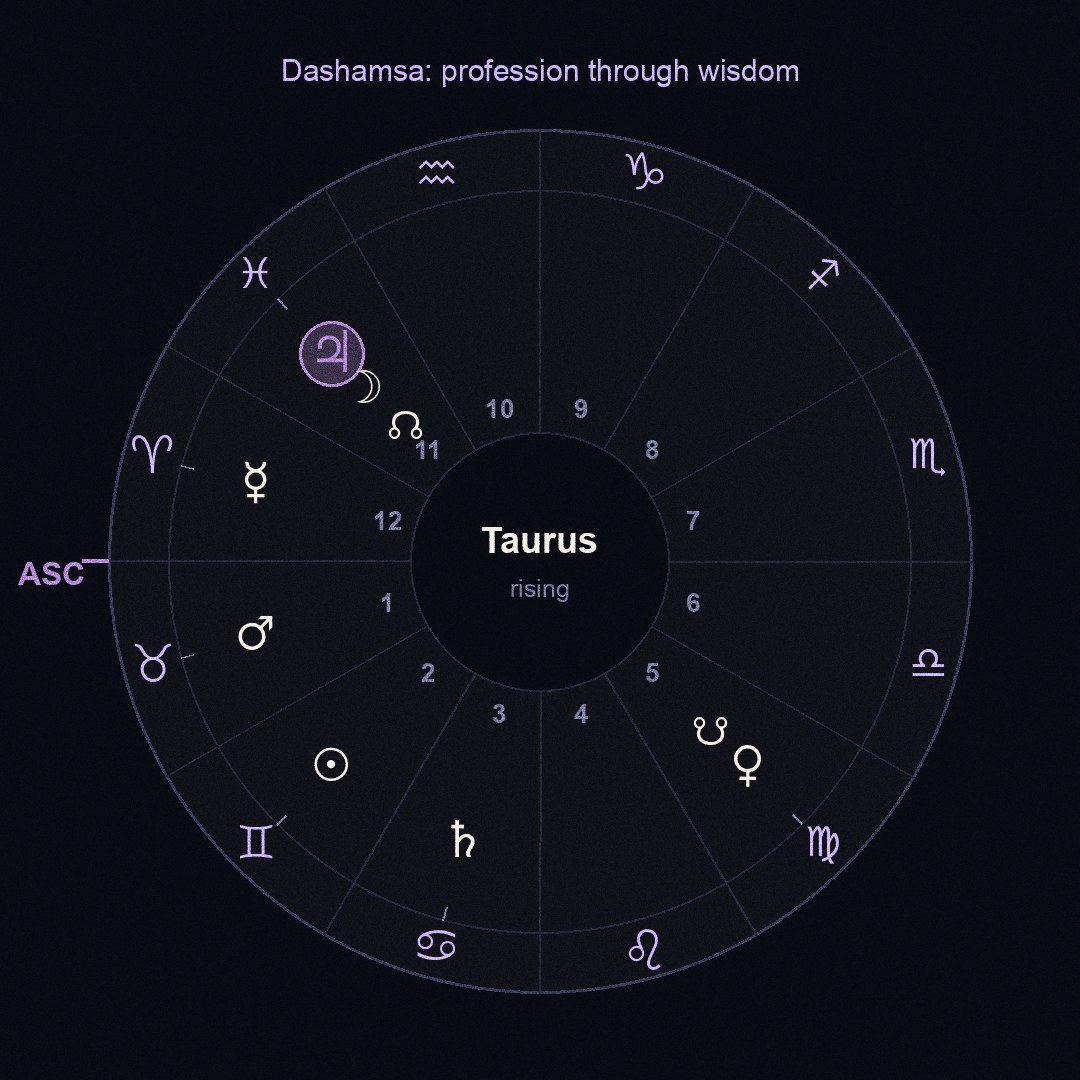
Two facts about career sit in tension and the chart keeps both. The 10th house (Taurus) carries the highest SAV in the chart — 36 — yet is empty, and its lord Venus is the weakest graha (1.00, mrita). The field of career is richly supported; the agent meant to seize it is under-powered. So the career succeeds through the environment's support and through the other engines (Jupiter and Mars) and through endurance (Saturn), rather than through any Venusian charm or personal drive. What upgrades the whole picture is the divisional chart: in the D10, Jupiter is exalted (Pisces, its own sign) — profession through wisdom, counsel, teaching, dharma — so the dashamsa lifts the Venus-driven 10th into something wiser and more principled than Venus alone would build. Amala yoga (Venus alone-ish in the 10th from the Moon) gives a clean, lasting reputation earned by conduct — but only in its looser reading, since Rahu shares that sign, so the reputation is clean and unconventional. Fenced: D10 placements are varga-sensitive; read the theme as solid, the exact placement as directional.
XI.The partnership axis — strong lord, weak karaka
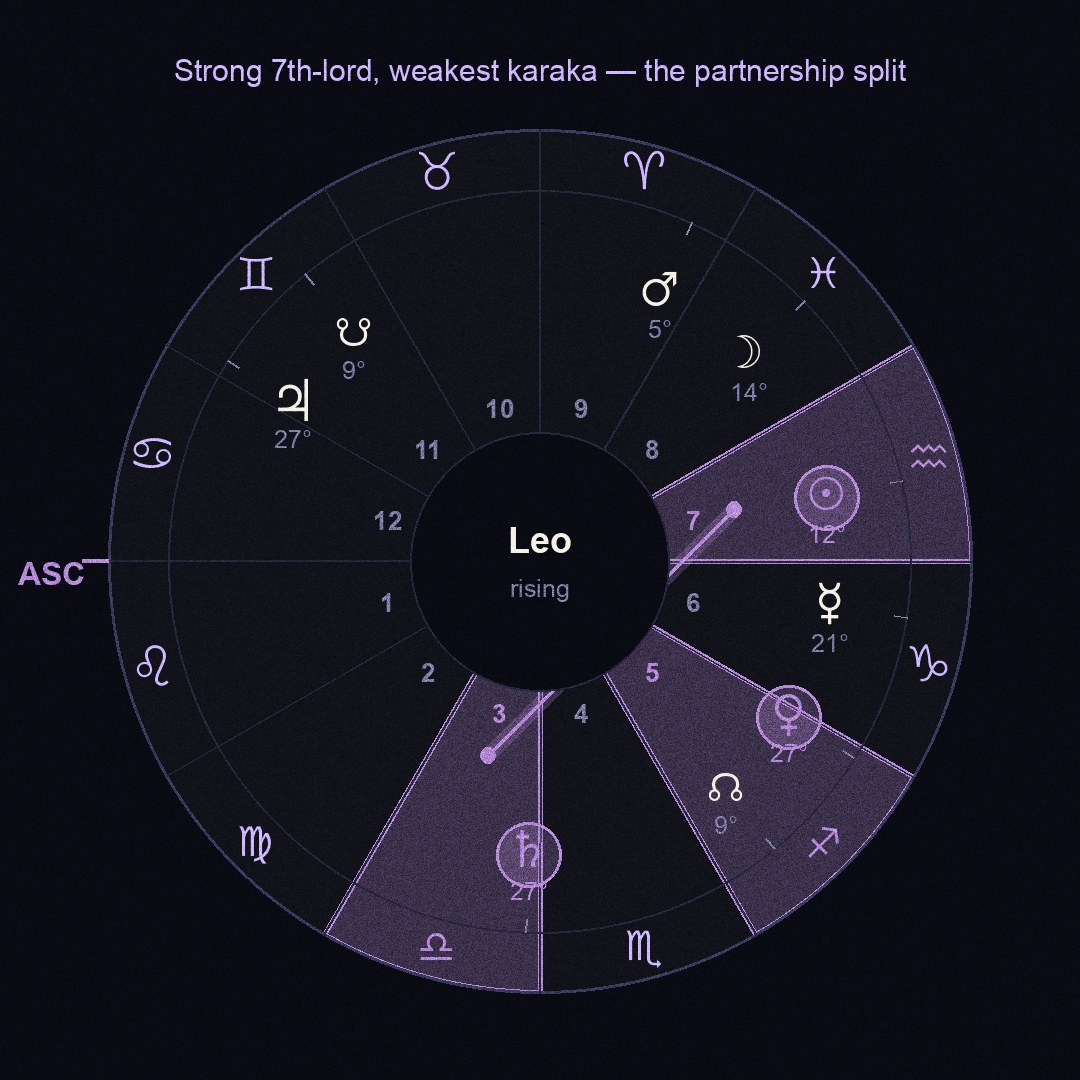
Two testimonies pull apart, and the chart calls it genuine ambiguity. The 7th lord Saturn is exalted (1.43) — strong raw material — but sits in the 3rd, away from the 7th, and is a functional malefic. The marriage karaka Venus is the weakest planet in the chart (1.00, mrita), sharing the 5th with disruptive Rahu, rescued only by vargottama. The lagna lord Sun sits in the 7th (the self invested in partnership), and the 7th carries only 22 SAV bindus. Read together: partnership is central to identity (lagna lord there) and can be dignified and enduring (exalted 7th lord) — but the Venusian ease, the romance-and-flow, is the soft spot, complicated by Rahu (unconventional or restless attraction) and pressured by Saturn (delay, duty, seriousness, age). The two truths are of different layers — the structure endures while the feeling-tone is the weak link — and the chart does not rank them. The Sun in the 7th adds its own two unresolved readings: a prominent/older/authoritative partner, or ego-friction in union. Fenced on the 7th being keyed to the Leo lagna holding.
XII.How the timing layer reads on top of this
The detailed timing reading was provided, so this section reads both the dasha spine and the dated windows. The vimshottari sequence is almost a commentary on the natal contradictions: the chart runs its weakest engines through the prime and holds its structural ones for the ends. Saturn (birth–1958, infancy, opening on the disciplinarian). Mercury 1958-03-22 – 1975-03-23 — seventeen years of the weak link (0.86 significator, 8-bindu 6th-house results): verbal soft spot outside, winning the contests inside. Ketu 1975-03-23 – 1982-03-22 — the renunciation note on the 11th Jupiter, an early turning-away. Venus 1982-03-22 – 2002-03-22 — the twenty-year prime (ages 27–47) handed to the weakest graha in the chart (1.00), which is also the 10th (career) and 3rd (craft) lord and the marriage karaka: career, creativity and partnership all falling due at once, under the one planet that delivers nothing lightly, saved only by vargottama. The reference date sits inside this. Sun 2002–2008 (the lagna lord's own chapter, identity-through-partnership). Moon 2008–2018 (the submerged 8th-house mind surfacing — the life closed inside it; SENSITIVE, terrain only, no astrological cause asserted). Mars 2018 / Rahu 2025 / Jupiter 2043 never reached — the "ripens with age" fortune the bala-avastha Mars had deferred was held in reserve and not collected.
At the anchor (1997-09-16) the chain was Venus / Saturn / Rahu. The Venus–Saturn antardasha (1995-01-21 – 1998-03-22) is the whole chart's temperament concentrated to three years: the weakest planet and the exalted-but-heavy disciplinarian, both in mrita avastha, running together — not at war (Saturn is Venus's adhimitra dispositor) but relentless, and Saturn's natal drishti falls on the 5th and the 9th, so this sub-period pressed on both fortunate houses at once. The pratyantar in force at the anchor was Rahu (1997-04-29 – 1997-10-19) — Rahu being the Mula co-tenant of the 5th-house knot, so the finest sub-division loaded the creativity/progeny domain and left it maximally unsettled, inside a chapter built to press it anyway.
The structural transit of the window is sade sati (1993-11-09 – 2000-06-06), with its peak — Saturn crossing Pisces, over the natal Moon itself — 1996-02-16 – 1998-04-17, exact conjunction 1997-03-15. This lands squarely on the one figure the chart already marked strong-on-surface, debilitated-at-root (Figure 5). So the peak is not generic hard luck: it is years of Saturn's full weight pressed onto the exact emotional structure the chart said was unsupported underneath — the dated version of the interior grind "the outside never sees," with Jupiter's repeated benefic trines (Jupiter is the Moon's Gajakesari protector) as the recurring counterweight.
The nodal transit put Rahu conjunct the natal lagna, exact 1997-07-12 (Ketu opposing) — nodal pressure on the 29°03′ Leo self, doubling the Rahu pratyantar and foregrounding the identity axis (Figure 1) in Rahu's unconventional register. This is the chart's most birth-time-fragile transit: it rests entirely on the late-degree lagna holding, and a small time error dissolves it. As sade sati released, Saturn moved onto natal Mars in the 9th — exact 1998-06-06, again 1998-10-29 (R) and 1999-02-25 (D) — the pressure migrating from the emotional body onto the dharma engine, mirroring the natal Mars↔Saturn mutual aspect and testing the "ripens with age" promise directly.
XIII.Where the chart forks
The beam carried its forks with explicit bands; kept ranked, both branches, in the beam's own words.
- The self, in the end (Pivot 1, moderate confidence). Most likely — the sincere reformer/healer: identity through a collective or cause, humanitarian/reformist/mystical register held loosely (favoured by the depth-loaded Moon, dharmic Mars, Ketu-on-Jupiter). Plausible — the contrarian outsider: the leader who insists on standing apart, friction as the recurring cost (favoured by the ego-clash reading of the Aquarian 7th and its 22 bindus). Distinguisher: the Sun mahadasha (2002–2008), after the anchor.
- The interior (Pivot 2, moderate). Most likely — emotional competence genuine and public; contentment the harder-won, unseen inner work (D1 Moon 1.34 vs D9 Scorpio debility, sade-sati peak as the dated grind). Plausible — the struggle surfaced as a visibly hard passage, not only a private one. Left to biography.
- The 5th-house knot (Pivot 3; high on the raja yoga, moderate on delivery). Most likely — recognised creative/intellectual distinction with a signature strangeness, validated late. Plausible (SENSITIVE, children as terrain) — difficulty-then-fruit, not barrenness. Possible — sustained difficulty in the progeny domain. The chart does not decide whether the anchor-date activation was creativity or children — identical signature.
- Partnership (Pivot 4; high on structure, moderate on outcome). Very likely — central, dignified, enduring (the strength/lord). Very likely — the Venusian ease is the soft spot, love built not assumed (the weakness/karaka). Plausible — a senior/prominent/authoritative partner (Sun in 7th). Possible — ego-friction in union (same Sun, read as clash).
- Mercury's dominance (Pivot 5, moderate). The domain-split is settled; which register marks the life more is not. Plausible either way — the fighter's win-record as load-bearing, or the verbal soft spot as the more defining limit. Both committed as simultaneously true.
XIV.Recurring keywords
- Depth / the hidden / mystical-healing — five independent witnesses (Moon 8th; Sun in Shatabhisha; Rahu in Mula 5th; Ketu on Jupiter; Vimala Viparita)
- Earned-not-given, ripening late — Mars bala avastha; Saturn on 5th+9th; weakest Venus runs the 1982–2002 prime
- Vargottama — exactly the two raja-yoga planets, Jupiter and Venus (the yoga is real, not paper)
- Mrita avastha — three of the load-bearing grahas (Jupiter, Venus, Saturn all band 5/5 dying)
- Water/dissolution — Moon in Pisces (8th), D9 Moon in Scorpio, Venus/Rahu in watery-ruled 5th
- The number 22/24 — the two most-invested houses (7th, 8th) among the lowest SAV
- Detachment / renunciation — Ketu on 11th Jupiter; Ketu mahadasha 1975–82; "is this it?"
- Retrograde inwardness — Mercury, Jupiter, Rahu, Ketu all retrograde
- Saturn everywhere — janma-nakshatra lord, exalted, opens the life, and runs the sade-sati peak
- The 6th-house win — Mercury BAV 8 (max) in its own Capricorn; Capricorn SAV 35 (2nd-highest)
- Late degrees — lagna 29°03′, Venus 27°56′, Saturn 27°56′, Jupiter 27°16′ (a chart clustered at sign-ends, leaning out of itself)