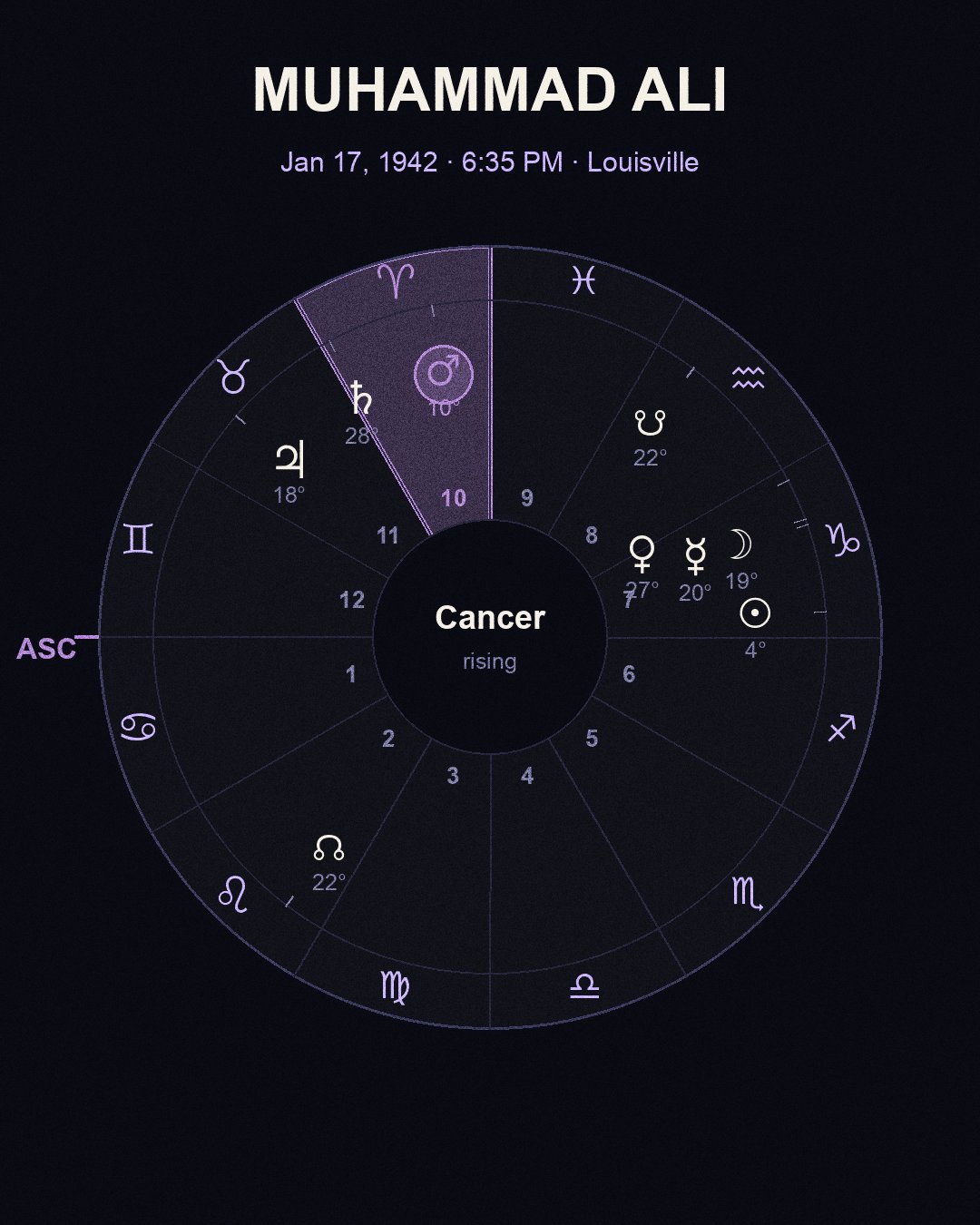

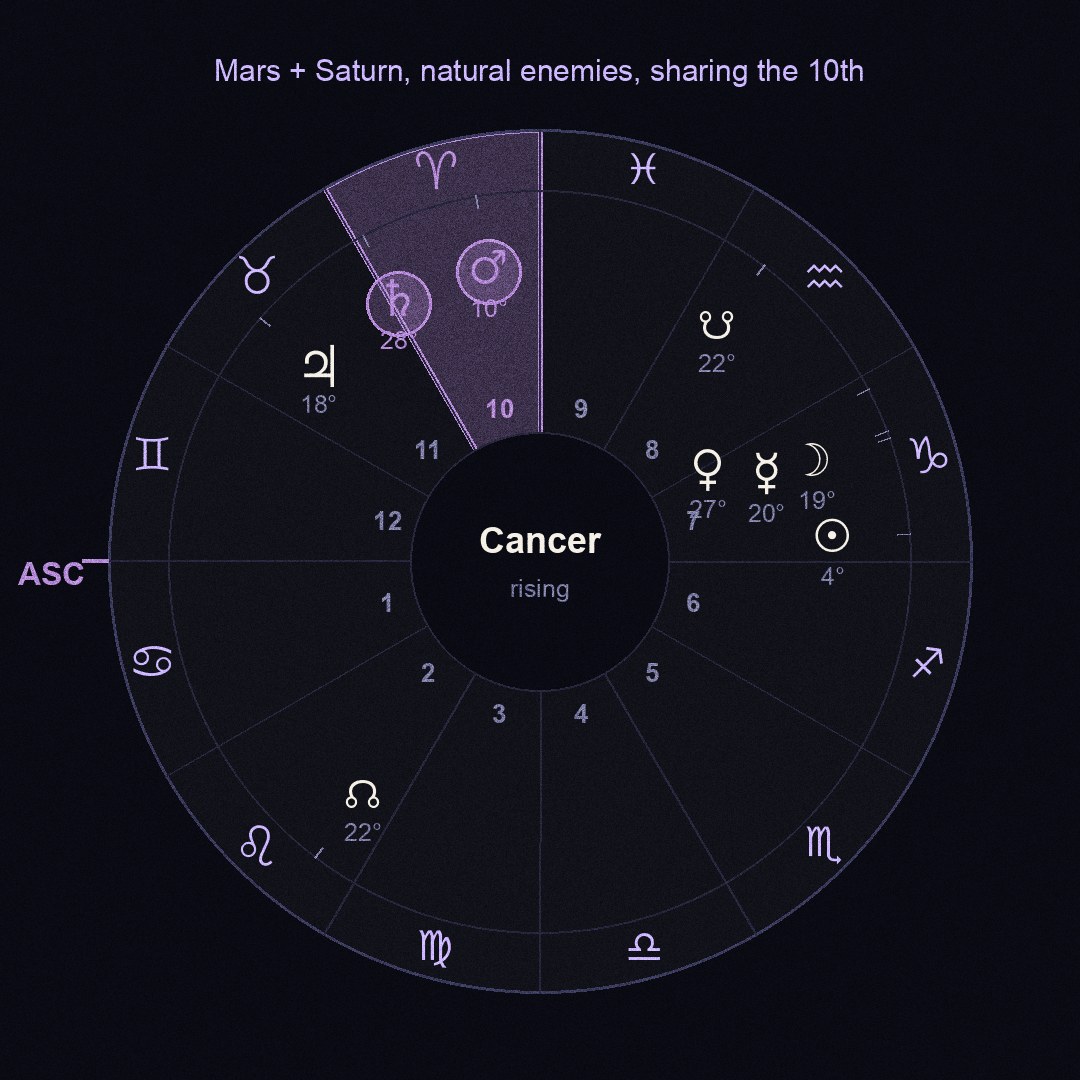
This chart is built sideways. The lagna lord — the ruler of the self — does not sit in the house of the self; it sits directly across the wheel in the 7th, the house of the other, and because that same graha (the Moon) is also the Chandra-lagna, the whole 1–7 axis gets stated twice. So the load-bearing fact is structural before it is thematic: identity is turned toward a counterpart. What runs the chart, by raw strength, is a different thing entirely — Mars in the 10th, shadbala ratio 2.04, rank 1 of nine, moolatrikona, digbala, Ruchaka mahapurusha — a single clean engine. The tension the whole reading turns on is that this commanding engine is bolted to two of the chart's weakest testimonies: the Sun (ratio 0.86, the only graha below its own required minimum) and Saturn (debilitated at 28°37′ Aries), and Saturn sits in the very same house as Mars, as its natural enemy. Power, in other words, is real and is achieved against friction — including friction built into the chart's own strongest room.
Birth data · birth-time quality: 1942-01-17 18:35, Louisville KY (UTC 1942-01-18 00:35). Time source stated, provenance birth certificate (Astro-Databank AA, Rodden AA) — this is a high-confidence birth time, so the lagna, the whole-sign house frame, and every house-lord claim below stand on firm ground. The one caveat is not the birth time's quality but the vargas' nature: the divisional charts (D9, D10, D7) shift with even a couple of minutes of clock time, so the varga-based claims are flagged in their own paragraphs as the finer, more fragile grain.
I.What actually carries weight here
Rank the grahas by the numbers the dossier already computed, not by house-meaning:
- Mars — ratio 2.04, rank 1. Own sign (moolatrikona Aries), 10th house, digbala 56.94 (highest of any graha), Ruchaka yoga, yogakaraka (5th+10th lord) for this Cancer lagna. The one unambiguous engine. But it falls to debilitation in both D9 (Cancer) and D10 (Cancer) — the two vargas that test fruition.
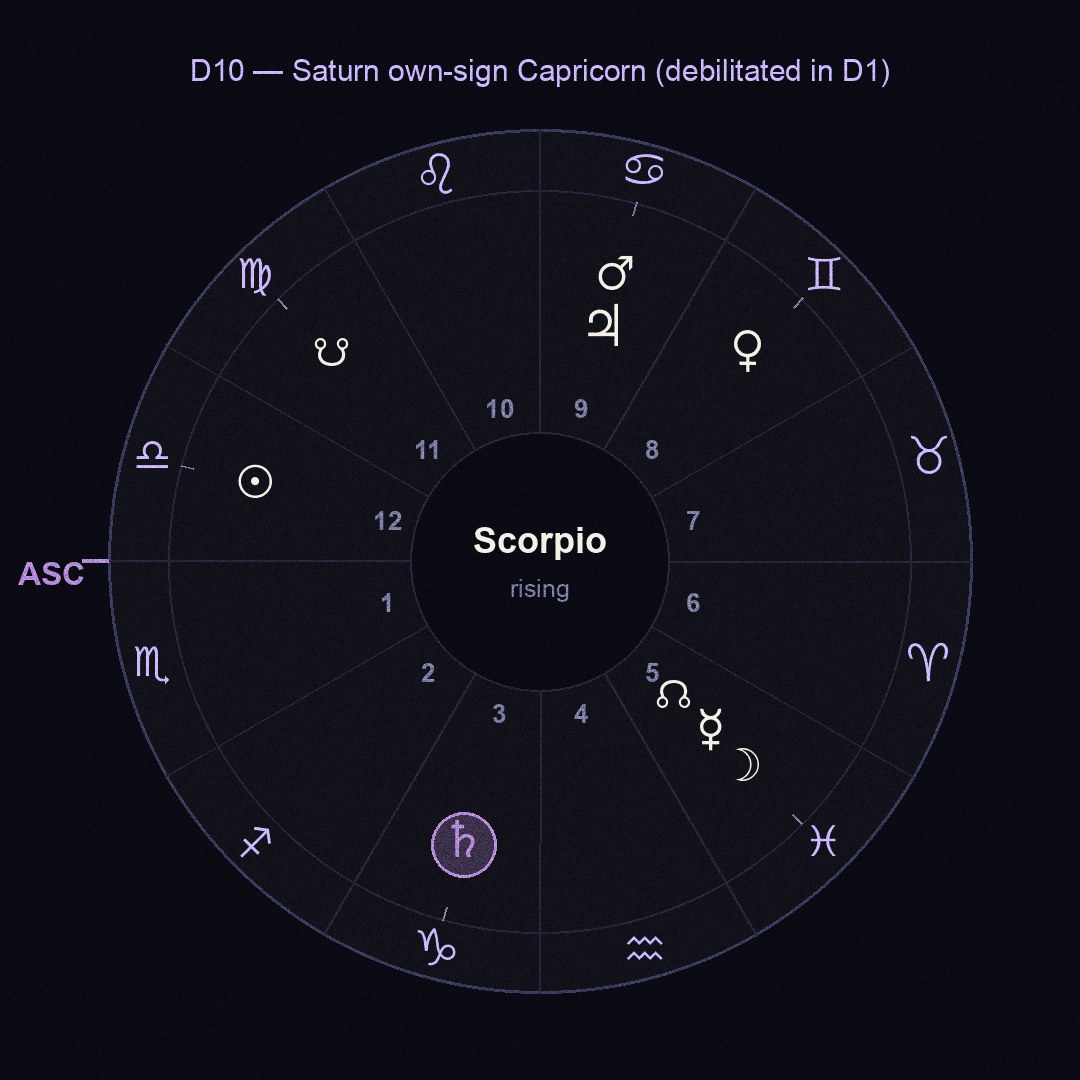
- Saturn — ratio 1.58, rank 2. High strength score but debilitated (8.61° from deep debilitation at 20° Aries), retrograde, mrita avastha, 7th+8th lord. Rescued by a strong neecha-bhanga candidacy (3 of 4 flags) and own-sign Capricorn in D10.
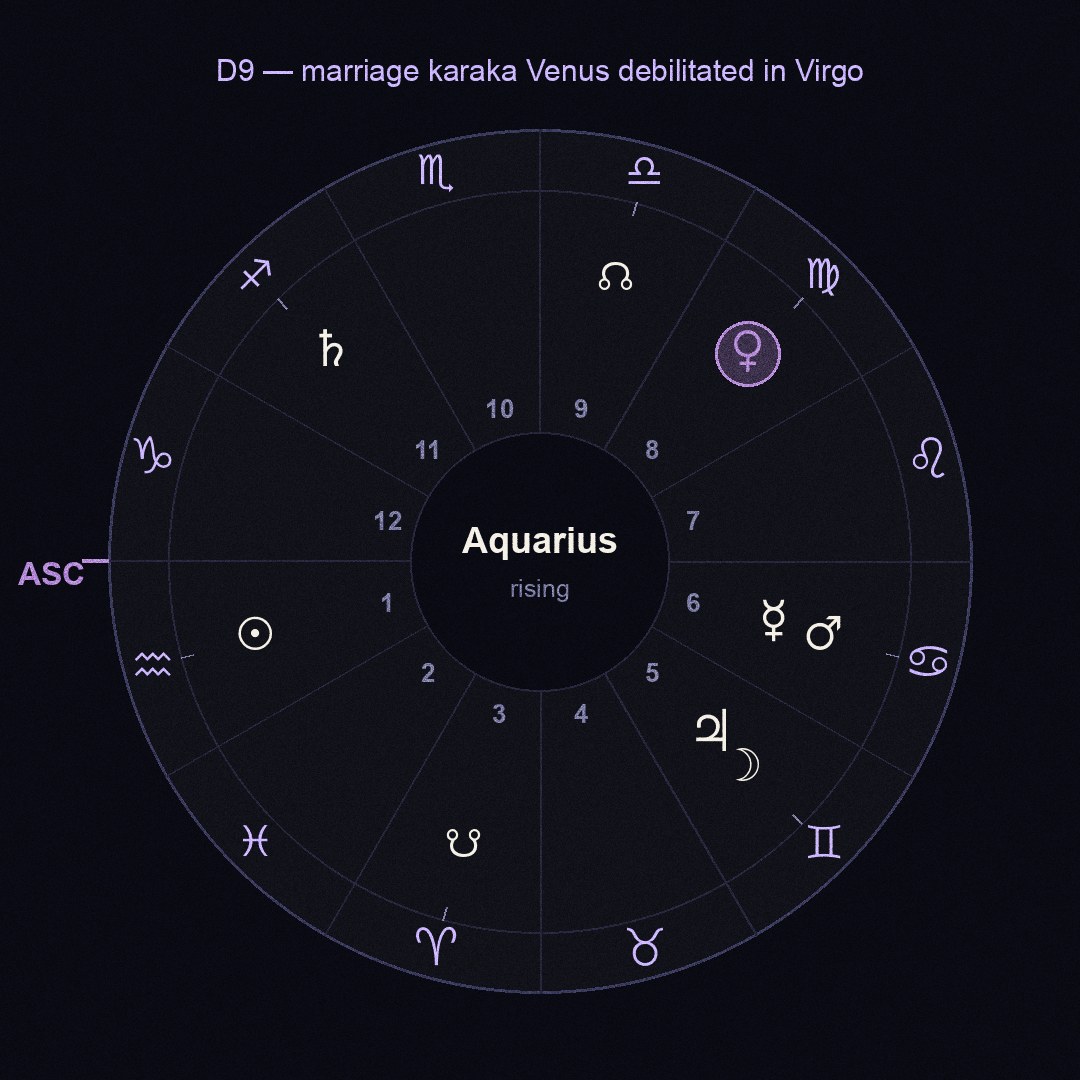
- Venus — ratio 1.43. Marriage karaka, 4th+11th lord, in the 7th, retrograde, bala (infant) avastha, debilitated in D9 (Virgo).
- Jupiter — 1.30, retrograde 9th lord in the 11th, own sign in D7.
- Moon — 1.17, lagna lord in the 7th, own nakshatra Shravana.
- Mercury — 1.03, barely over minimum, in the 7th stellium.
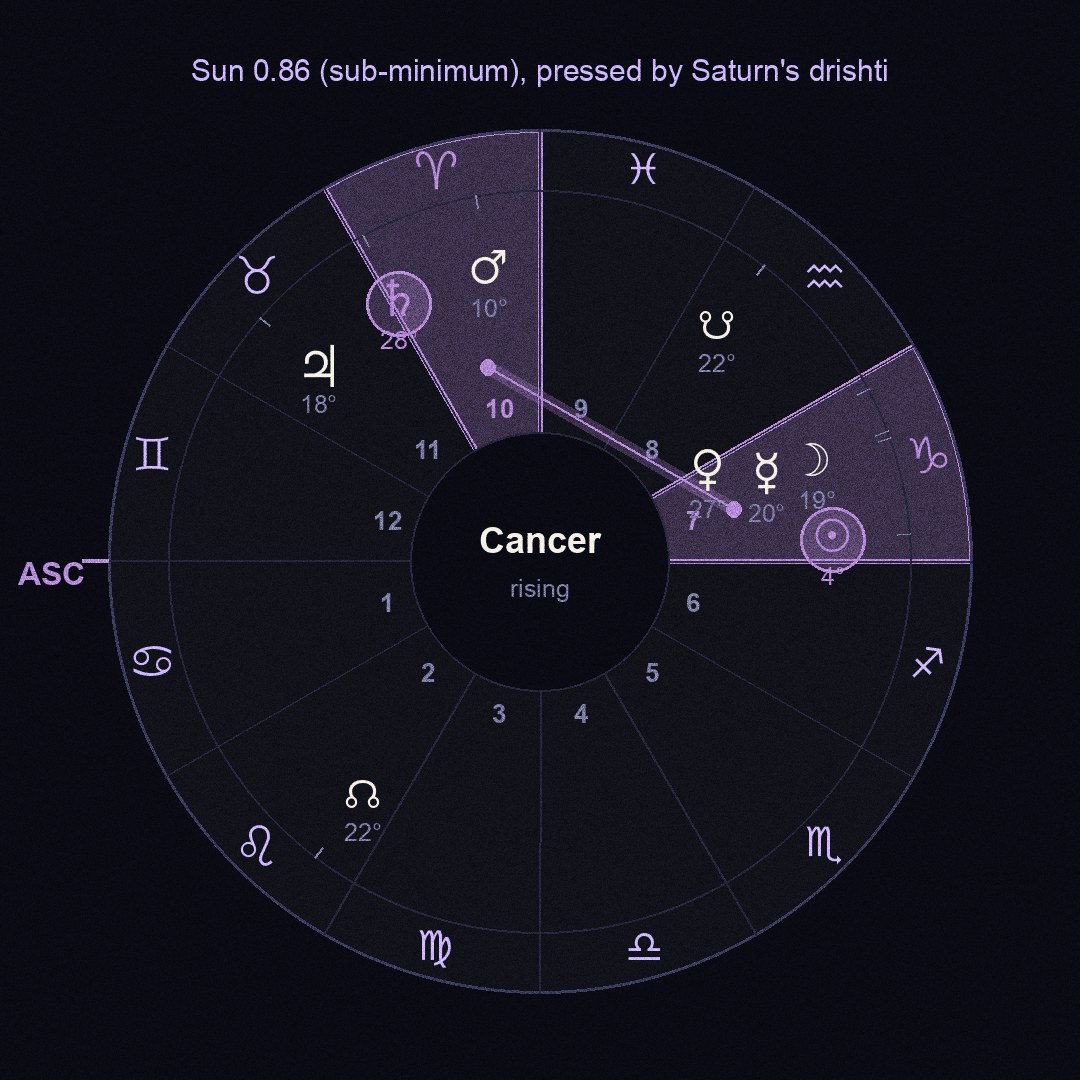
- Sun — 0.86, the only sub-minimum graha. Cheshta 0.00, drik −1.93 (aspected down by Saturn), mrita avastha, 2nd lord in the 7th. The chart's structural soft spot.
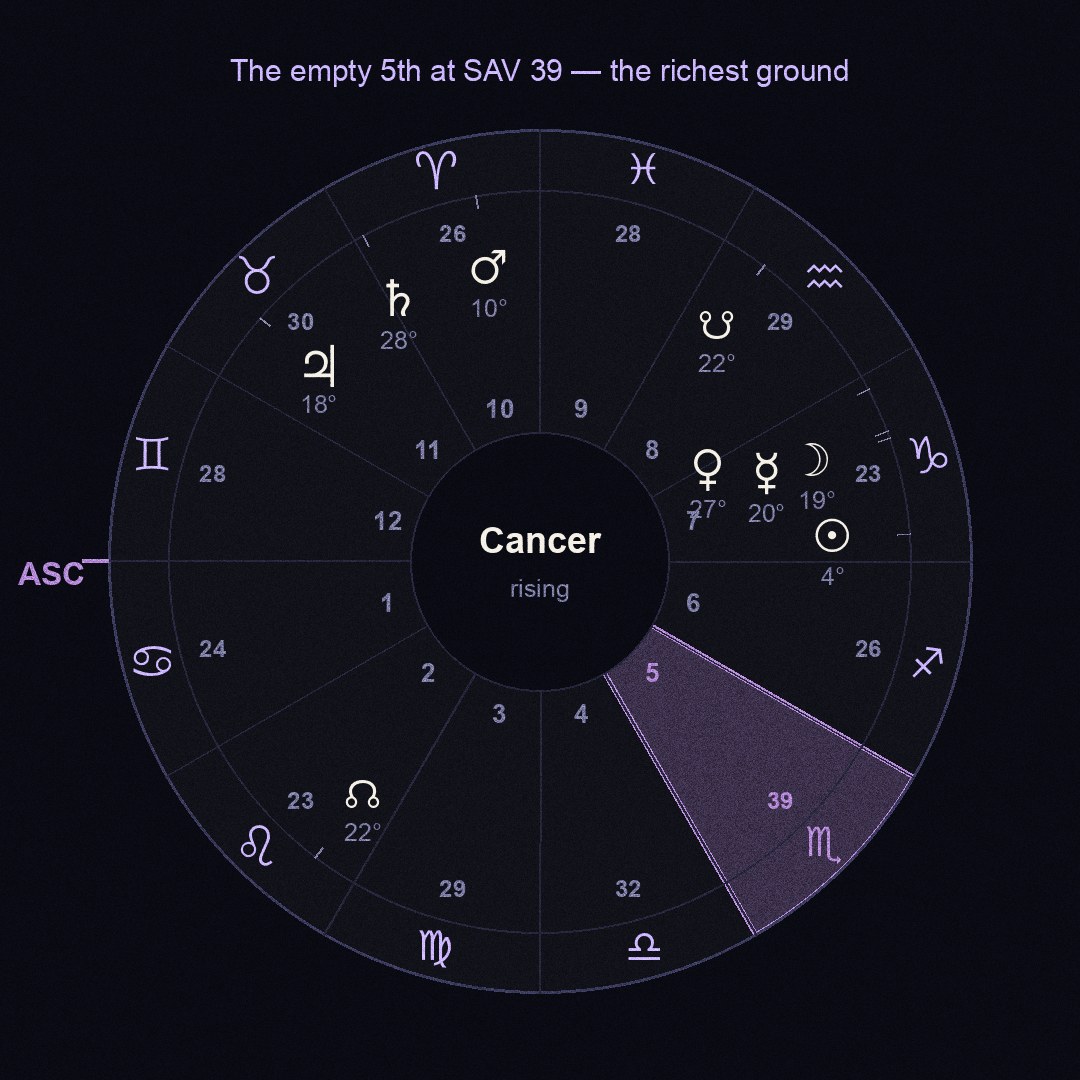
And the ashtakavarga tells you which houses have ground under them: the empty 5th (Scorpio) carries 39 bindus, the highest in the chart; the four-planet 7th (Capricorn) carries 23, tied for the lowest. So the most inhabited house is one of the least fortuned — hold that, it re-weights everything about partnership.
What is decorative: the panchanga limbs (Dwitiya tithi, Siddhi yoga, Balava karana) are character colour, no relational leverage. The 3rd/6th/12th carry nothing beyond their lords already read. D2 clustering in Leo/Cancer adds nothing. Graha yuddha: none.
II.The self is stated in the seventh, and stated twice
The lagna is 26°29′ Cancer — late in the sign, Ashlesha pada 3 (lord Mercury), a serpent nakshatra, clinging and self-concealing in outer manner. Its lord, the Moon, sits at 19°23′ Capricorn in the 7th, i.e. opposite the lagna it rules. That alone would turn the identity outward. But the Moon is also the Chandra-lagna, and from the Moon the ascendant falls in the 7th — so the same 1–7 axis is asserted from both ends of the chart. This is not a weak Moon doing this: ratio 1.17, above minimum, own nakshatra Shravana (the listener), mitra with its dispositor Saturn, kumara avastha. So the self-leg is genuinely strong — it just delivers through the counterpart rather than through self-assertion. This is the loudest single statement in the chart, carried by six-plus independent testimonies (lagna lord in 7th; Sun, Mercury, Venus also in 7th; Venus is the 7th's own karaka sitting there; lagna 7th from Moon). It does not fork — only the identity of the "other" forks.
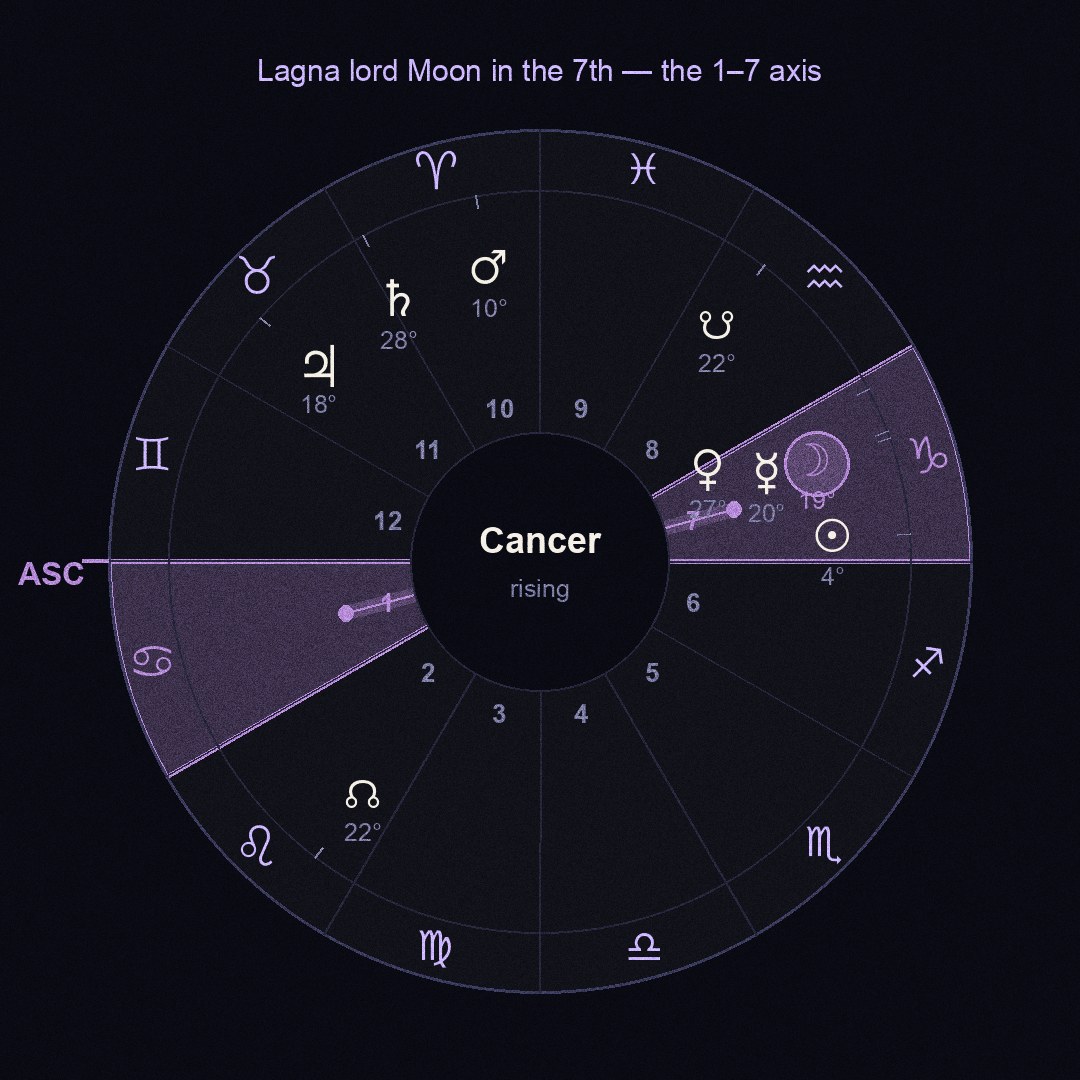
III.Four self-signifiers collect in the house of the other — over the poorest field in the chart
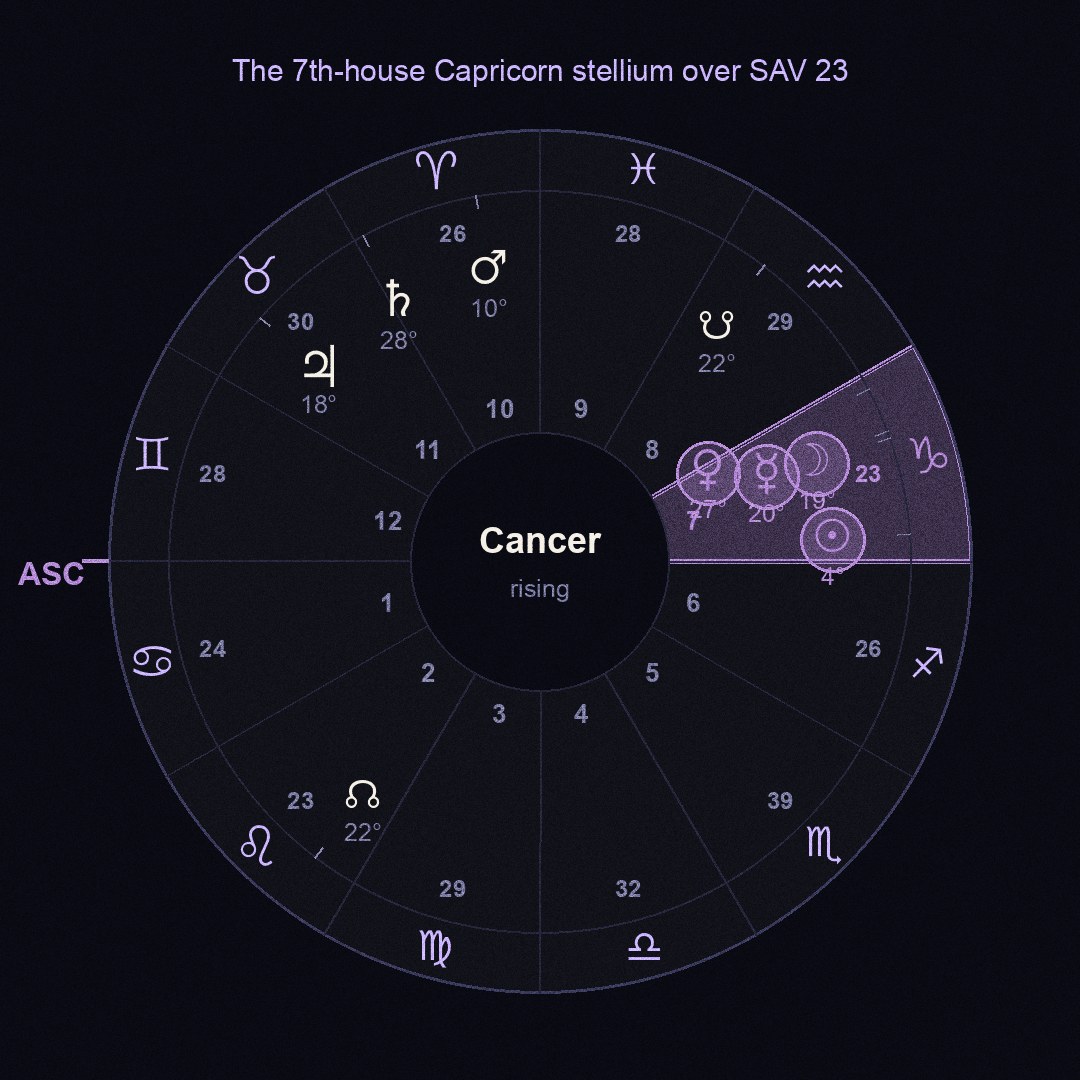
The 7th (Capricorn) holds four grahas: Sun 4°15′, Moon 19°23′, Mercury 20°28′, Venus 27°37′. Every signifier of the self the chart owns — lagna lord (self), Sun (soul), Mercury (intellect/speech), Venus (love/aesthetics) — is gathered in the house of engagement. None is combust: Mercury clears at 16.22° against its 14° limit, Venus at 23.38° against 10°, so the stellium is crowded but not burnt. It fires three named yogas: Budhaditya (Sun+Mercury), Dhana (Sun+Venus, 2nd+11th lords), and a Kendra-Trikona Raja pairing (Moon+Venus, 1st+4th lords). Jupiter blesses all four by its 9th-from-itself drishti from the 11th; Saturn presses on all four by its 10th drishti from the 10th. Two aspects, benefic and malefic, fight over the same four planets.
And here is the contradiction the ashtakavarga forces in: this most-inhabited house carries SAV 23, tied lowest in the chart. The domain the person pours the most into returns the least reliable yield per unit invested. Capricorn also makes the engagement dutiful, structured, achievement-flavoured — partnership as an institution to be built and maintained, not a romance.
IV.The engine: Mars in the 10th, own sign, at full strength
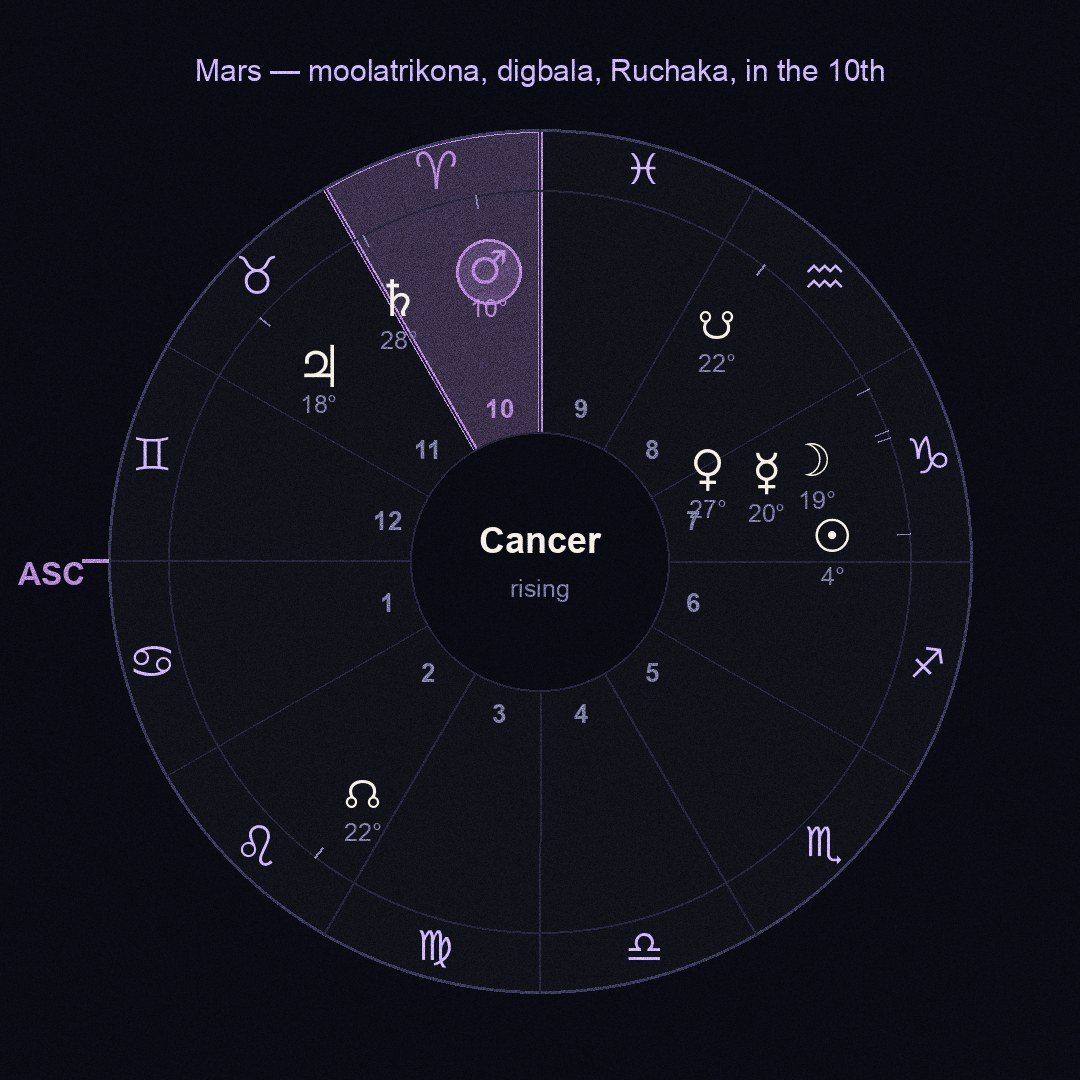
Mars 10°01′ Aries in the 10th is the chart's one clean engine — moolatrikona dignity, digbala 56.94 (the highest single strength component any graha earns here), shadbala ratio 2.04 and rank 1, Ruchaka mahapurusha yoga (own sign in a kendra), Ashwini pada 4. As yogakaraka it owns the 5th and 10th, the trine and the angle, so it carries both fortune and career in one hand. This is where the worldly standing comes from, and it is unmistakably real: a natural commander, hard/structural/disciplined force — the body, combat, command, athletics, machinery, land. When the reading calls the standing "settled," this is the graha it is pointing at.
V.The engine is yoked to its enemy in the same room
Saturn 28°37′ Aries sits in that same 10th, conjunct Mars — and Mars and Saturn are natural enemies (adhisatru, mutual). Together they form a Kendra-Trikona Raja yoga (Mars the 5th-trikona lord, Saturn the 7th-kendra lord), so the conjunction simultaneously builds a raja yoga and strains it. This is the source of the reading's signature texture: power achieved against friction. Authority is won through grinding conflict, often against a rival or a co-holder of the same seat, and standing is built slowly and then defended — because the chart's best planet and one of its most wounded planets are sharing one house as adversaries. The friction is not bad luck laid over the strength; it is inside the strength.
VI.Saturn is wounded and rescued at once — read the split by domain (varga-fragile)
In D1 Saturn is debilitated (8.61° from deep debilitation at 20° Aries), retrograde, mrita avastha. But it is a strong Neecha Bhanga candidate — 3 of 4 flags true: its dispositor Mars sits in a kendra from both lagna and Moon, and its exaltation-lord Venus sits in a kendra from both; only "dispositor aspects the debilitated graha" is false. And in the D10, the career varga, Saturn rises to its own sign Capricorn. The synthesis commits to reading the debility as largely cancelled for standing and durability of position, and fully felt for softness, ease, and the 7th/8th significations (marriage-comfort, longevity-anxiety) that Saturn rules. The strength of that cancellation is the one interpretive knob here — a stricter school softens it. This is a divisional-chart claim, so it is minute-sensitive even on a stated birth time.
VII.The dimmed Sun — the soft floor under a commanding chart (SENSITIVE)
The Sun is the weakest thing in the chart by a clear margin: ratio 0.86, the only graha below its required minimum (6.5 rupas), cheshta bala 0.00, drik bala −1.93 (it is literally being aspected down by Saturn's 10th drishti), mrita avastha, 2nd lord buried in the crowded 7th, dispositor Saturn (sama). As the karaka of soul, father, vitality and authority, a Sun this dimmed means the machinery to impose the self is underpowered — competence without the felt entitlement to it, a standing that must be earned rather than assumed. Uttara Ashadha (lord Sun) is the one compensating resource: late, principled, slow-rising determination. This is terrain, not verdict, and it is SENSITIVE where it touches the father — the reading it most supports is a father present-but-diminished rather than absent. Note the counter-evidence kept in: Jupiter's 9th drishti does reach the Sun, partly relieving it — but Saturn's aspect is the stronger presence, which is why the drik score lands negative.
VIII.The central bond: central and costly at once (varga-fragile, SENSITIVE)
Both testimonies for partnership are loaded but compromised. The 7th lord Saturn is debilitated in the 10th (rescued for standing, not for softness). The marriage karaka Venus sits in the 7th at 27°37′ Capricorn, retrograde, in bala (infant) avastha — the weakest expressive band — and is debilitated in D9 (Virgo), the very varga that tests marriage. Two independent signals discount the ease of partnership while the sheer concentration of planets guarantees its centrality, and the SAV-23 field (Figure 2) confirms it is dear-bought. This is emphatically not barrenness — it is a relationship-saturated life whose relationships cost: dutiful, institutional, tested by time, and (Venus retrograde) revisited and re-worked rather than effortless. Venus wears Dhanishta (lord Mars), a Martian nakshatra — desire that is ambitious and status-flavoured, not soft, which reinforces the dutiful-institutional read. The D9 debility is minute-sensitive; the centrality of the bond is not.
IX.Children and creativity — the quiet overdelivery
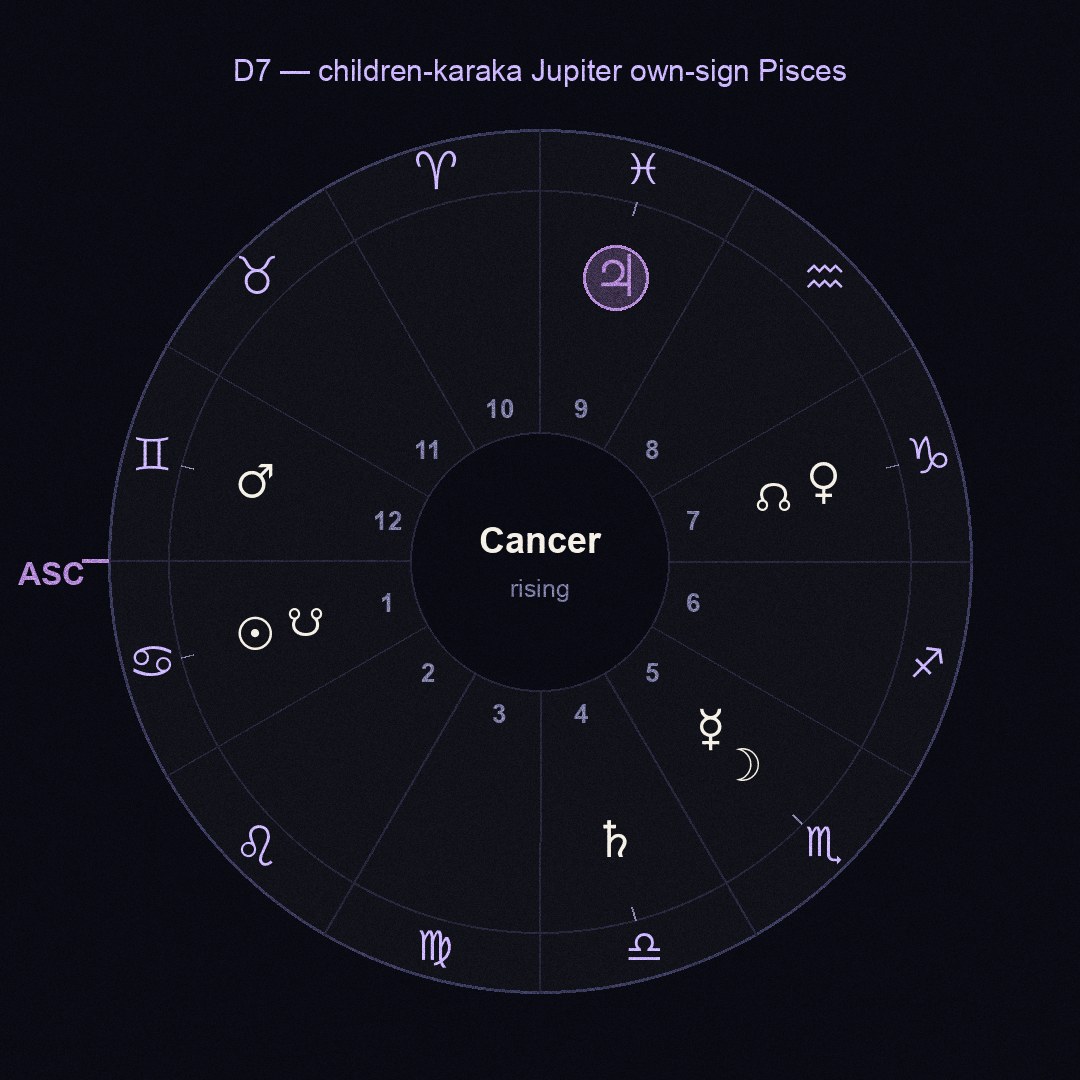
Against the saturated-but-poor 7th, the 5th (Scorpio) is the richest ground in the chart: empty of planets but carrying SAV 39, the highest, with its lord Mars strong in the 10th and both Jupiter's and Mars's 5th drishti landing on it. The children-karaka Jupiter is natally mixed — retrograde, adhisatru with its dispositor Venus — but it sits in own sign Pisces in the D7, the saptamsha that reads children, the reassuring second witness. Four testimonies converge: strong lord, top bindus, dual benefic-and-yogakaraka aspect, own-sign D7. Where Jupiter's retrograde/enemy state bites is on ease and timing, never on capacity. This is the sphere the person might underinvest in that quietly pays back the most — the ashtakavarga's blunt inversion of the 7th.
X.The nodal 2–8 appetite axis — the natal owner of the reference window
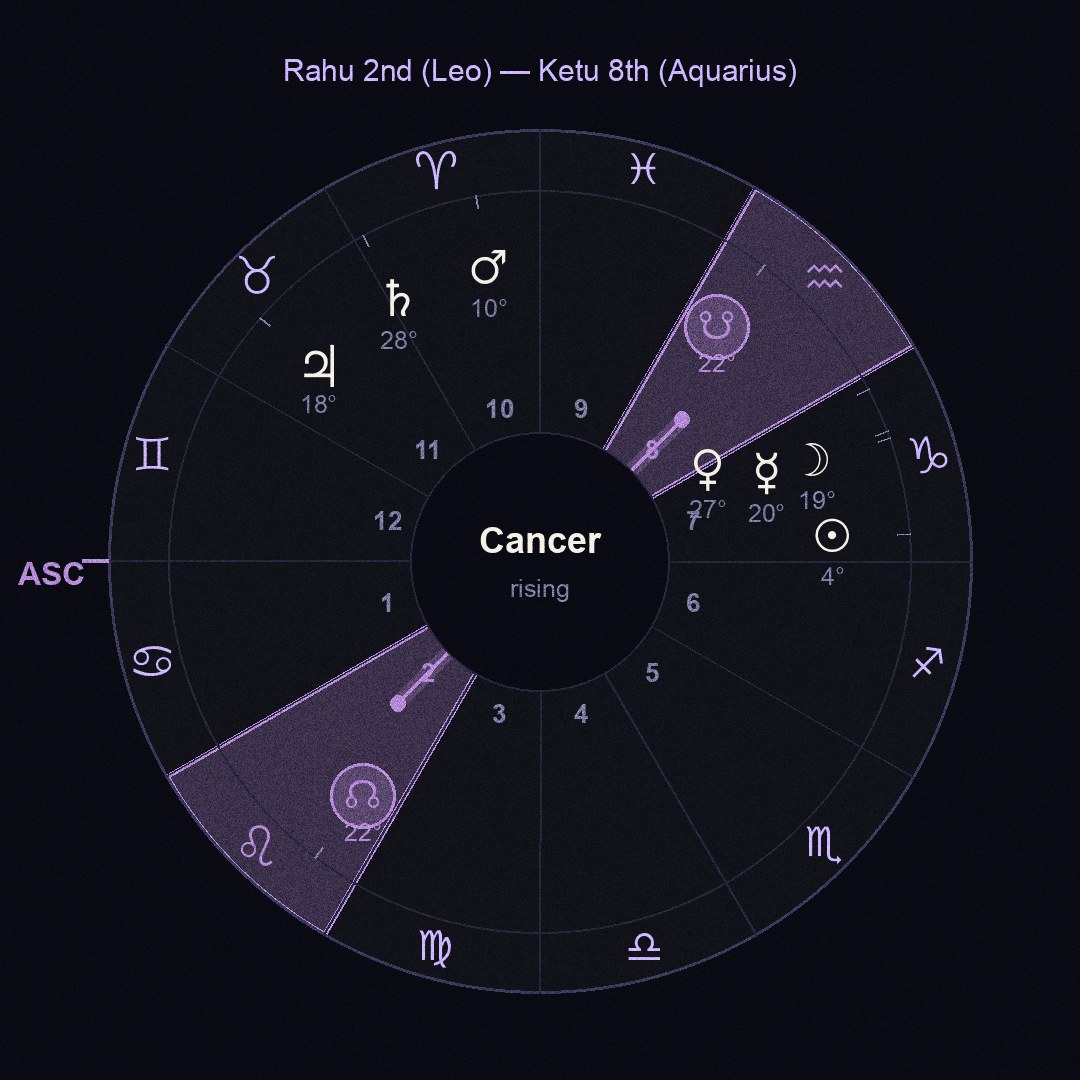
Rahu 22°54′ Leo sits in the 2nd (Purva Phalguni, lord Venus); Ketu 22°54′ Aquarius sits in the 8th (Purva Bhadrapada, lord Jupiter). Under the locked conservative posture the nodes own nothing, aspect nothing, and are grahas by placement only — so Rahu works entirely through its placement and its sign-lord. The hunger-axis runs 2nd (wealth, family, speech-as-sustenance, self-worth) to 8th (transformation, the hidden, mortality): Rahu inflating the 2nd, Ketu voiding the 8th. Rahu sits in Leo, the Sun's sign — so it operates through the dimmed Sun as dispositor, tying the appetite for name and worth directly to the chart's soft spot. This matters for timing because the entire reference window (1963–1971) sits inside the Rahu mahadasha (1952–1970) — the natal owner of this loud axis runs the very years the timing layer scores.
XI.How the timing layer reads on top of this
The detailed timing reading is among the inputs, so this section is written from it (with the dossier's dasha and gochar tables behind it). The reference date is anchored at 1967-04-28 — a documented point inside this now-completed life — so everything the timing material calls "now" is being read as history, in the past tense.
The mahadasha sequence hands the chart's figures out almost in the order salience ranked them. Moon (birth–1945) opened the life on the 1–7 axis it rules. Mars (1945–52, ages 3–10) gave the childhood to the yogakaraka engine — the one chapter where the raw D1 Mars strength governed a whole period before the D9/D10 fruition-debility could be tested, because a boy's native force is not an outcome. Rahu (1952–70, ages 10–28) ran the appetite-chapter of the ascent — eighteen years of unconventional ambition around name, voice and self-worth, its texture set entirely by which graha Rahu was sub-dealing at each moment (Rahu being inert by ownership and drishti). Then Jupiter (1970–86) the softening chapter, Saturn (1986–2005, SENSITIVE) the long payoff-and-tax of position and body, Mercury (2005–22, SENSITIVE) the 3rd+12th lord over an aging 7th-stellium — the terrain, named never dated, the life ended inside.
Inside the Rahu maha, the antardashas are the real story. Rahu/Venus (1963-07-23 – 1966-07-23) lit the compromised marriage karaka over the low-bindu 7th, and coincided with the heavy sade sati (1963-04-28 – 1966-04-08) — Saturn pressing the Moon during the years the central bond was formed and tested. Crucially, sade sati had lifted by the reference date, so the anchored moment sits in the thaw, not the pressure. Rahu/Sun (1966-07-23 – 1967-06-17) — current at the reference date — sub-deals the nodal appetite to the dimmed Sun, lighting the chart's structural soft spot (Figure 6): a confrontation with the authority-principle, forced open by the appetite for name and self-worth, SENSITIVE where it touches the father. The reference date 1967-04-28 falls at the very start of the Venus pratyantar (1967-04-23 – 06-17), so the anchored knot is nodal-appetite over dimmed-authority over compromised-Venus, all at once.
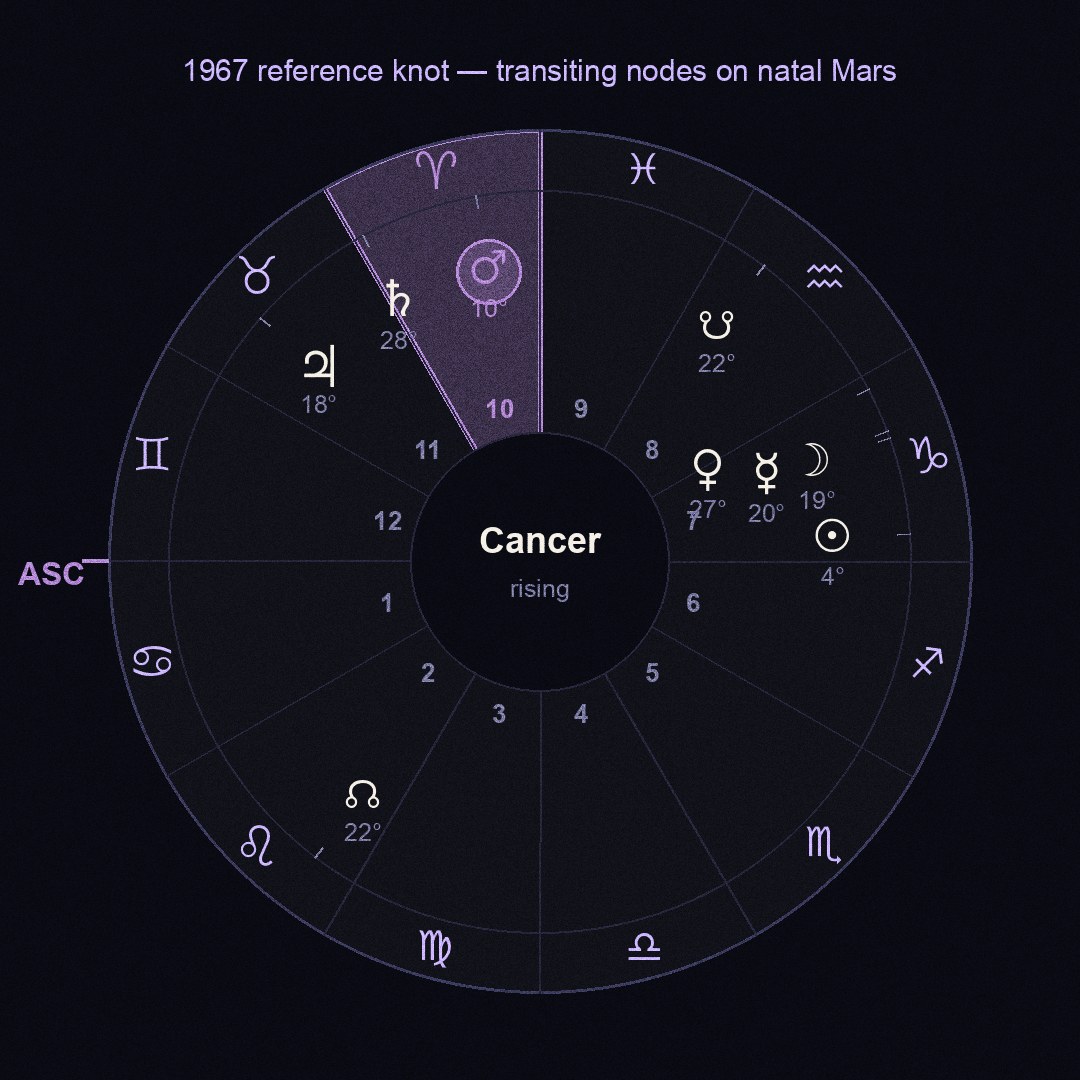
The loudest transit of the window lands squarely on the engine (Figure 3/4): transiting Rahu conjunct / Ketu opposite natal Mars, exact 1967-07-07 — the dasha-lord itself transiting onto the career-graha inside its own mahadasha. Obsessive ambition gripping the vocation (Rahu conjunct) and severance from it (Ketu opposite) at once, landing on the strongest planet in D1 whose fruition-vargas are debilitated. Alongside it, Jupiter opposition natal Sun (exact 1967-05-07) faces the dimmed Sun with grace during the Sun sub-period, but over the SAV-23 ground even a benefit lands thin; and nodes square natal Sun (exact 1967-10-23) extends the authority-theme past the reference point. The timing layer's counsel, read out of the chart, is exact: the passage asks that standing be earned and built, not assumed — because the thin inner Sun cannot fund a status simply claimed.
XII.Where the chart forks
The beam carried these pivots with their own bands; both branches stay ranked, verbatim.
How the Mars-power lands — outer standing vs inner fruition. Path A — the empire of position, very likely: authority won against friction and then held, durable across decades, favoured for durability of position (Saturn own-sign D10, the KTR raja yoga, Mars moolatrikona/Ruchaka/digbala). Path B — the brilliant driver who keeps arriving somewhere slightly other than intended, plausible: the outer power unmistakable but the felt fruition a step behind, favoured for inner satisfaction (Mars debilitated in both D9 and D10). Not an average — Path A governs position and the world's eyes, Path B governs felt satisfaction.
The "other" of the 7th — private spouse or public/market. Path A — married to both a person and a vocation, most likely (the private stellium plus the career strength, the 7th ruling both). Path B — primarily the private spouse, plausible. Path C — primarily the public/market, plausible. The chart loads all three and decides none; the 1967 timing sharpens the authority/public reading but the Venus pratyantar keeps the spouse in play.
The 1967 knot itself. Path A — a principled stand against authority at the height of the vocation that severs the professional seat mid-career, very likely (Ketu opposite Mars, Rahu/Sun lighting the thin authority — it costs the seat precisely because the Sun's entitlement is not innate). Path B — the standing seized by obsessive unconventional ambition, plausible (Rahu conjunct Mars). Path C — the "other" is the private partner, possible (Venus pratyantar). The chart is decisive that the window fired on the axis of vocation and authority; less so about which face carried most weight.
Was the lost seat regained? Path A — the empire restored, very likely (Saturn own-sign D10, KTR — durability of position; the Jupiter maha from 1970 restores it). Path B — merely sweetened, plausible (Mars D9/D10 debility — the outer power holds while felt fruition runs behind). The chart leans A for durability of position, B for the inner satisfaction of it. The turn is dated: Jupiter maha opens 1970-01-03, first Saturn return exact 1970-08-10.
XIII.Recurring keywords
- 1–7 axis — stated twice (lagna lord in 7th; lagna 7th from Moon)
- Everything lands in the 7th — 4 grahas + Venus-as-karaka, over SAV 23 (lowest)
- Mars-Saturn friction — enemy conjunction, 10th; power against resistance
- Capricorn/Saturn tone — 7th, 8th lord; institution, duty, coldness
- Dimmed Sun — ratio 0.86, only sub-minimum; authority achieved, not assumed
- Varga debility on the best planet — Mars debil in both D9 and D10
- Rescue-in-varga — Saturn own-sign D10; Jupiter own-sign D7
- Shravana repeats — Moon and Mercury in it; the listener
- Rahu maha owns the window — 1952–70; appetite over the dimmed Sun
- Nodes on Mars, 1967-07-07 — the engine seized and cut
- 5th overdelivers, 7th underpays — SAV 39 vs 23
- Retrograde load — Jupiter, Venus, Saturn all retrograde; things re-worked