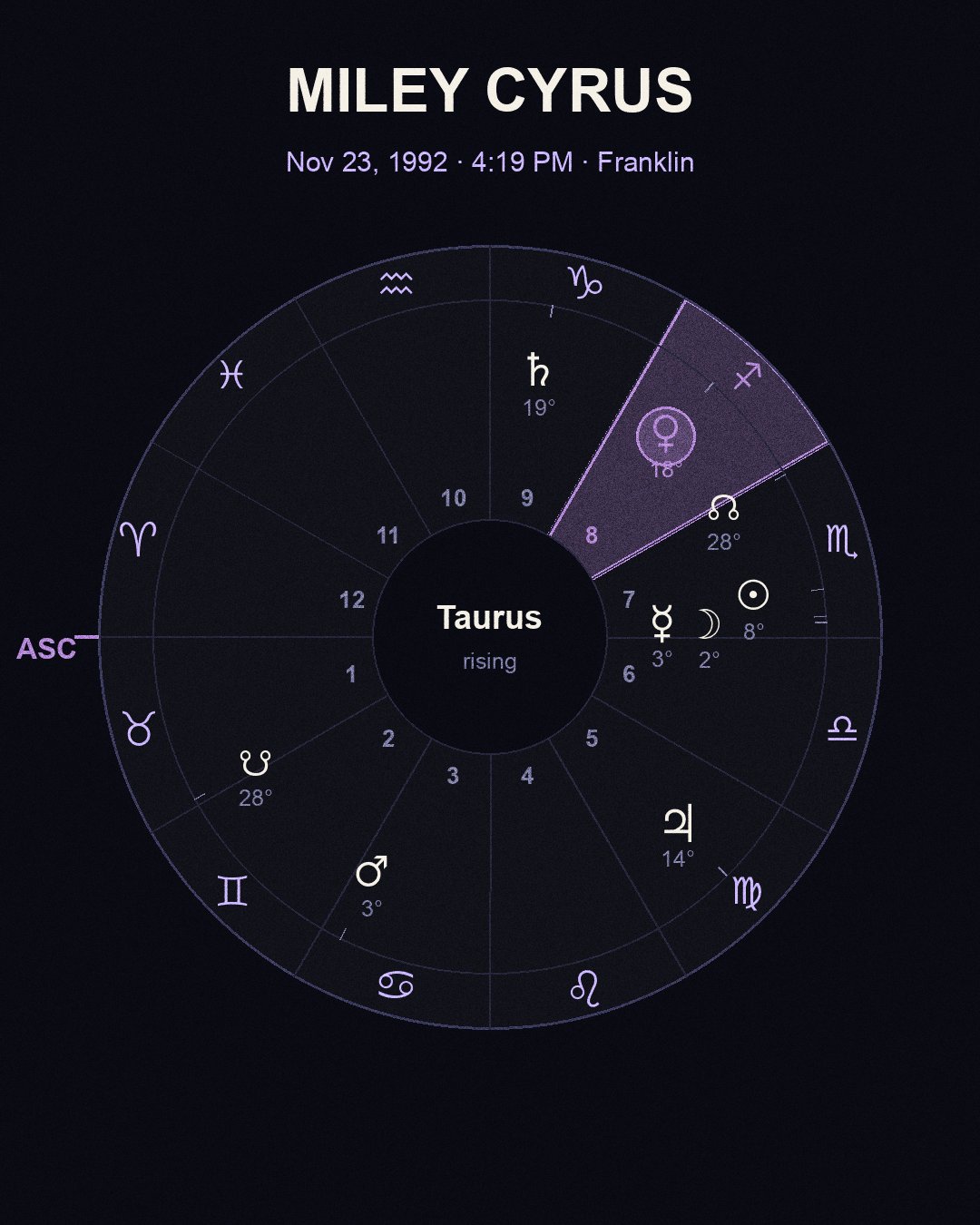

This is a Taurus-lagna chart whose felt life and whose structural life are not the same object, and almost everything interesting about it lives in that gap. What actually runs the chart is Saturn — yogakaraka for this lagna, in its own sign Capricorn, in its own 9th house, shadbala ratio 1.37, rank 2 of nine. What the chart feels like from inside is a four-graha pile-up in Scorpio in the 7th — Sun, Moon, Mercury, Rahu — sitting on the second-lowest bindu count in the whole figure (Scorpio SAV 21). The hollow parts are exactly where the weight is felt: the 7th (21) and the 8th (17, the lowest sign) carry the most planets and the lagna lord, and they are the two least-supported signs in the chart. So this is a chart built to deliver through structure and ache through relationship, and the two do not resolve into each other.
Birth data · birth-time quality: 1992-11-23 16:19 America/Chicago (22:19 UTC), Franklin, TN. Time source stated, provenance birth certificate (Astro-Databank AA / Rodden AA) — the high-confidence tier. Because the time is clean, the Taurus lagna at 4°37′, the whole-sign house frame, the entire functional-lord scheme, and the D9/D10 divisional claims all stand on solid ground rather than on a rectification. Two things stay orb-sensitive regardless of time quality and are flagged where they come up: the two close combustion calls (Moon 5.68°, Mercury 4.69°), and the Moon/Venus ashtakavarga rows, which shift a little under the rival AV lineage.
I.What actually carries weight here
Rank by shadbala ratio: Moon 1.43 > Saturn 1.37 > Mercury 1.01 > Venus 1.01 > Mars 0.97 > Jupiter 0.85 > Sun 0.83. Read that against dignity and it immediately splits into a paradox and a spine.
- Saturn is the one unambiguous engine. Own sign, own 9th, yogakaraka (9L+10L), ratio 1.37, rank 2. For a Taurus lagna it is simultaneously the best functional lord, in full dignity, in the best house for itself. Nothing else in the chart is clean like this.
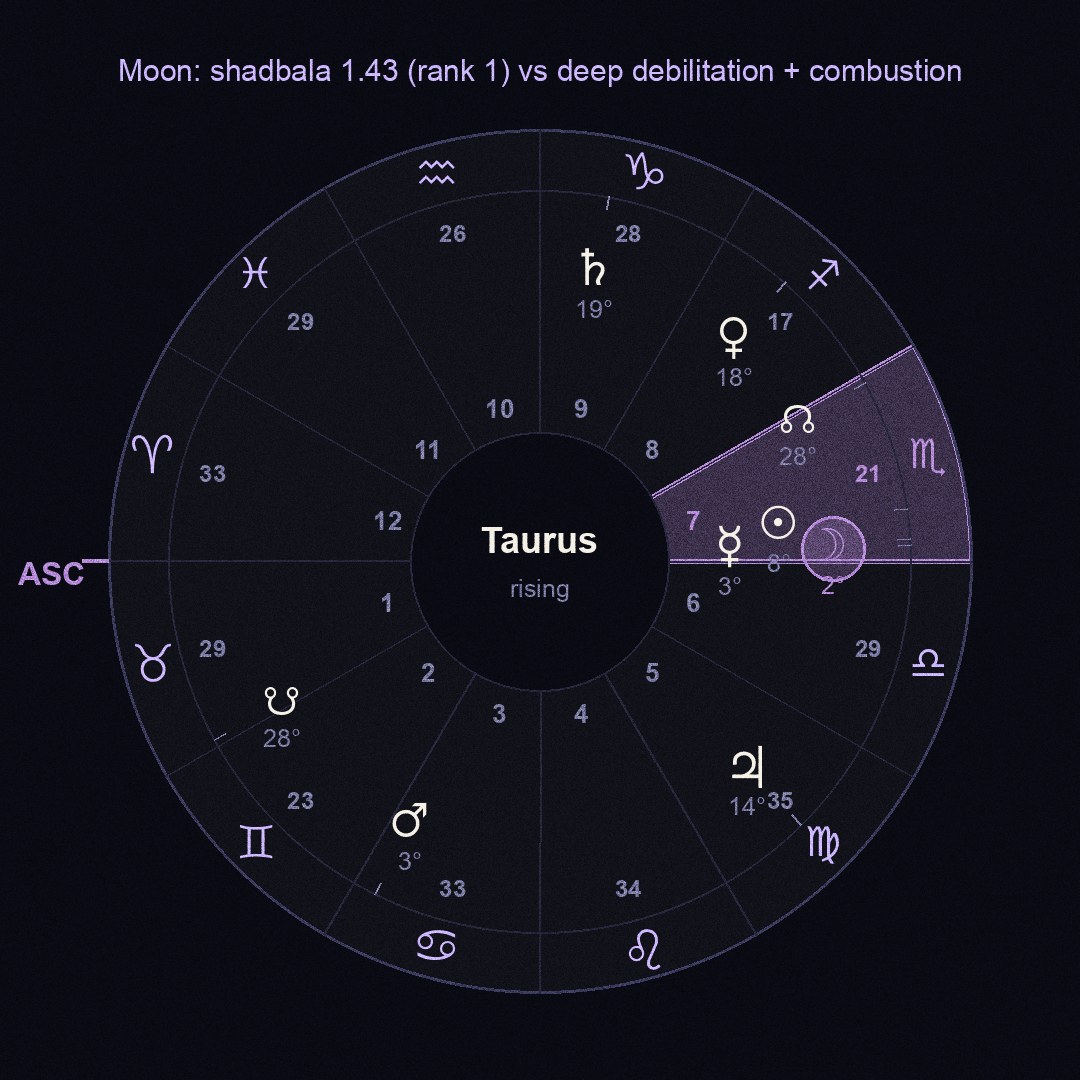
- The Moon is the loudest object and the most wounded object at once. Ratio 1.43 — highest of the seven — against deep debilitation (0.55° off the exact fall point), combustion (5.68° from the Sun), and mrita ("dead") avastha. This is not a faint Moon; it is a large, insistent, unreliable signal. Do not average the 1.43 against the debilitation — they are different axes (force vs. function) and both are true.
- The two functional benefics are benefic in status but compromised in condition. Venus (1L+6L, the lagna lord) is exiled to the 8th with no dignity; Mercury (2L+5L) is combust and retrograde inside the 7th stellium. Both just clear their shadbala minimums (1.01) — adequate, not abundant.
- The Sun is the weakest graha (0.83) — identity-as-radiance is the least reinforced thing here, which is why the chart leads by reliability, not charisma.
- Dasha ownership overrides raw strength. The native has been in Mercury mahadasha 2012-12-15 → 2029-12-15 — so a combust, retrograde 2nd/5th lord sitting in the partnership stellium has been running the entire adult chapter. A compromised graha that owns seventeen years outranks a strong one that never gets its turn.
Decorative by comparison: the empty 2nd, 6th, 11th, 12th houses; the graha-yuddha layer (none within 1°); and the Sun/Moon/Mercury aspects to Ketu, which only tint a general detachment tone and never build into a figure.
II.Saturn in its own 9th is the load-bearing wall
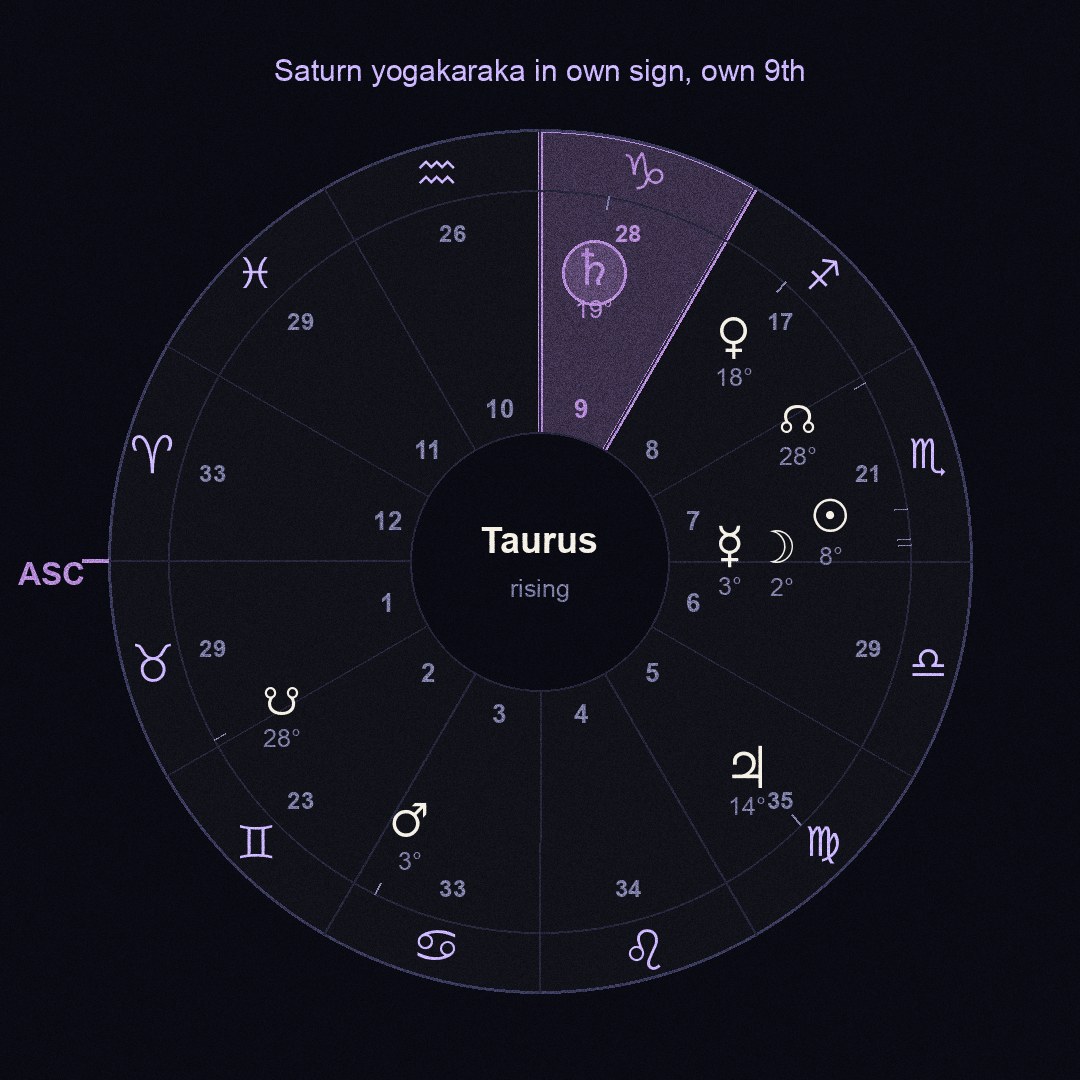
The single strongest structural fact is Saturn — Capricorn 19°19′, own sign, 9th house, yogakaraka, ratio 1.37, kumara avastha, Shravana pada 3 (lord Moon). The 9th-lord-in-the-9th-in-own-sign is one of the most stabilising things a chart can carry: dharma, father/teacher, fortune and standing have a real floor, and because the avastha is kumara ("adolescent"), the authority matures — it accrues with age rather than arriving early. This is why the whole reading resolves to "under-rated first, then the reliable pillar."
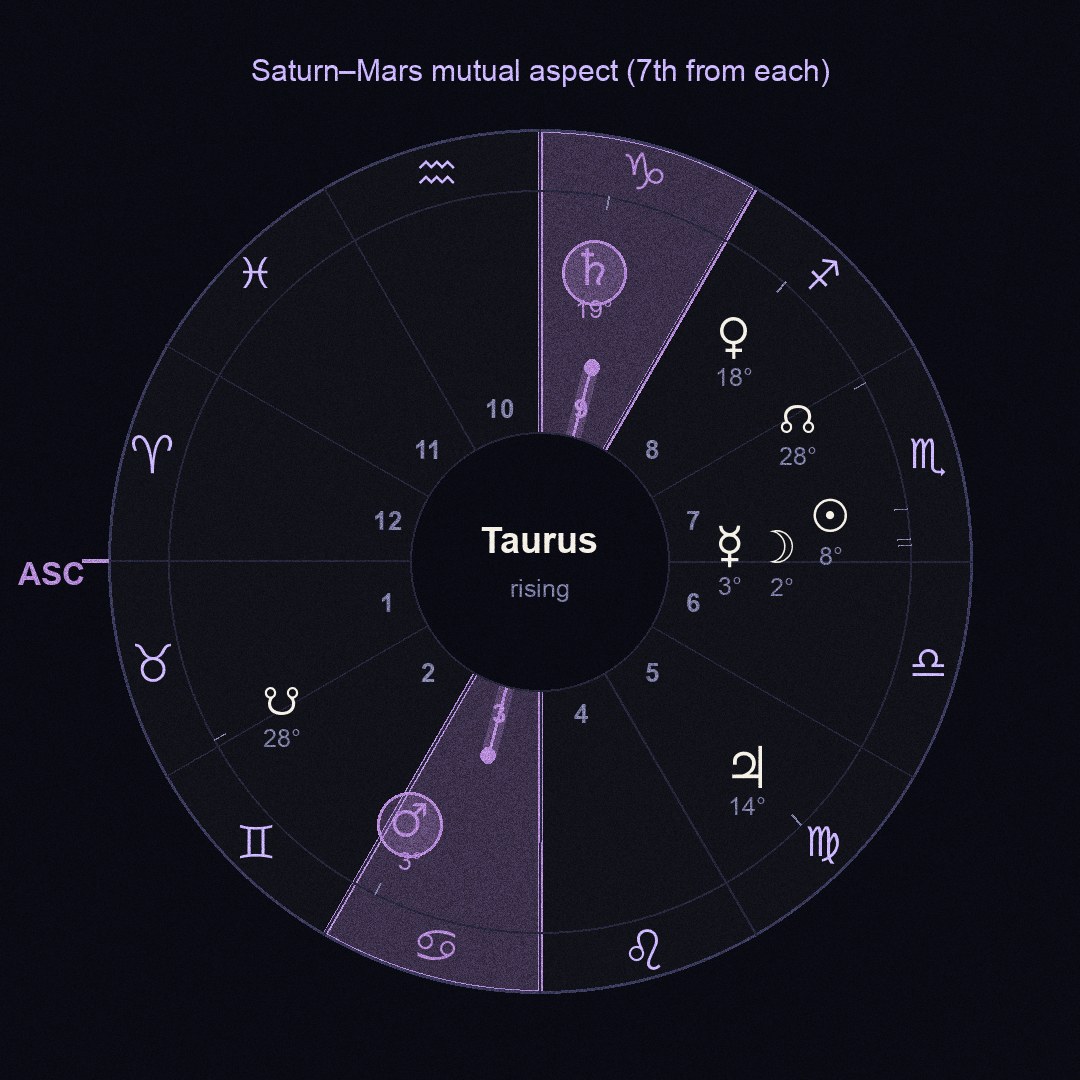
But it is a spine forged through friction, and the mechanism is specific. Saturn sits in mutual full drishti with debilitated Mars (Mars in Cancer 3°41′, in the 3rd; each is 7th from the other), and the dossier logs this as a genuine Kendra-Trikona Raja Yoga (Mars 7L, a kendra lord + Saturn 9L, a trikona lord, bound by mutual aspect). Two malefics in mutual aspect is classically abrasive, so the raja yoga is real but grinding — discipline imposed on a volatile drive, achievement wrung out of conflict rather than flowing. And there is one honest deflation the synthesis kept in: Saturn is strong by dignity and shadbala yet only modest in the bindu layer — its own Capricorn cell is SAV 28, and Saturn's own bhinnashtakavarga total is 39, tied with Mars for the lowest in the chart. So the strength is real but not lavishly supported: nothing arrives easy, the achievement is earned every time, but what arrives stays. Shravana (the "listener," Moon-ruled) is the tell for how it is earned — through absorption and sustained attention, not force.
III.The Saturn–Mars forge, drawn as one aspect
The abrasion that shapes the spine is a single mutual aspect worth isolating, because it is the whole difference between "smooth benefic Saturn" and the Saturn this chart actually has. Saturn (9th) and Mars (3rd) sit exactly seventh from each other and aspect each other by full drishti. Mars is debilitated — but shallowly, 24.31° off its deep fall point, so it retains residual functionality the Moon does not. That residual Mars, redeemed to own-sign Aries in the D10 (below), is what lets the friction read as "hard disciplined effort" rather than pure blockage.
IV.The crowded 7th is the felt center — and it sits on hollow ground
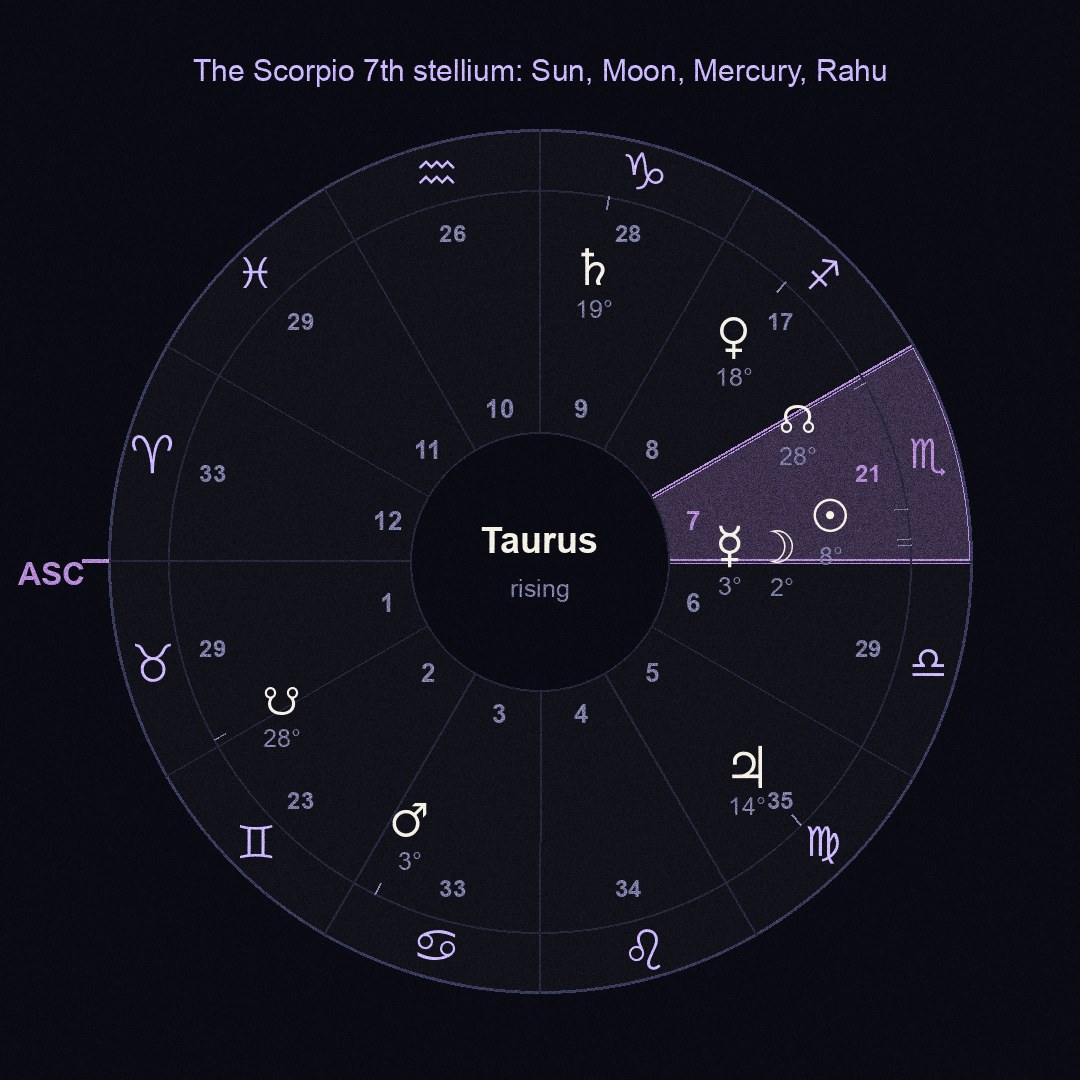
The most-tenanted house is the partnership house: Scorpio 7th holds Sun 8°08′, Moon 2°27′ (deb + combust), Mercury 3°26′ (combust + retrograde), and Rahu 28°41′. This same Scorpio is the 1st from the Moon — the Chandra lagna — so from the Moon all four of these grahas fall in the house of the self. That double-exposure is the mechanism behind the reading "the self is found through the other": what is the 7th (partner) from the lagna is the 1st (self) from the Moon, and the two vantage points land on the same four grahas. Relationship therefore isn't one compartment; it is where identity gets processed.
Two yogas form inside this stellium and both are flagged weak by their own strength data. Budhaditya (Sun + Mercury same sign) is real intelligence but carries mercury_combust=True — the classic bright-mind-self-cancelling-under-its-own-heat. And a second Kendra-Trikona Raja Yoga (Sun 4L + Mercury 5L, conjunction) exists on paper but fires inside a combust cluster on a 21-bindu house. The ashtakavarga is the receipt here: Scorpio's SAV of 21 is the second-lowest of the twelve signs, so this house does not deliver ease — it delivers depth and repetition. Rahu at 28°41′ amplifies and distorts the whole field: an appetite that repeats until understood rather than fed.
V.The Moon–Mars mutual fall: emotion wired straight to drive, both through wound
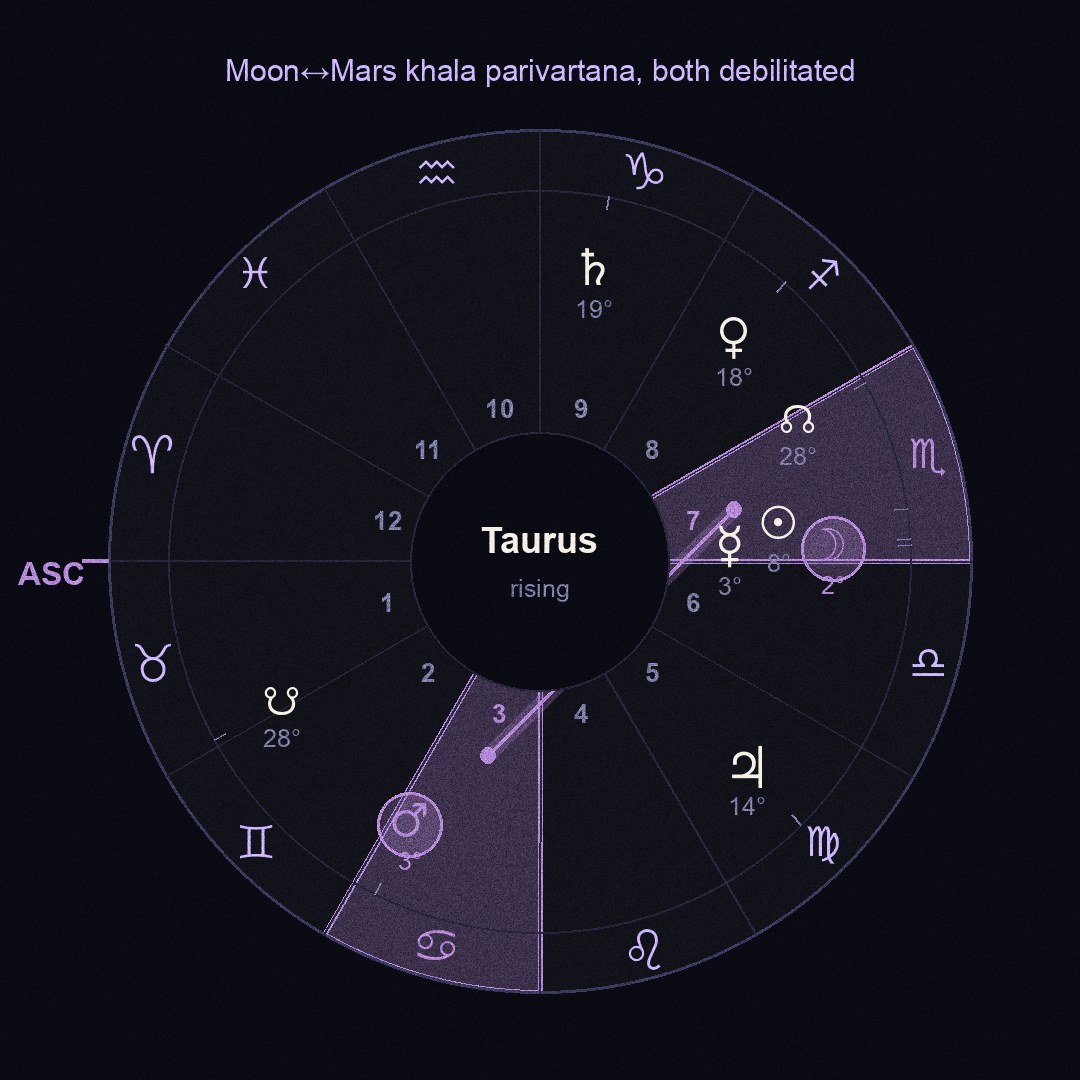
The emotional foundation is defined by a khala parivartana between two debilitated planets. Moon (Scorpio 2°27′, debilitated 0.55° off the deepest point, combust, mrita, 3L) sits in Mars's sign; Mars (Cancer 3°41′, debilitated, mrita, 7L+12L) sits in the Moon's sign. Each is therefore the other's dispositor — and each dispositor is itself fallen, so the mutual rescue is structurally hollow. The classification is khala (the 3rd house is involved), the unwholesome variety, not maha; and the two carry temporal-enemy relations, so the exchange forces contact between planets that don't like each other. The reading that falls out: feeling and action keep swapping places — the person acts out what should be felt and broods over what should be done — and the parivartana guarantees you can't move one without the other moving.
The asymmetry in the degrees is the whole fork. The Moon is at its deepest fall, combust and mrita; Mars's fall is shallow (24.31° off the deep point) and carries a partial neecha-bhanga (dispositor Moon in kendra from lagna and from Moon, though the other flags are False). So the drive recovers more readily than the emotional floor does. This is why the synthesis favours the "turbulent-then-forged" path — early instability metabolised into resilience — while keeping the "stuck-loop" path as a permanent floor beneath it, never displaced. SENSITIVE: the mother / emotional-origin material is terrain and tendency, not a verdict on anyone.
VI.The Moon paradox, shown as force vs. dignity
Because it is the chart's core contradiction, the Moon gets its own figure with the bindu layer. Ratio 1.43 (rank 1) carried almost entirely by kaala and sthana, against deepest-fall debilitation + combustion + mrita, with Cheshta bala 0.00 — a luminary with no self-propelled motive force. The resolution is not a compromise: shadbala measures quantity of force, dignity measures quality of function, so the Moon is powerful and impaired simultaneously — the most emotionally present presence in the room and the least sure of its own footing, in the same moment. Under pressure the force projects outward (loud) while the judgment fails inward (wounded). The combustion call is orb-sensitive (5.68° in a 12° limit), which is worth naming since the whole "burnt" layer rests on it.
VII.Venus in the 8th: the self's steward in the vault, and the viparita rescue
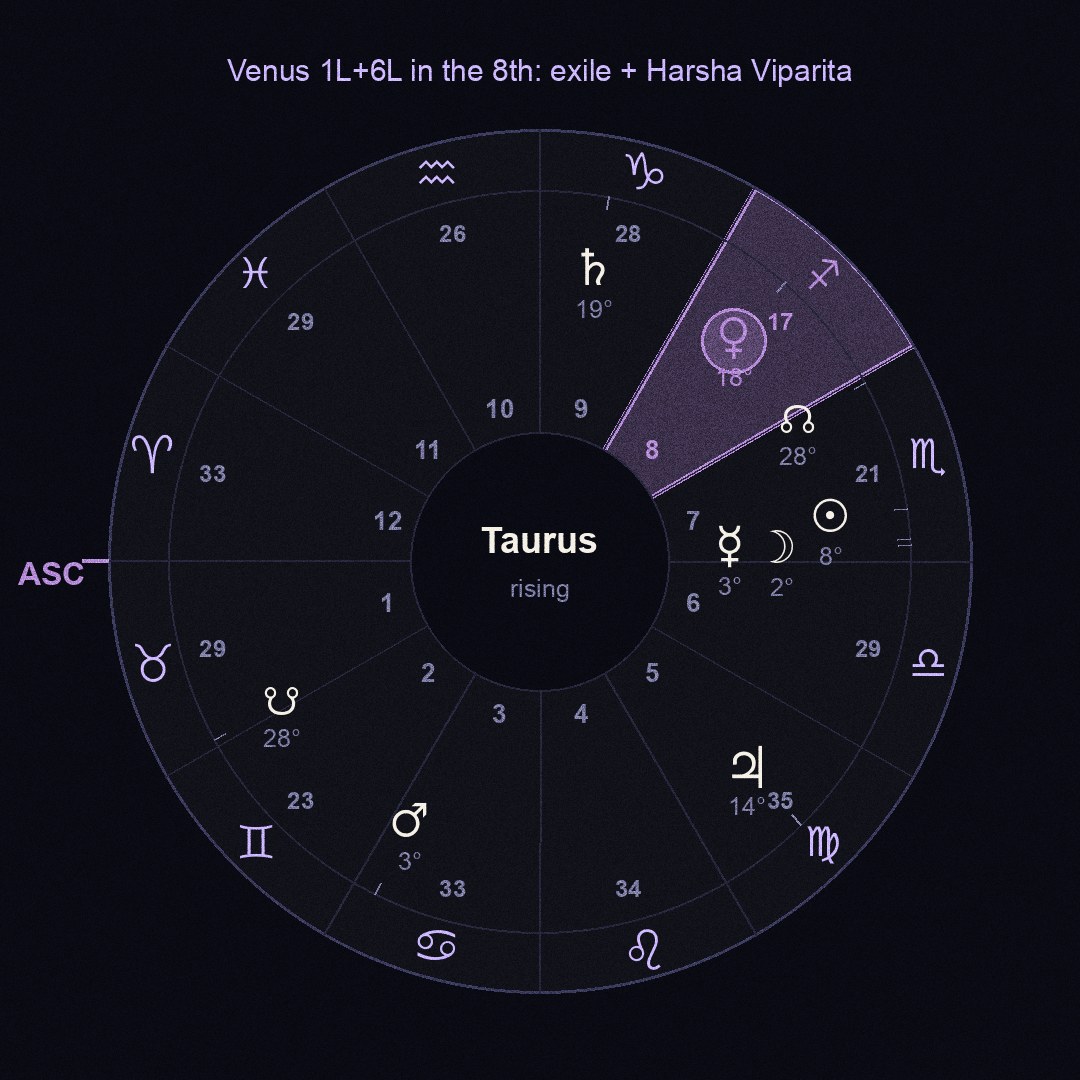
The lagna lord Venus (Sagittarius 18°42′, no dignity, 8th house, not combust, vriddha, Purva Ashadha pada 2 — its own nakshatra, ratio 1.01) rules the 1st and the 6th, and the 8th splits those two hats. As lagna lord in the 8th, the ruler of body-and-self is exiled into the house of vulnerability, secrets, others' resources and sudden change — a self perpetually drawn under the surface. As 6th lord in the 8th, the identical placement is a textbook strict-form Harsha Viparita Raja Yoga (strength flags: not combust, not retrograde, dispositor Jupiter, lords_maraka False) — the lord of enemies/disease/debt buried in the 8th turns those significations against themselves: crisis converts to advantage.
The bindu layer sets the tone honestly: Sagittarius is SAV 17, the lowest sign in the chart, so this is survival-and-depth, not comfort-and-ease. The two faces are time-sorted, not tied — the liability face dominates in ordinary flow (ease genuinely withheld), the redemption face fires in crisis. Confidence on the placement is high; on how strongly the viparita fires, only medium, because its guarantor — dispositor Jupiter — is itself undignified and a functional malefic. The full delivery is dated: it belongs to the Venus mahadasha from 2036, outside the current window. Purva Ashadha ("the unsubdued") is the flavour note — they do not stay down.
VIII.Jupiter in the 5th: a strong field with an unreliable steward
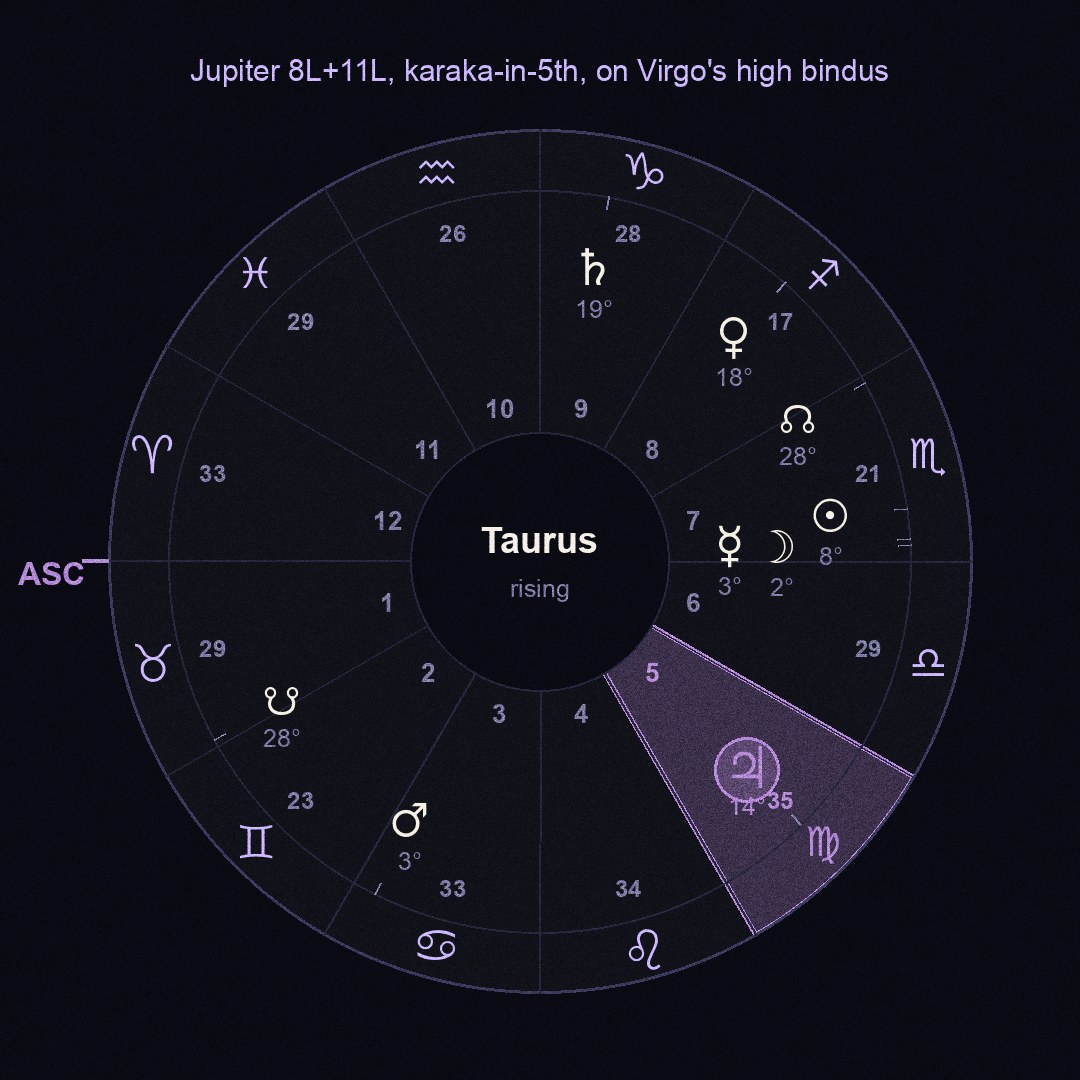
Jupiter (Virgo 14°49′, no dignity, 5th house, yuva, Hasta pada 2, ratio 0.85, rank 6) is the natural great benefic, but for Taurus it is a functional malefic (8L+11L) — so the reading must never soften into "lucky Jupiter." Three things pull against each other and the resolution is a clean split between field and tenant. (1) Jupiter is karaka for children sitting in the 5th of children — karako bhavo nashaya, the significator in its own bhava classically strains that bhava. (2) It has no dignity and near-bottom shadbala. (3) Yet it sits in Virgo, SAV 35 — the highest bindu sign in the whole chart. So the environment is favourable while the tenant is not: the 5th is a strong, high-traffic field with a weak steward. Children, creativity and speculative intelligence are major, live themes — but worked-for, obstructed or intense, not smooth and lucky. The corroborating note is that the 5th lord Mercury is combust and retrograde in the 7th, so both children-testimonies are compromised. Hasta (Moon-ruled, skilled-hands) is the one warmer note — an applied, detail-competent intelligence rather than a philosophical one. SENSITIVE: the children signification is load-and-difficulty, never a barren verdict.
IX.Where the vargas re-sort the chart
The navamsha and dashamsha do not merely echo the D1 — they overturn parts of it, and this is the single most important interpretive layer after shadbala. Two rescues and one indictment.
The rescues: the Moon, debilitated in D1, returns to its own sign Cancer in both the D9 and the D10 — the inner/marital chart and the vocational chart. So the emotional foundation is wounded at the surface but sound at depth; the person heals inward, over time. And Mars, debilitated in D1, is in its own sign Aries in the D10 — the fallen drive becomes effective specifically in the career arena, which is why "initiative and courage work at work" even though they misfire emotionally.
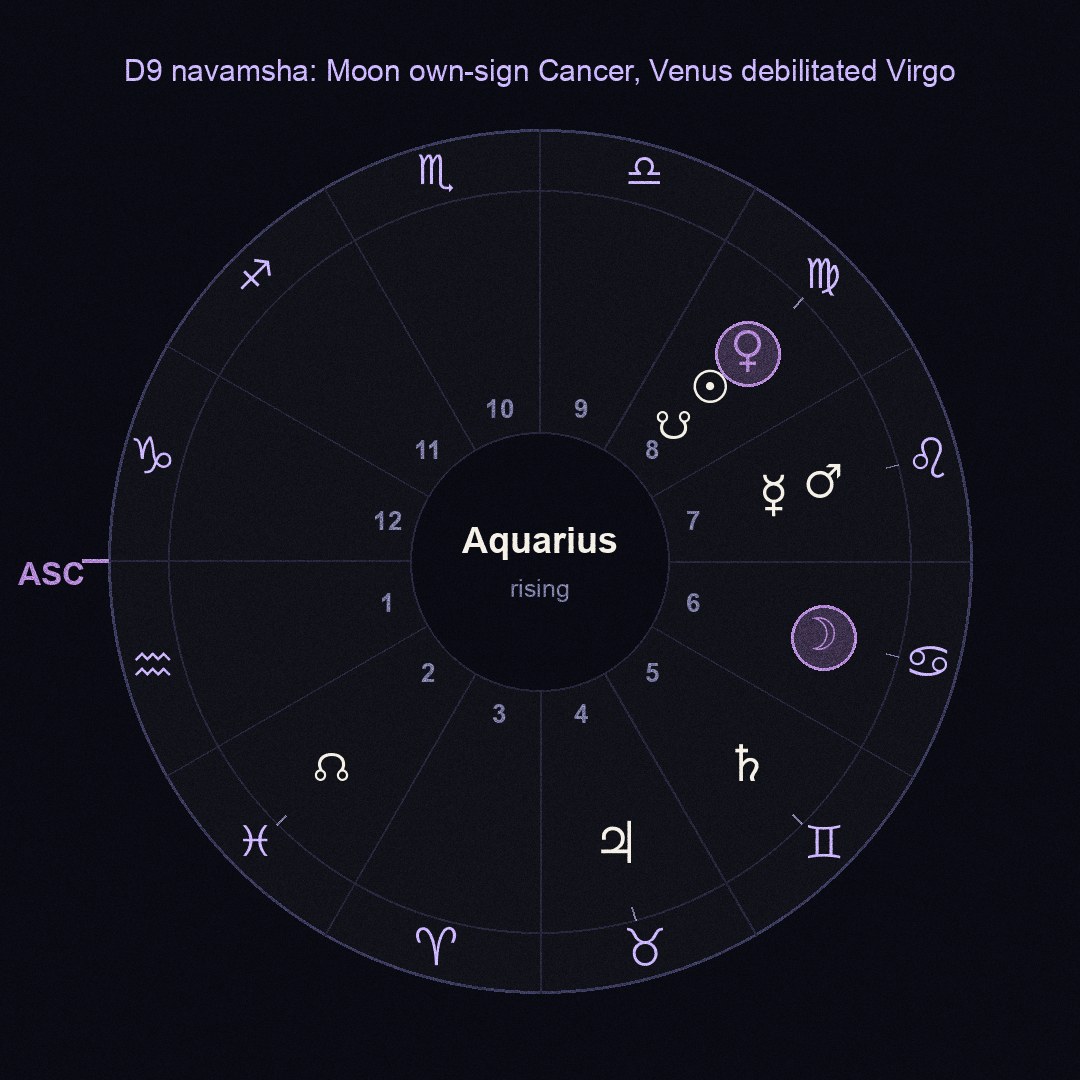
The indictment: the lagna lord and marriage-karaka Venus is debilitated in the D9 — the navamsha is the marriage chart, so the vargas here agree with the D1's worst reading rather than relieving it. This is why partnership is the loudest convergent thread in the chart: lord, karaka, navamsha, occupancy, ashtakavarga and Chandra-lagna all say the same thing. No placement is vargottama — nothing is doubly locked D1=D9 — so the re-sorting genuinely moves the picture rather than reinforcing it.
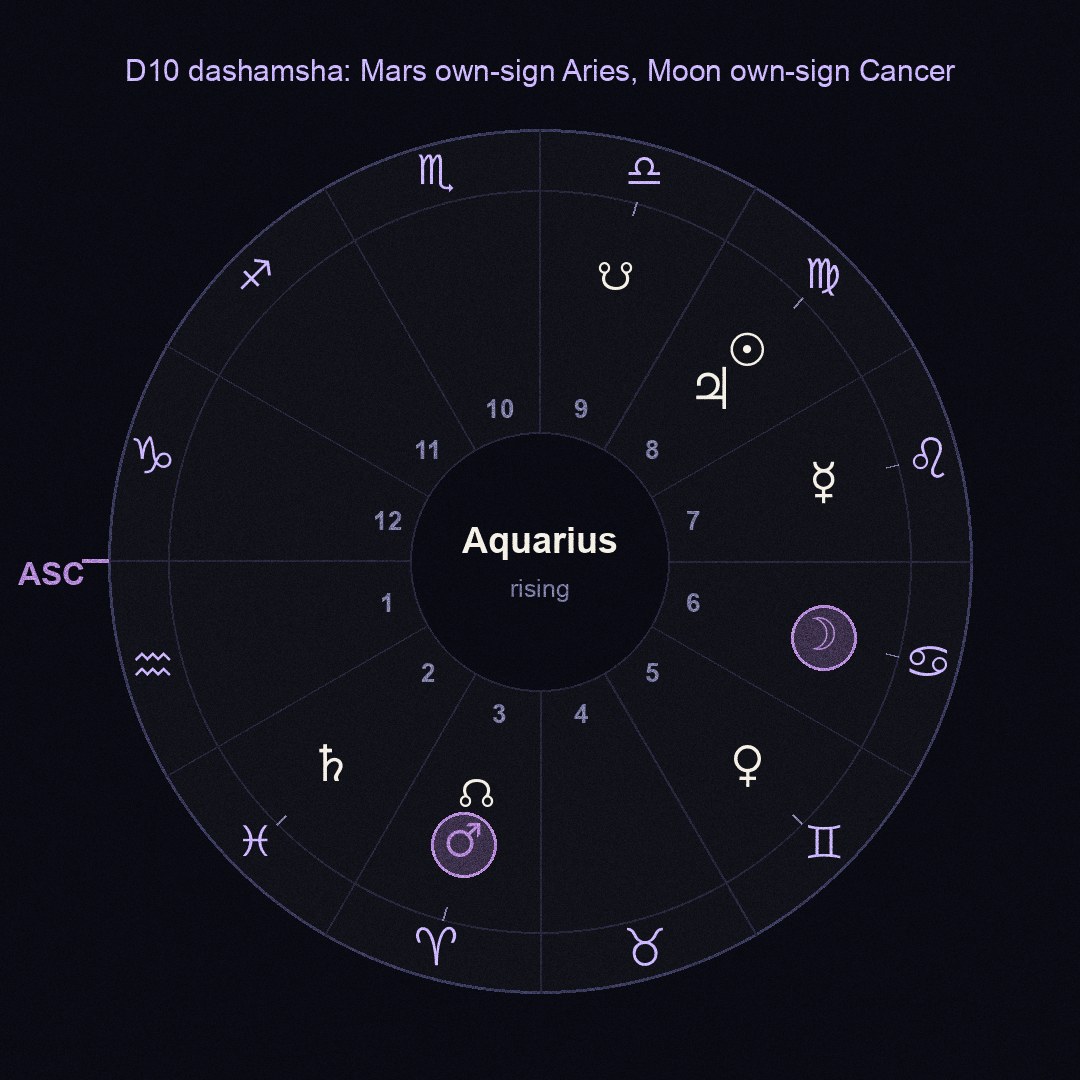
X.How the timing layer reads on top of this
The detailed timing reading is among the inputs, so this section is written from it. The life divides into long vimshottari chapters, and the map names what each is about by naming which figure the dasha-lord is.
The Saturn mahadasha, 1993-12-15 → 2012-12-15 (age ~1–20) poured the yogakaraka spine across the entire formative period — the load-bearing wall was laid young. But a childhood-length dasha most activates the Moon–Mars parivartana, so the childhood reads as structure over an unsafe emotional floor: competence built early, partly as armour. The Mercury mahadasha, 2012-12-15 → 2029-12-15 (age ~20–37, current) is governed by the combust-retrograde Mercury inside the 7th stellium — which is why the entire adult chapter has played out on the partnership-and-identity axis. The chapter closes on the spine and then hands off: Ketu 2029–36, then the Venus mahadasha 2036-12-15 → 2056-12-15, which is the viparita's home window — midlife is when the depth-worker steps forward and the crisis-into-advantage capacity most fully delivers.
Inside the current chapter, the antardashas are sub-plots on the same figures. The just-past Mercury/Rahu antar (2022-06-12 → 2024-12-30) ran the 7th at maximum Rahu voltage. The current Mercury/Jupiter antar (2024-12-30 → 2027-04-07) lands on the strained 5th (Figure 7) — creativity and the progeny theme both foregrounded and both worked-for. The Mercury/Saturn antar (2027-04-07 → 2029-12-15) lights the spine — the constructive close, the payoff arc.
The transits that matter are the ones landing on structural figures, and the dossier grades the ground they land on. W1 — 2026-05-08 → 2026-10-22: transiting Saturn squares natal Venus, two passes (exact 2026-06-09 direct, 2026-09-12 retrograde), pressing the lagna lord + marriage karaka in the 8th — the chart's loudest convergent thread — overlaid by nodal squares to the Lagna (exact 2026-09-09), Mercury (2026-10-01) and Moon (2026-10-20). Crucially this lands on the two weakest bindu signs (7th = 21, 8th = 17), so ashtakavarga confirms rather than cushions the stress. The pratyantar pointer stacks precisely here — Sun PA to 2026-08-08, Moon PA 2026-08-08 → 10-16, Mars PA 2026-10-16 → 12-04 — lighting the wounded cluster as the heavy transits arrive. W2 — 2026-04-04 → 2027-02-19: Saturn opposition natal Jupiter, two rounds, doubling the 5th-house testimony inside the Jupiter antar. The saving grace of the order: a Jupiter benefic prelude in June–July 2026 (conjunct Mars 06-20, trine Moon 06-14, trine Mercury 06-19, sextile Lagna 06-24, trine Sun 07-11) opens real ground just before the pressure — build in the opening, brace for the test. And sade sati is absent from the window — the dreaded Saturn-on-Moon ordeal is simply not running.
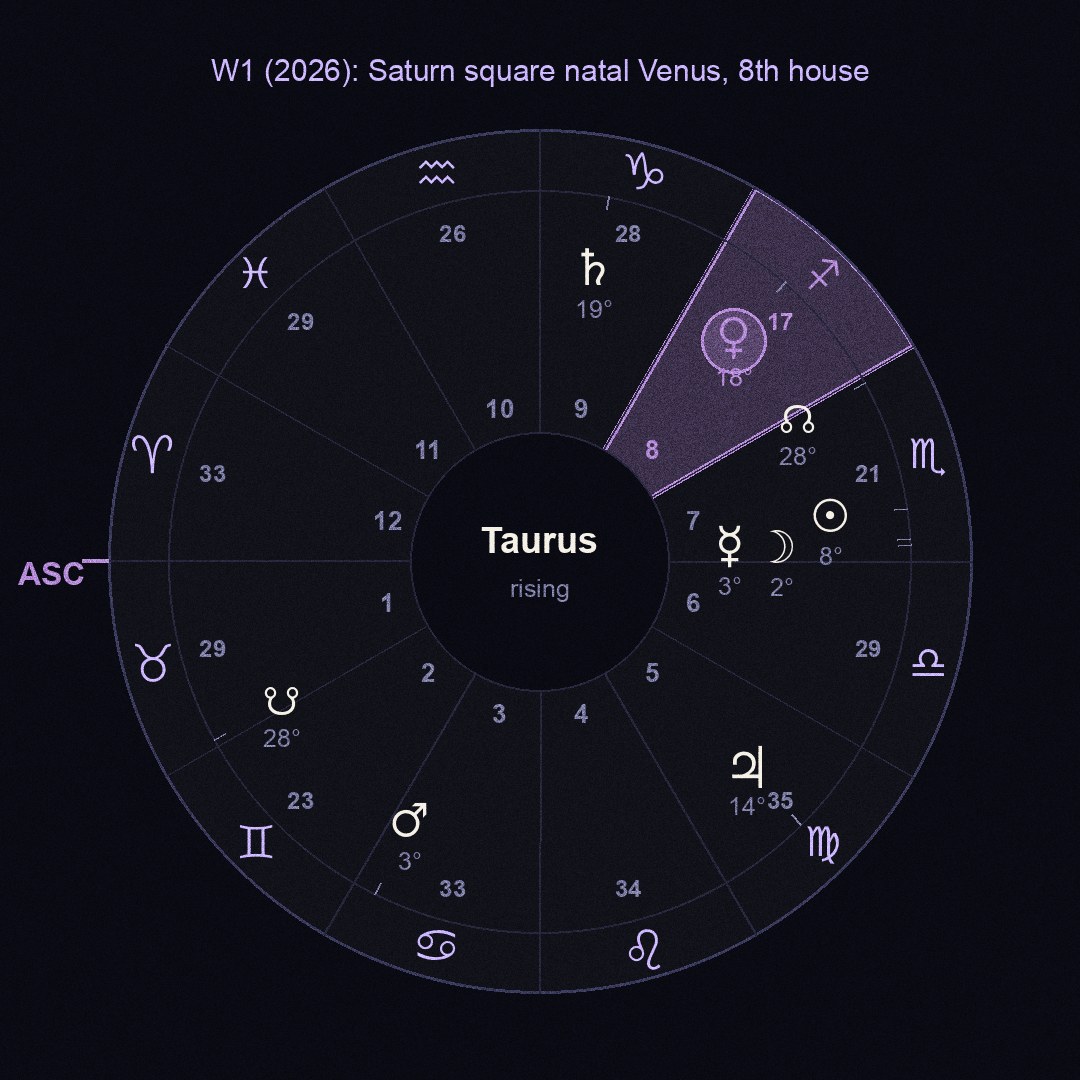
XI.Where the chart forks
The timing reading carries two genuinely forked pivots, and both are decided behaviourally, not fatally — the distinguishing marker is knowable.
The autumn-2026 window (W1, roughly August–December). Met in the disciplined mode — slowly, structurally — it metabolises: the reality-test forces something true to the surface and consolidates the relational and identity work of the whole adult chapter (the "more likely turn, if you engage it deliberately"). Met in the reactive mode — feelings running ahead of judgment, the loud-but-unreliable Moon in charge at the October pressure point — it corrodes: the same contacts destabilise the axis without any reckoning cohering ("the real second possibility"). The chart does not settle which; the distinguisher is whether the native meets the window deliberately or reactively, and the structural support (Saturn sextile natal Saturn, 2026-05-13 → 10-14) is standing ready as the tilt toward the good outcome.
The 2027–2029 consolidation (W3). If the autumn was metabolised, the relational years cash out as durable, earned standing — very likely. If it corroded, the same window gets taxed: the structural gift is present but spent absorbing unresolved load — a real possibility, under-collected. This dependency is the single live chain in the road ahead: how late 2026 is met largely decides how much of 2027–2029 is kept.
XII.Recurring keywords
- Scorpio 7th — four grahas (Sun, Moon, Mercury, Rahu); the felt engine
- debilitation — Moon (deep), Mars (shallow), Venus (in D9) — three times
- own-sign rescue — Moon D9+D10, Mars D10, Saturn D1
- combustion — Moon 5.68°, Mercury 4.69° (both orb-sensitive)
- hollow ground — 8th SAV 17 (lowest), 7th SAV 21 (2nd-lowest) hold the weight
- Saturn dispositor — 4 nakshatra lords (Sun, Mars, Mercury lie in Saturn-ruled stars)
- Cheshta 0.00 — Sun and Moon both — luminaries lacking motive force
- parivartana — Moon↔Mars, khala, both fallen
- force ≠ function — Moon rank 1 shadbala / rank last dignity
- Mercury MD — a compromised graha owns 2012–2029
- deliberate-vs-reactive — the behavioural fork gating W1 → W3