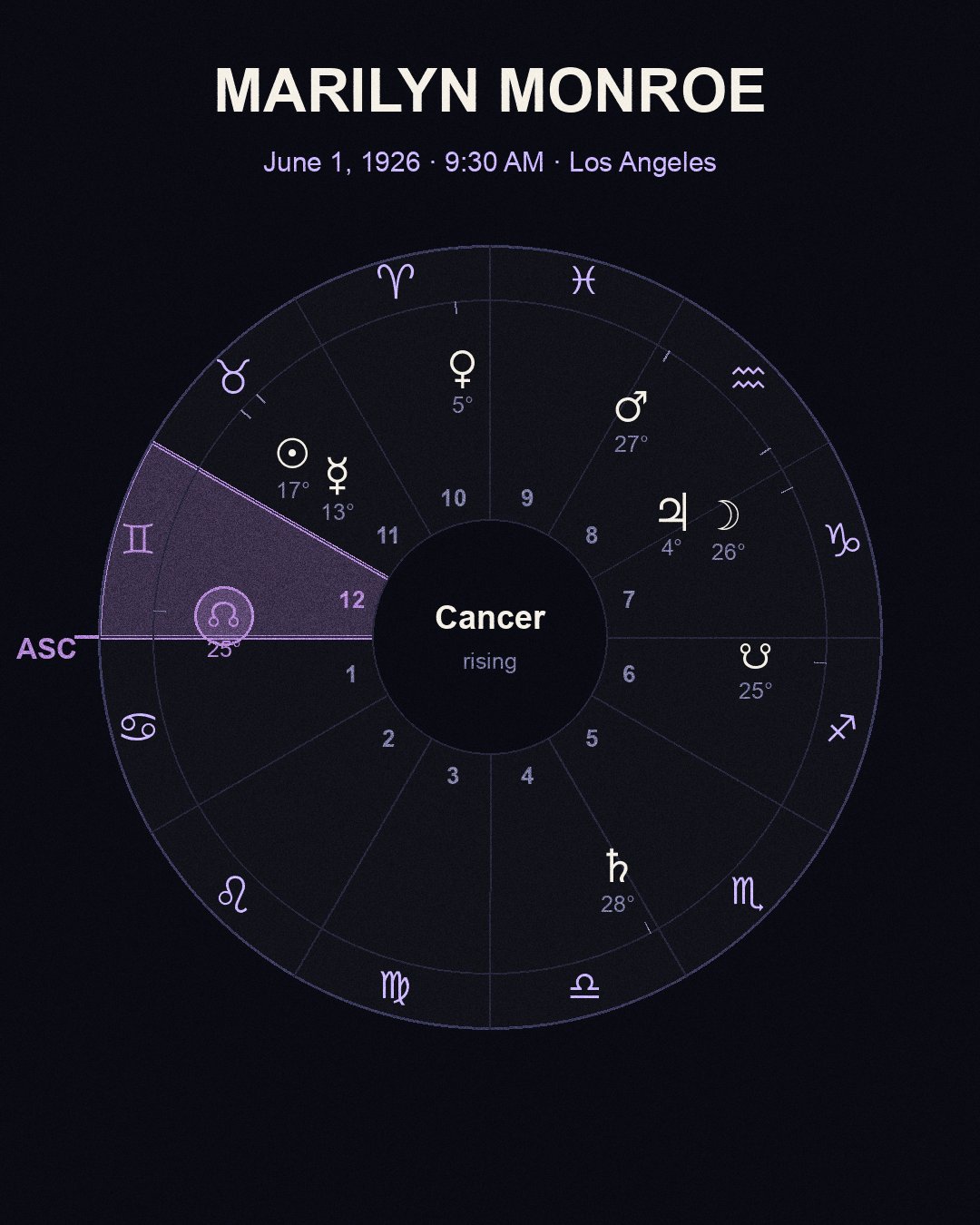

This is a Cancer-lagna chart whose engine, spine and wound sit in three different places, and every load-bearing claim below is really a claim about the distance between them. The outer machinery is formidable — Venus is the strongest graha in the chart (shadbala ratio 1.71, rank 1 of nine), crowning the 10th in Amala yoga, own-sign across the vargas that decide careers. The soul-axis is exalted retrograde Saturn (Libra 28°37′, 8.62° from deep exaltation, ratio 1.30, Sasa yoga, highest-degree graha and so Chara Atmakaraka). And the vehicle of the self, the lagna lord Moon, is the single weakest graha in the whole chart — ratio 0.72 against a required 1.00, kaala bala a near-collapsed 15.22 virupas, only 2 bindus on its own sign. The two grahas below required strength (Moon 0.72, Mercury 0.77) are precisely the significators of feeling and thought; everything at or above strength is a significator of persona, career, action or endurance. That split is the chart.
Birth data · birth-time quality: 1926-06-01T09:30 America/Los_Angeles (17:30:00Z), Los Angeles; time source stated, provenance birth certificate (Rodden AA). This is the strongest possible data class, so the lagna (Cancer 20°15′), the whole-sign house frame and the divisional charts are all on firm ground — the house-dependent claims below are not fenced for time quality, only for their own school-level caveats.
I.What actually carries weight here
Read by the dossier's own numbers, not by house-meaning:
- Shadbala rank: Venus 1.71 > Mars 1.37 > Sun 1.35 > Saturn 1.30 > Jupiter 1.17 > Mercury 0.77 > Moon 0.72. The last two are below their required minimum; the top four are the machinery.
- The dasha clock overrides all of it. The two strongest structural candidates for the "spine" — Venus (engine) and exalted Saturn (soul) — never received their mahadasha in the lived life. The sequence is Mars (birth–1931), Rahu (1931–1949), Jupiter (1949–1965, the anchored and final chapter), Saturn (1965–1984, unlived), Venus (2008–2028, unlived). A weak graha that runs a chapter outranks a strong one that never gets its turn — which is why Jupiter-from-the-8th and Rahu-in-the-12th, not Venus and Saturn, are the grahas that actually shaped the life.
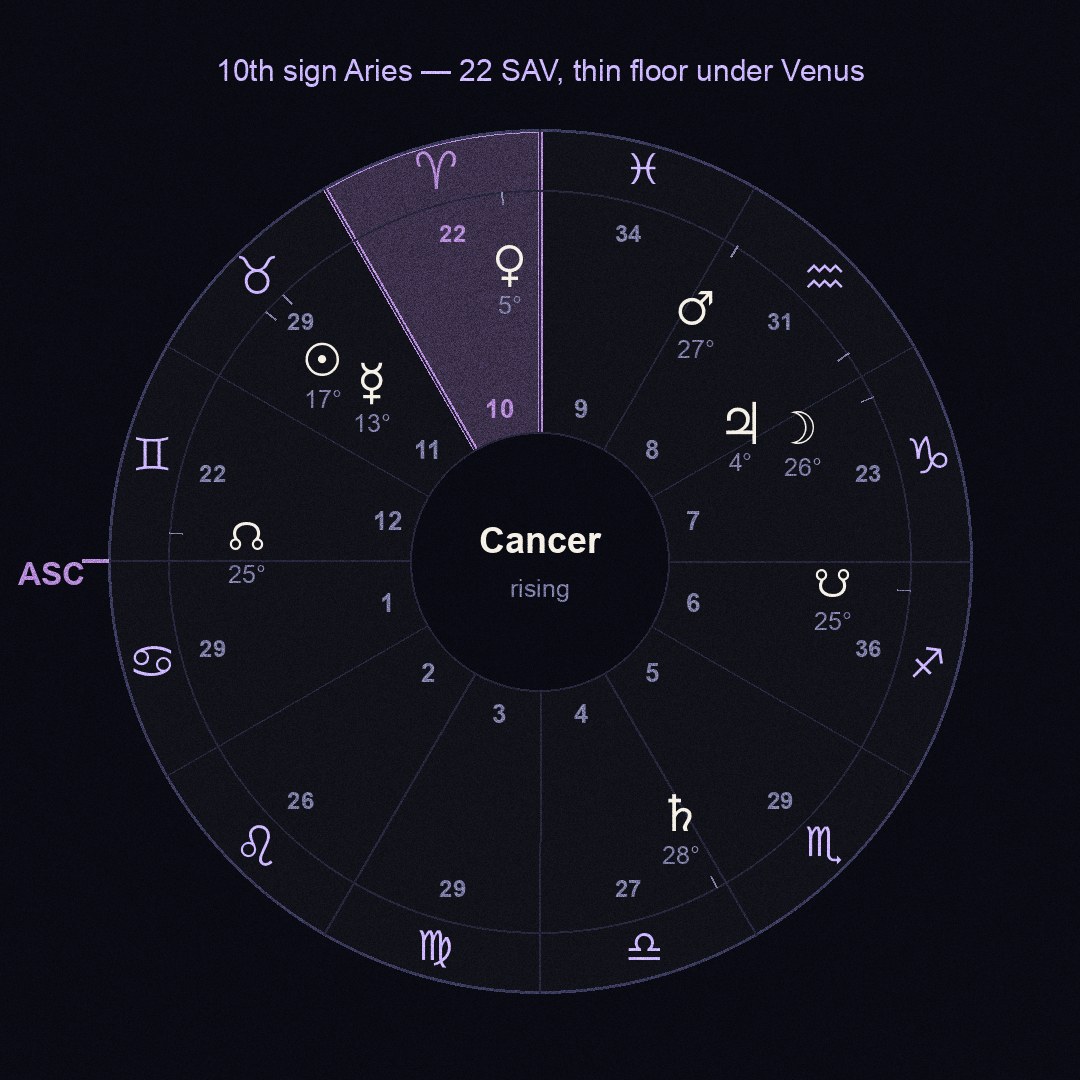
- Ashtakavarga floor vs. dignity ceiling: the 8th (Aquarius) carries a high 31 SAV and the 6th (Sagittarius) the chart's highest 36, but the 10th (Aries) has only 22 and the 7th (Capricorn) only 23 — the two houses of career-standing and partnership have thin floors under strong significators.
- Decorative / inert: the 2nd (Leo), 3rd (Virgo) and 5th-as-a-sign (Scorpio) are empty, taking only Mars's aspects; the famous-sounding placements there add nothing. Nodal dignity and drishti are withheld by the locked conservative posture — every node reading below is
[T]-flavoured, never headline.
II.The engine is a functional malefic: Venus, strongest graha, crowning the 10th
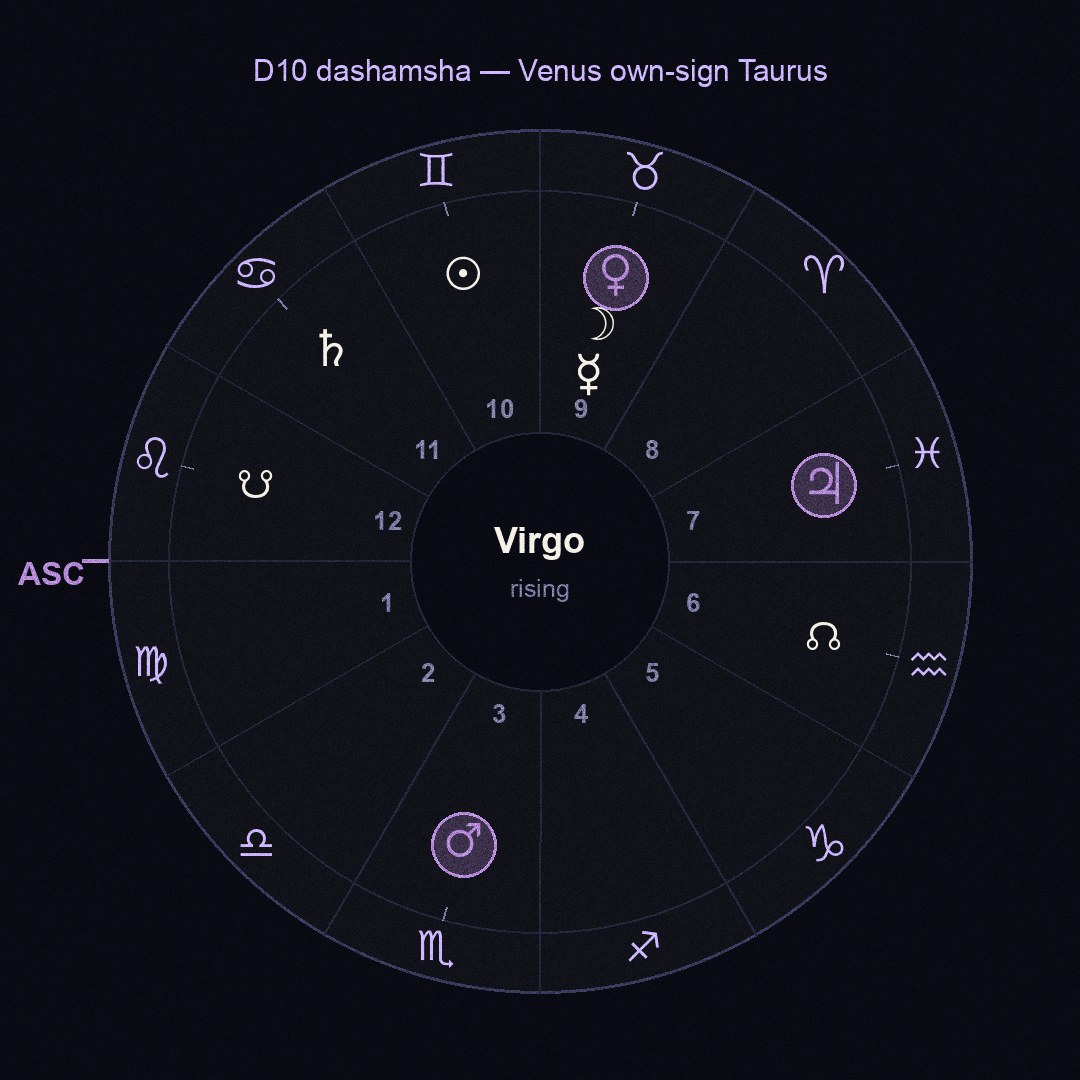
Venus is the most reliable asset in the chart and, for this lagna, one of its structural destabilizers — and there is no separating the two. By shadbala Venus is rank 1 at ratio 1.71 (sthana 259.52, the highest positional strength of any graha), sitting in Aries 5°56′ in the 10th, alone among benefics there — which is exactly the definition of Amala yoga, the spotless-reputation combination (a natural benefic alone in the 10th from lagna, no non-benefic sharing the sign). And Venus is own-sign Taurus in the D9, own-sign Taurus in the D10, own-sign Taurus in the D7 — dignified in every varga that a career-and-marriage question actually consults. That is why the reading commits to a brilliant public/creative career without hedging: this is the least ambiguous thing in the chart.
The cruel part is functional. For Cancer lagna Venus rules the 4th and the 11th — a kendra and a trishadaya — which the dossier's functional-lord table marks a functional malefic (trishadaya_lord). So the chart's strongest, most dignified, most beautiful graha plays for the other team: the same pleasure-beauty-network engine that builds the life is where it leaks its floor. The gift and the instability pour from one tap.
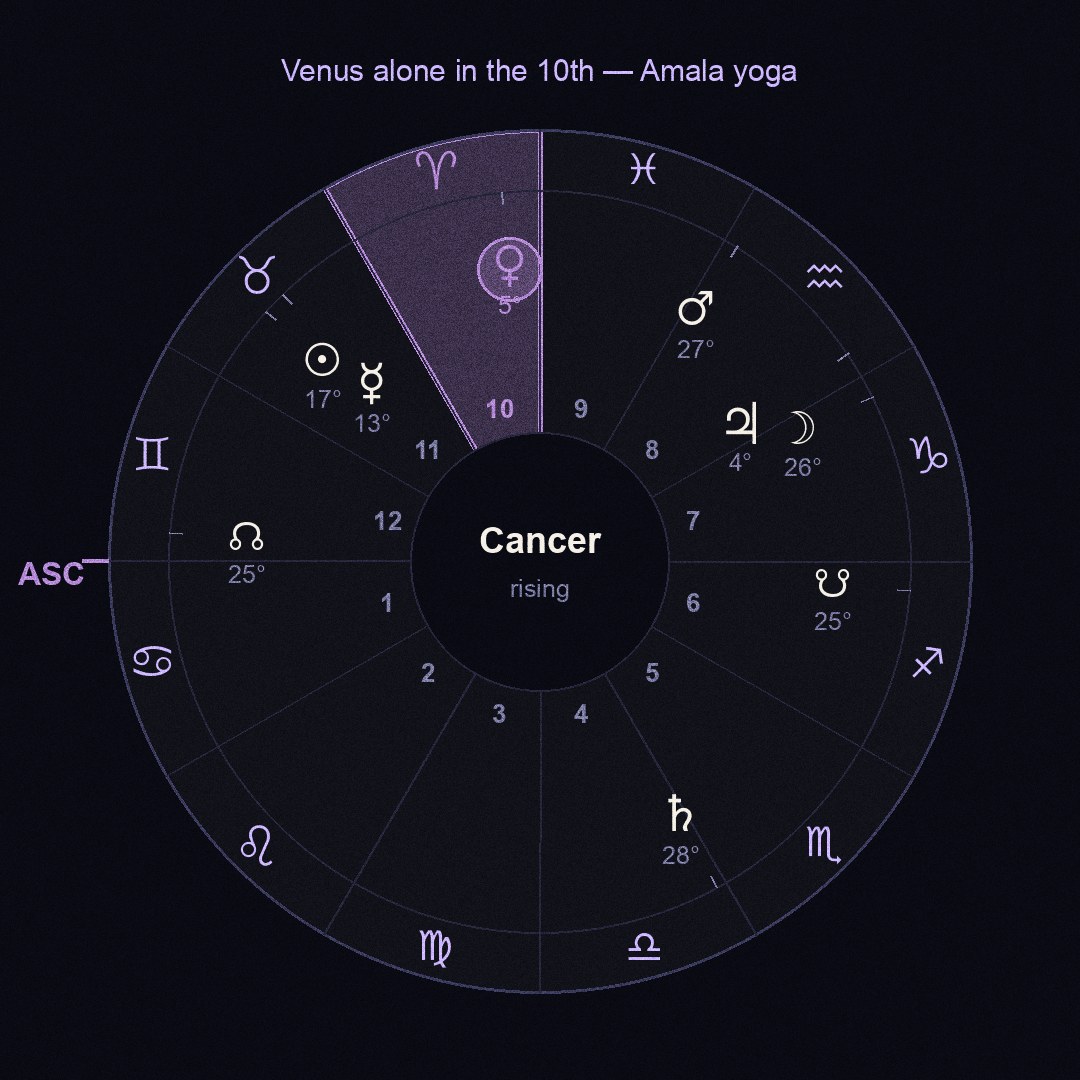
The varga claim needs its own varga chart, because Amala is a D1 fact but the reliability of the engine rests on the dashamsha:
III.The reputation stands on thin ground: 10th sign at 22 SAV
This is the counter-evidence the synthesis kept in, and it is not a contradiction of Figure 1 — it is the true shape. Every system that measures capacity screams a brilliant career: Venus rank 1 + Amala, three own-sign planets in the D10, a strong Sun (ratio 1.35, highest kaala bala 231.78) in the 11th. But the one system that measures sustaining support, ashtakavarga, gives the 10th sign (Aries) only 22 SAV — among the lowest in the chart — and the D10 Saturn is weak in Cancer. So the standing is genuine, clean and luminous, and it sits on a structurally thin floor: hard-won, volatile, requiring constant re-earning. The weak D10 Saturn points the warning specifically at the late career — the peak is real; holding it is the labour.
IV.The buried treasure: a raja-yoga knot dumped in the 8th, rescued by its exalted lord
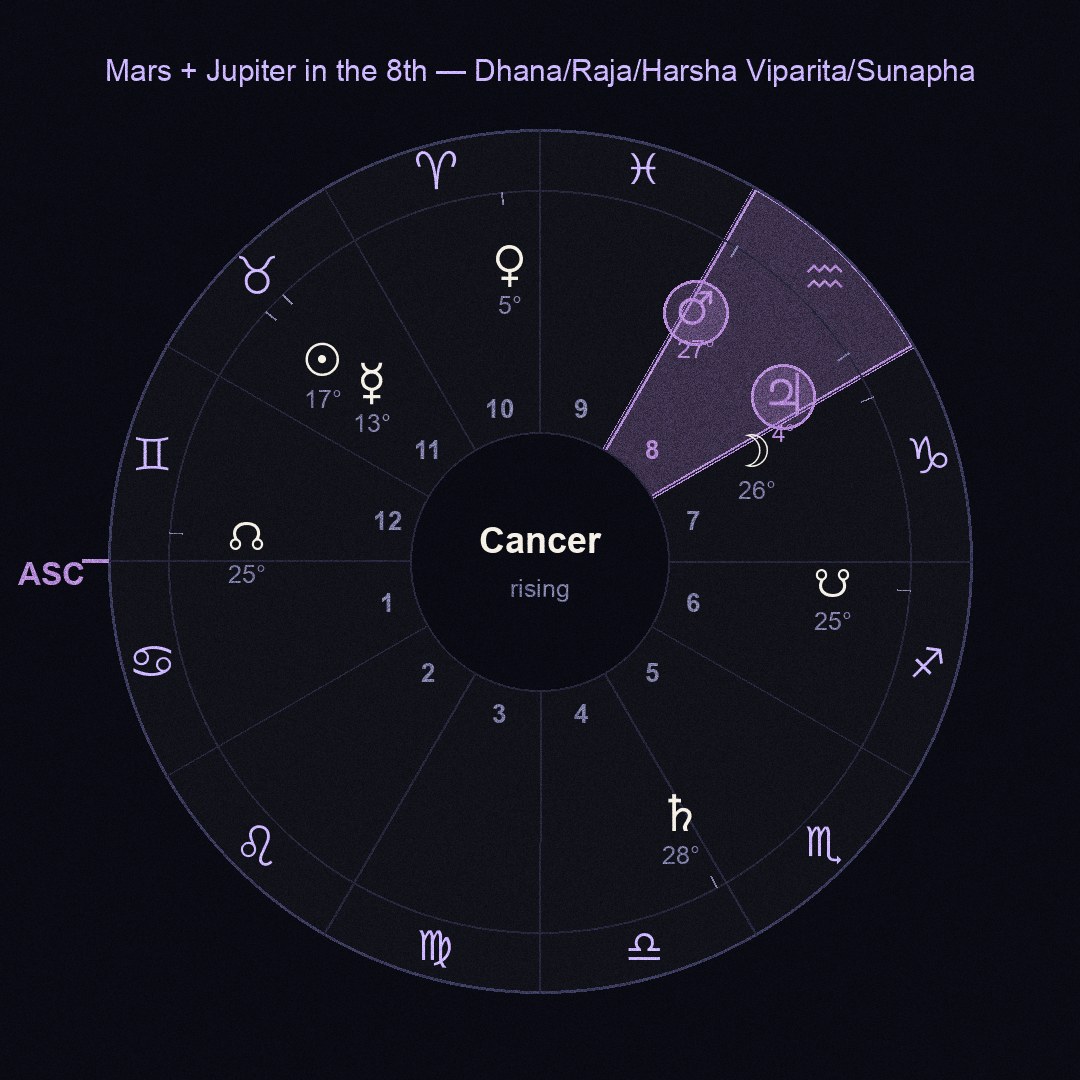
Mars (yogakaraka, 5th+10th lord) at Aquarius 27°54′ and Jupiter (9th+6th lord) at Aquarius 4°00′ both sit in the 8th, and between them they generate four catalogued yogas: Dhana (5th+9th lords conjunct), Kendra-Trikona Raja (10th+9th lords conjunct), Harsha Viparita (6th lord Jupiter in the 8th — loss reversed to gain), and Sunapha (both in the 2nd from the Moon). The two best functional planets for this lagna have been thrown into the worst house — which ordinarily buries the raja yogas. Two things haul them back up: their dispositor is Saturn, exalted (the 8th, Aquarius, is Saturn's own sign, and its lord is dignified in a kendra), and the 8th itself carries an unusually high 31 SAV. So power, status and money arrive through the 8th house — transformation, crisis, other people's resources, reinvention, sudden reversal — never around it.
But the ignition is effortful and late, and the avasthas say why: Mars is in mrita ("dead") avastha, and Jupiter is in bala avastha band 1/5 (infantile) with a temporal-enemy dispositor. The raja yoga is real but fires under pressure, not early and easily — which is exactly what "rise by going down and coming back" means mechanically.
V.The defining tension: Saturn ↔ Venus, beauty delivered under discipline
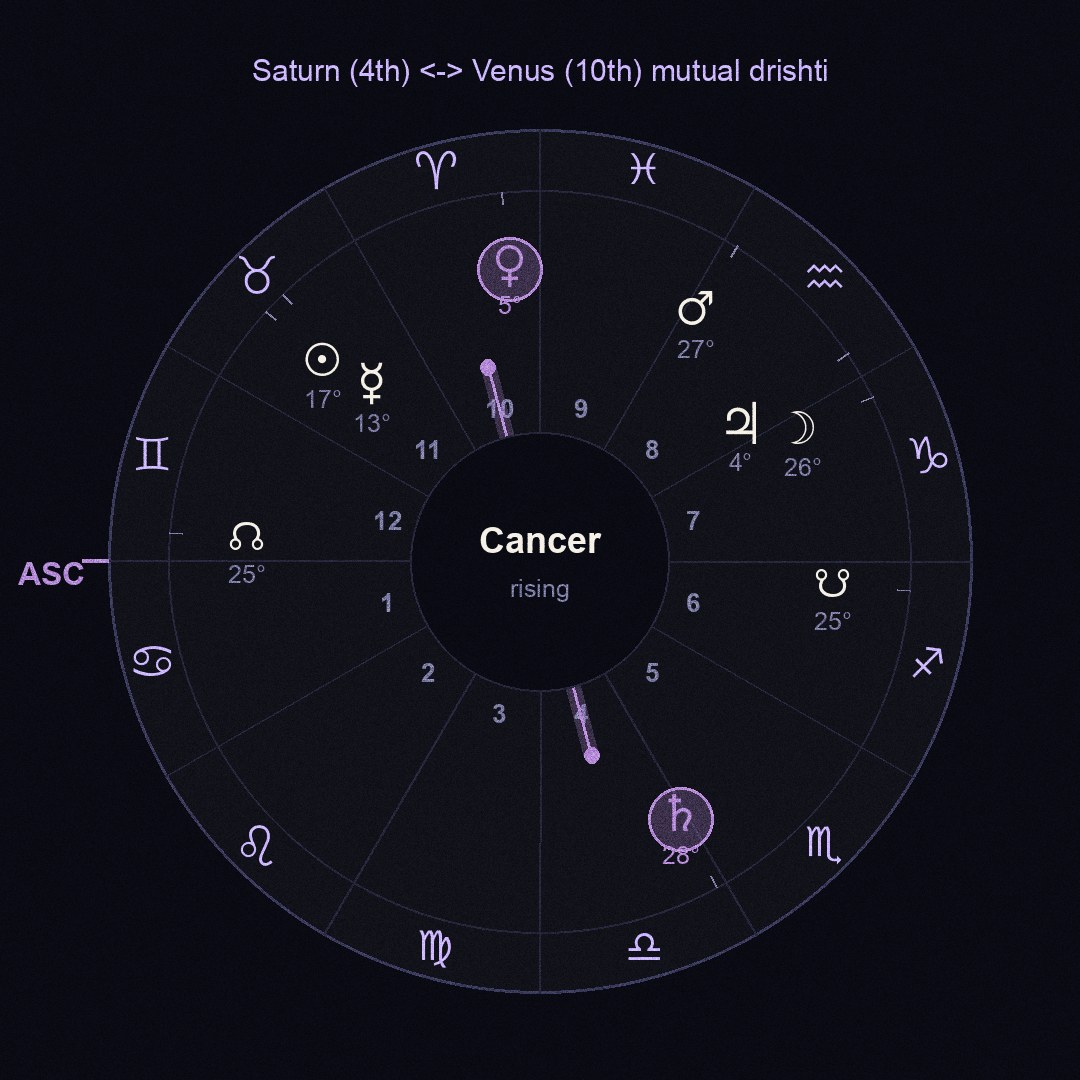
The two heaviest testimonies in the chart stare directly at each other. Exalted retrograde Saturn in the 4th (Libra, the seat of home and heart) and Venus in the 10th (Aries, the seat of career and reputation) stand in mutual full drishti across the 4th–10th axis — Saturn's 7th aspect lands on Venus, Venus's 7th aspect lands back on Saturn. The dossier's graha-to-graha drishti list confirms both directions. So every Venusian gift — art, charm, love, pleasure — is conditioned continuously by Saturnine terms: discipline, delay, duty, endurance, an undertow of melancholy. And because Saturn is retrograde, the restraint is internalized as permanent inward weight rather than only imposed from outside. The significator of the heart sits in the 4th and is built to withhold satisfaction, which is why success in this chart never reads as enough.
VI.The weak center: lagna lord in the 7th, self constituted through the other
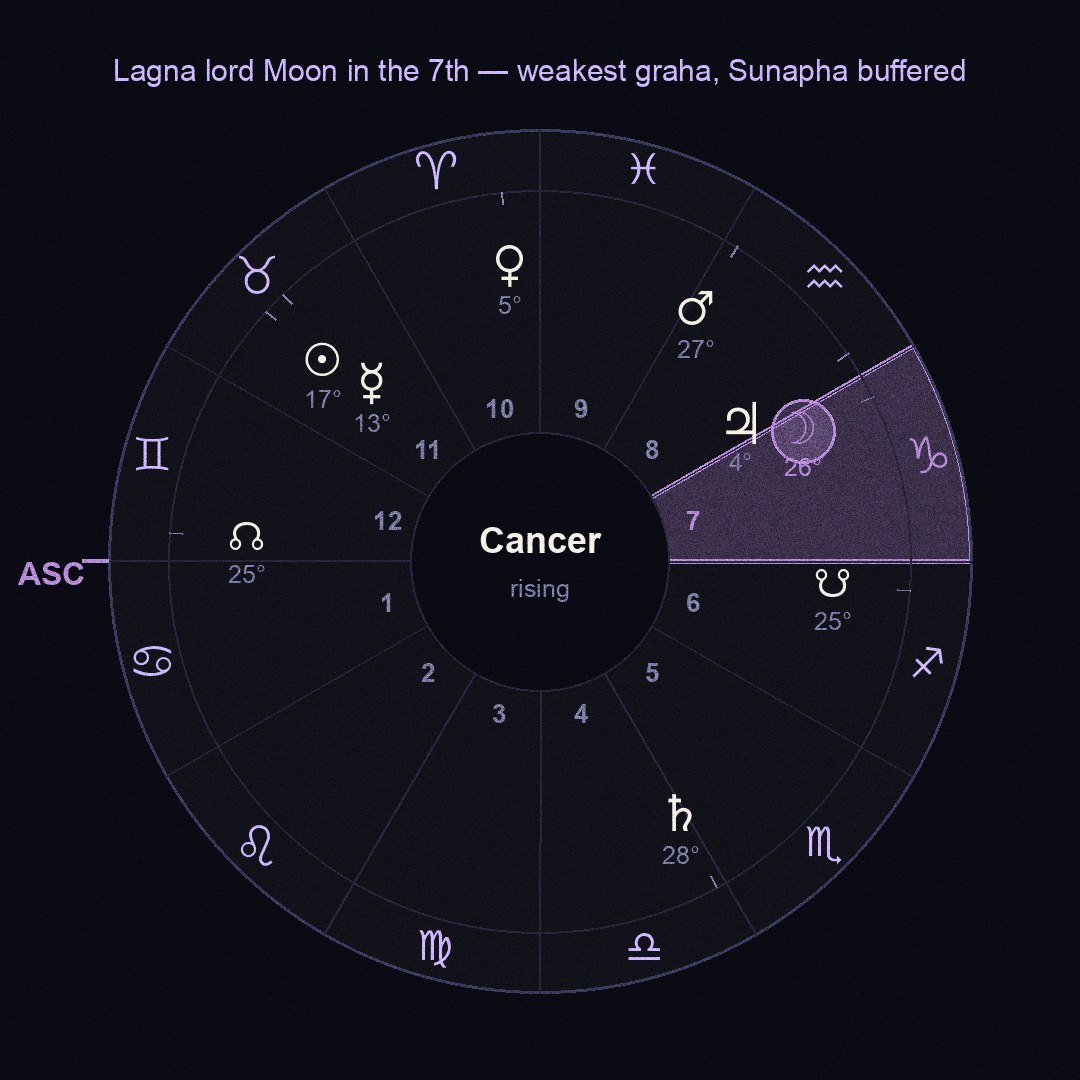
The Moon rules the lagna and is the weakest graha in the chart — ratio 0.72, kaala bala 15.22 (a waning krishna-paksha Moon, 248.65° from the Sun), only 2 bindus on its own sign Capricorn. It sits in the 7th (Capricorn 26°16′, Dhanishta pada 1), so the vehicle of the self is both under-resourced and displaced into the house of the partner and the public — and the lagna itself falls 7th from the Moon, doubling the theme. Identity is not held internally; it is constituted through relationship and through the audience. But this is compensated, not catastrophic: Kemadruma is absent, Sunapha is present (Jupiter and Mars flank the Moon from the 2nd with wealth and ambition), Dhanishta gives the mind a performer's and accumulator's cast, and in the D9 the Moon lifts to Leo — a prouder navamsha heart than the Capricorn cold suggests.
VII.The burned intellect that is vargottama anyway: Budhaditya, combust
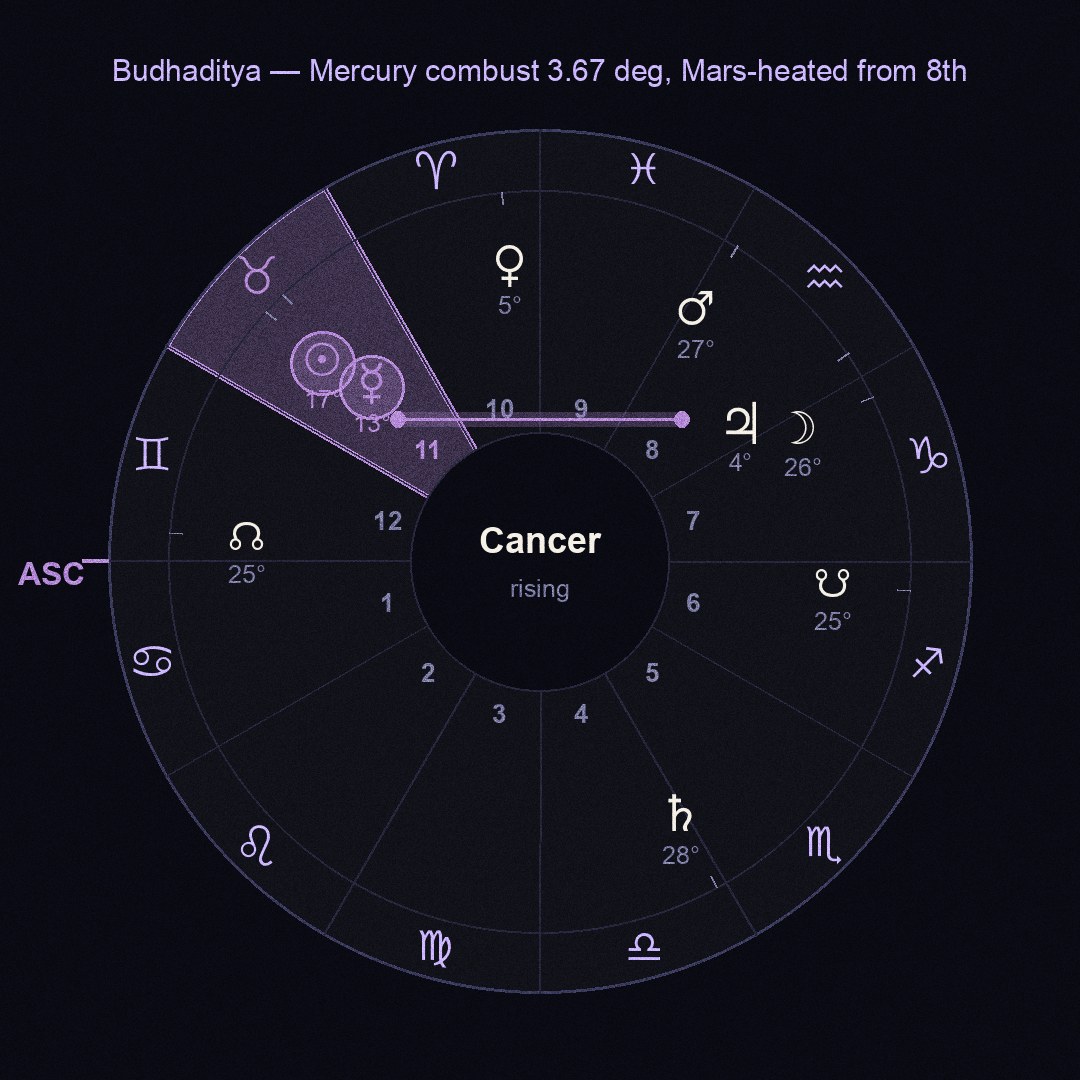
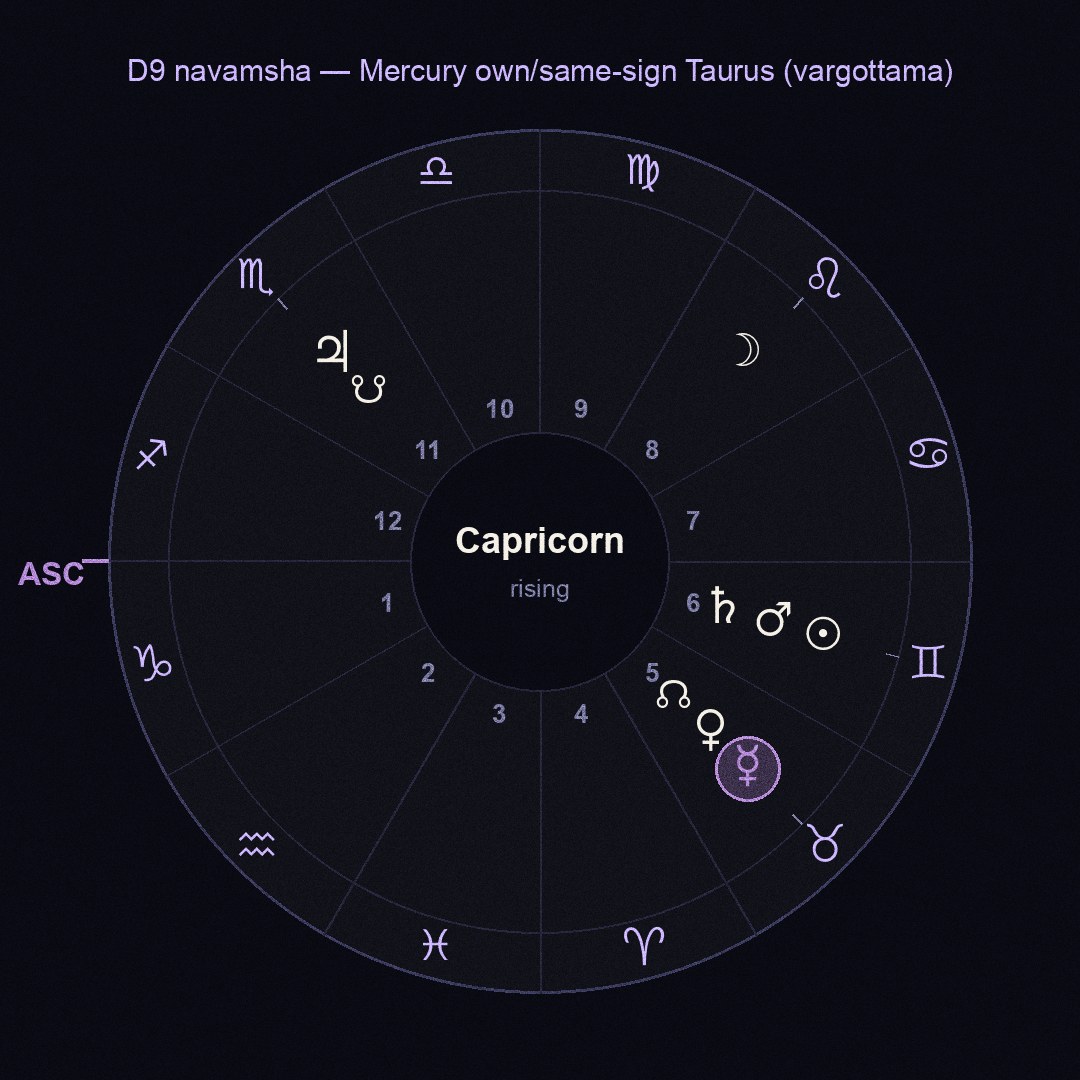
The intelligence yoga and its poison are the same fact. Sun (2nd lord) and Mercury (3rd+12th lord) conjoin in Taurus in the 11th, both in Rohini — that is Budhaditya — but Mercury is combust at 3.67° (inside the 14° limit), and it is below required strength at 0.77. Yet Mercury is the chart's one vargottama graha (Taurus in both D1 and D9), so the intellect is fundamentally sound at the level of destiny while being unable to operate free of the ego it sits on top of. Mars aspects the pair from the 8th (Mars → Sun and Mars → Mercury in the drishti table), heating an already-scorched Mercury further. The result is a genuinely sharp, commercially capable mind (Rohini — beauty, art, sensuality; 11th — gains and network) that is inseparable from the persona and rarely speaks on its own behalf.
The vargottama half is a D9 claim and needs the D9 to show it:
VIII.Ketu in the 6th: the one uncomplicated strength
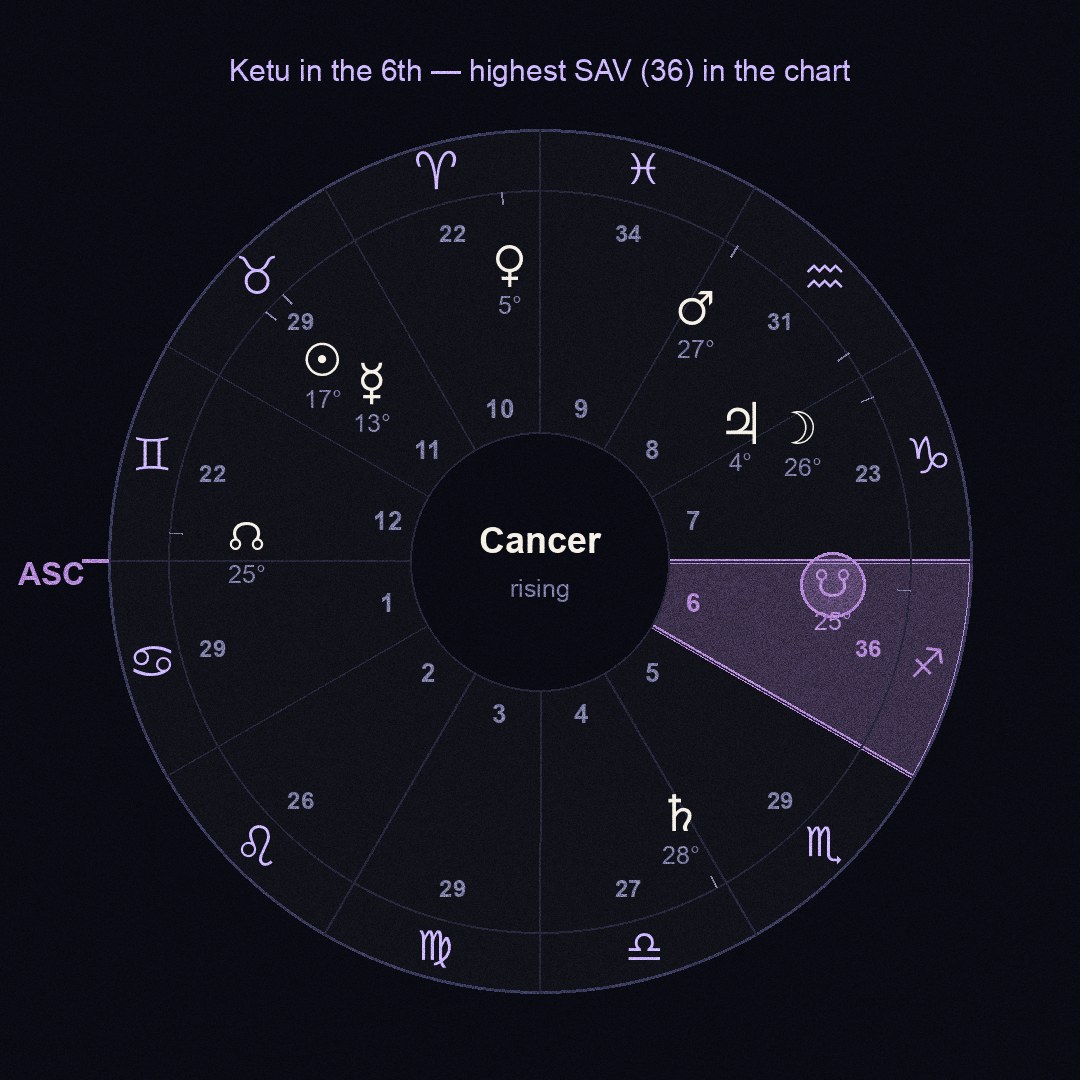
Ketu sits in the 6th (Sagittarius 25°27′, Purva Ashadha), and the 6th sign carries the chart's highest SAV, 36. Detachment placed in the house of enemies, disease and debt, on the best-supplied ground in the chart, is a classic strength: conflicts are won by not clinging, adversity and illness managed through renunciation. This is the cleanest cell in an otherwise doubled chart. The caveat is honest — under the locked conservative posture the nodes carry no dignity and no drishti, so this reads on placement and bindu support, not on nodal aspect.
IX.The progeny axis — the most strained domain, held as terrain
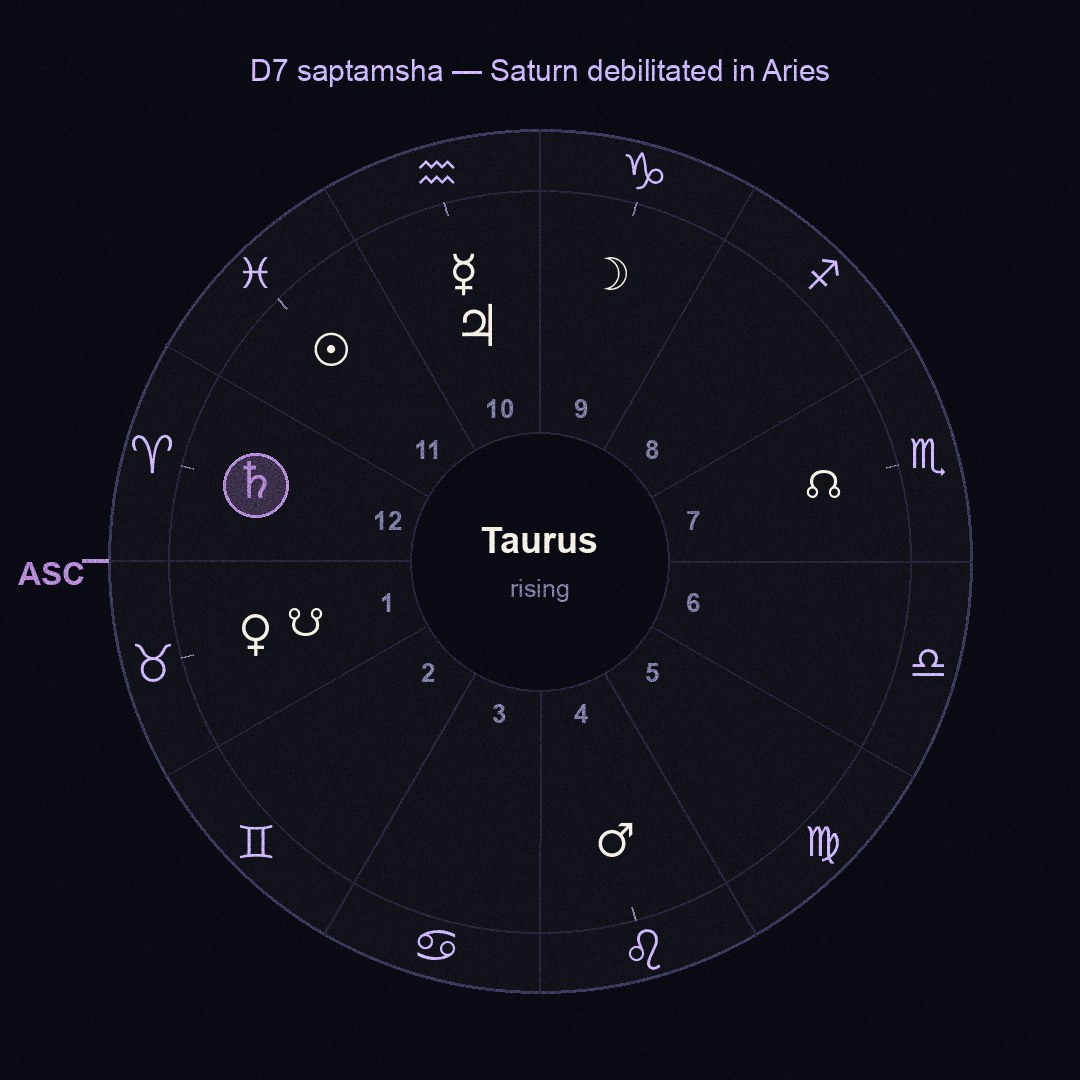
SENSITIVE: The 5th lord Mars and the putra-karaka Jupiter both sit in the 8th (Mars mrita; Jupiter bala band 1/5, enemy dispositor), the 5th house (Scorpio) is empty and receives only the Sun's and combust Mercury's aspects, and the D7 Saturn is debilitated in Aries. Every witness of children loads toward difficulty, delay, loss or transformation — the most consistently strained axis in the chart. It is read strictly as structural burden and caution, never as a sentence of barrenness, and it leans on the D7, which is birth-time-sensitive (here the birth time is stated, so the fence is about the divisional-chart method, not the clock).
X.How the timing layer reads on top of this
The detailed timing reading was provided, so this section reads on top of it rather than reconstructing it.
The load-bearing timing fact is structural, not eventual: neither spine-planet ever got its mahadasha. The dasha sequence is Mars (birth–1931-11-15) · Rahu (1931-11-15–1949-11-15) · Jupiter (1949-11-15–1965-11-15) · Saturn (1965-11-15–1984, unlived) · … · Venus (2008–2028, unlived). The subject died inside the Jupiter chapter. So the natal §5 question — is the felt spine Venus or Saturn — is answered by the clock: neither got its turn. The life ran on infancy-Mars, youth-Rahu, and Jupiter-from-the-8th.
- Rahu mahadasha (1931–1949, age 5–23) — the forming chapter. Rahu in the 12th (Gemini, Punarvasu, Jupiter-lorded and Jupiter-aspected) is Figure G made into eighteen years: the appetite toward the foreign, secluded, imaginative and behind-the-scenes — the dasha under which a public self is manufactured out of image, absence and reinvention.
- Jupiter mahadasha (1949–1965, age 23–39) — the anchored and final chapter. Jupiter is 9th+6th lord operating from the 8th, in bala avastha — Figure 4's raja yoga finally handed a dasha, but delivering fortune through the house of crisis and mortality. The career peak belongs here; so does the ending.
SENSITIVE:the chart routes the fame and the foreshortening through the same 8th-house door.
At the anchor (1955-06-01) the running chain is Jupiter / Mercury / Sun: the 8th-house fortune-lord over the combust vargottama intellect (Figure 7), with the strong 11th-house Sun briefly forward (Su pratyantar 1955-05-16–06-26). The convergent windows the beam commits to, each named to the natal figure it activates:
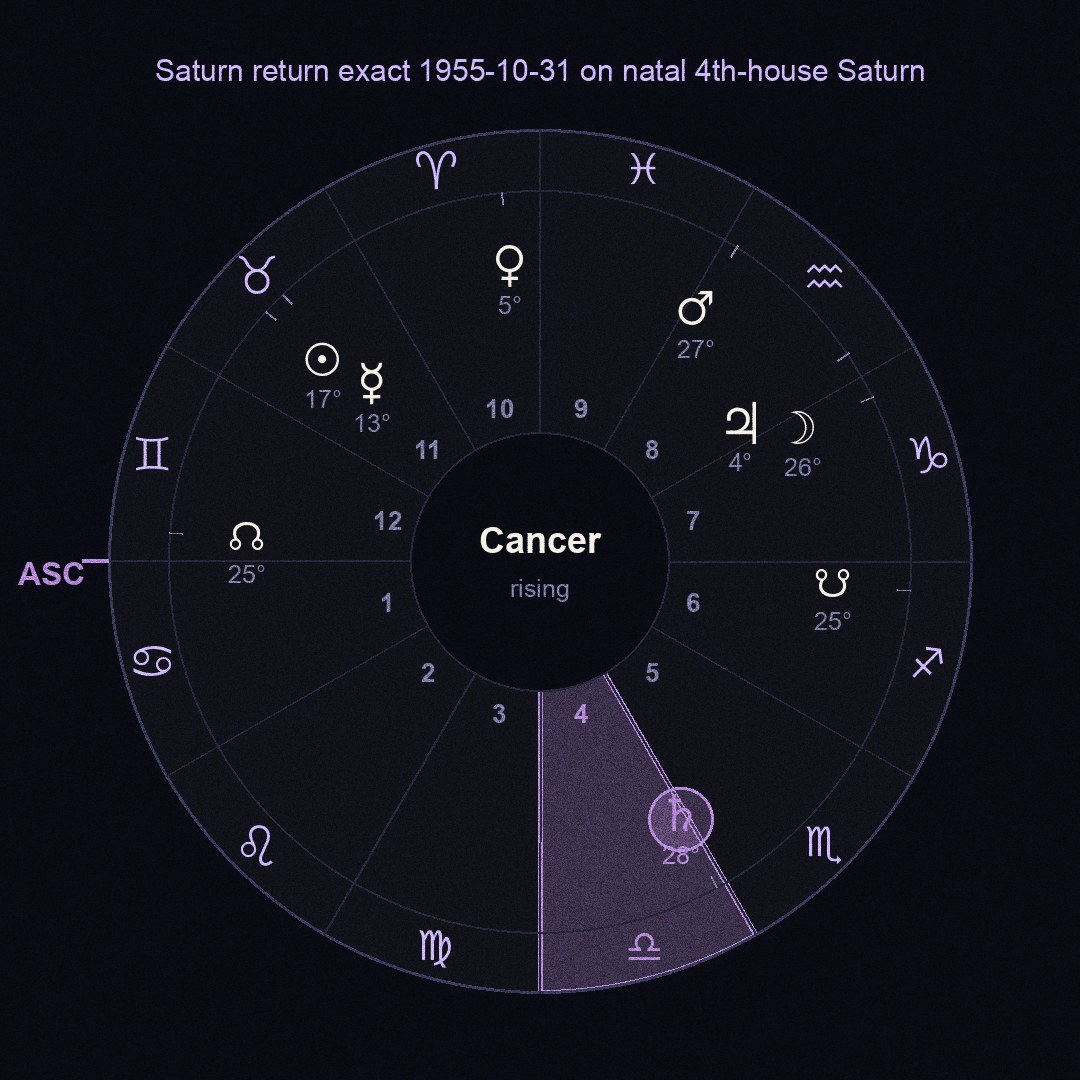
1. Late-1955 "the accounting" (≈09-08 → 11-25). Saturn square natal Moon exact 1955-10-10 + the Saturn return (transit Saturn conjunct natal Saturn) exact 1955-10-31 + Jupiter opposition natal Moon exact 1955-09-12. Touches Figure 6 (the weak Moon, on Capricorn's 2-bindu floor — unsupported ground) and Figure 5 (the atmakaraka Saturn — supported ground, Sasa). The exterior consolidates at the Saturn return while the interior is squeezed on the thinnest cell in the chart.
2. Aug–Sep 1955 "the crossing" (≈08-01 → 09-27). Jupiter conjunct lagna exact 1955-08-15, then opposite natal Moon exact 1955-09-12 — the mahadasha lord personally crossing the self and then the self's fragility, inside a fast-transit storm over the Taurus stellium and the nodal axis.
3. Early 1957 — Rahu conjunct natal Saturn, exact 1957-04-02. The node of illusion over the atmakaraka (Figure 5), re-loading the Saturn-return theme.
4. 1958 onward — sade sati opens (first phase, 12th from Moon, from 1958-02-08), inside the Jupiter/Venus antardasha (1957-09-27–1960-05-28) — the engine's own brightest sub-period meeting Saturn's shadow on the already-weak Moon. Not active at the anchor.
XI.Where the chart forks
The beam carried the pivots with bands; the likelier branch does not erase the other.
- Pivot-1 — what "rise through the 8th" became. Path A — a public/creative career that survives by repeatedly dying and being reborn — very likely; the dasha sequence (Rahu-built image + Venus-in-10th + Jupiter-from-8th) tilts decisively here, 8th-house material showing as career volatility. Path B — a life whose subject-matter is the 8th-house deep/hidden/transformative (research, the occult, work with mortality) — plausible. The distinguishing marker is exactly what the biography shows: is the upheaval in how the work went, or in what it was about.
- Pivot-2 — partnership. Path A — serious, mature, dutiful, public-facing, likely delayed or held to a cold Saturnine standard, whose inner quality (Venus own-sign in D9) is sounder than its outer scaffolding — most likely. Path B — structurally under-supported and may not endure (both significators displaced from the 7th, 7th sign only 23 SAV) — plausible. The natal chart does not settle it; only the D9 dasha activation would, and that was foreclosed by death.
- Pivot-5 — the intellect. Path A — sharp, commercial, fused to the persona, rarely speaking for itself — very likely. Path B — fundamentally sound at the level of destiny (vargottama), surfacing when the ego relaxes — plausible.
XII.Recurring keywords
- 8th-house engine — Mars + Jupiter there, Saturn (8th lord) exalted, Rahu 12th, Harsha Viparita; 31 SAV
- Two below the line — Moon 0.72, Mercury 0.77; the only sub-required grahas = manas + buddhi
- Saturn everywhere on the interior — exalted 4th, aspects lagna, atmakaraka, retrograde
- Public > private — Sun/Venus/Mars/Saturn ≥ 1.00; Moon/Mercury < 1.00
- Thin career floor — 10th sign 22 SAV, 7th sign 23 SAV, under rank-1 significators
- Rohini repeats — Sun + Mercury both Rohini (Moon-lorded, sensual) in the 11th
- Dhanishta / Mars thread — janma nakshatra Dhanishta (lord Mars); Moon + Jupiter in Dhanishta; Mars the yogakaraka
- Own-sign D10 cluster — Venus/Taurus, Mars/Scorpio, Jupiter/Pisces
- Mrita avasthas — Mars and Saturn both "dead" band 5/5; power that fires only under pressure
- Neither spine got its dasha — Venus (2008) and Saturn (1965) chapters both unlived
- Combust + vargottama — Mercury, the same fact twice: burned and sound