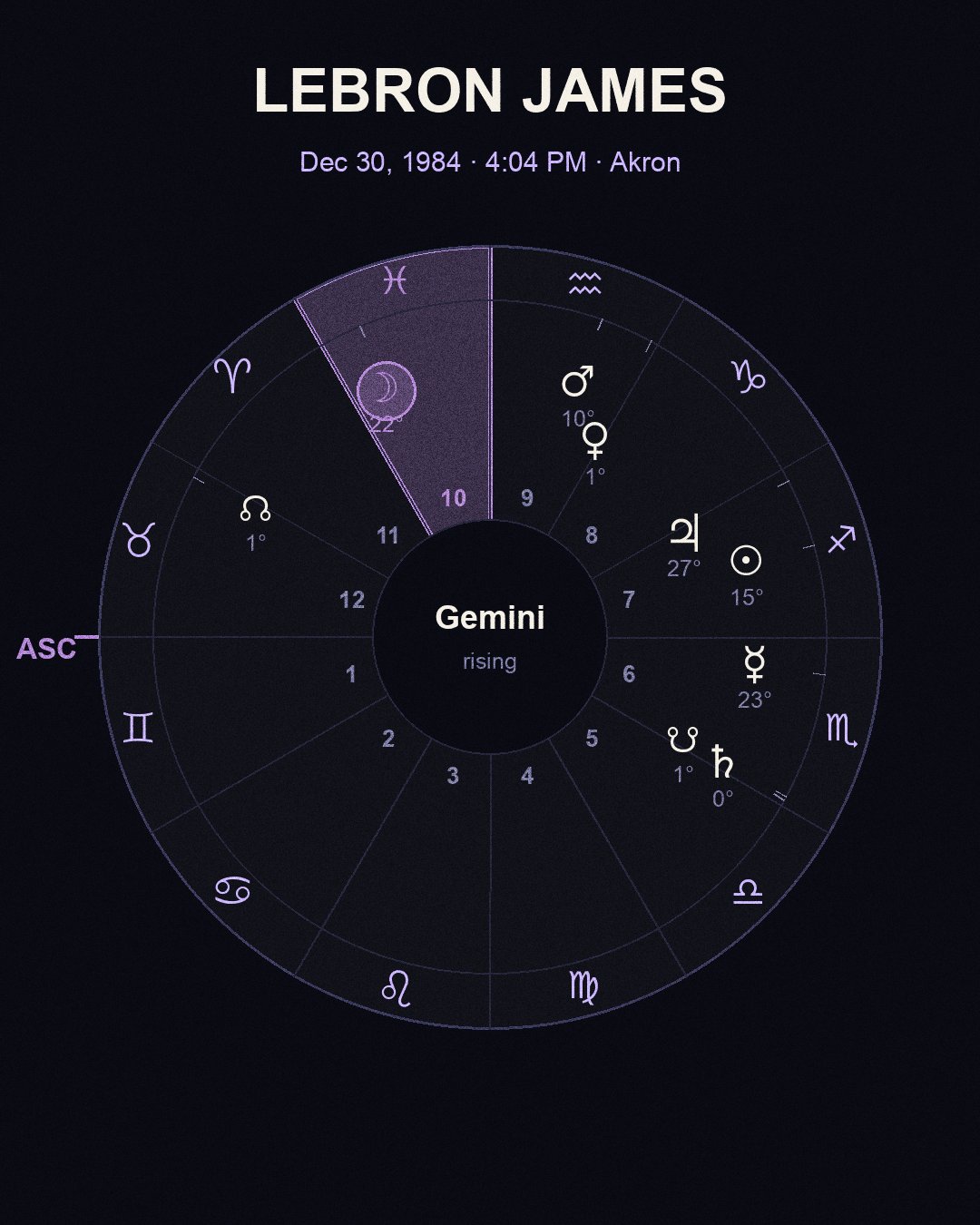

This is a Gemini-rising chart whose center of gravity is not the rising sign at all. The strongest, best-placed graha is the Moon at 22°45′ Pisces in the 10th — highest sthana bala of the seven (230.34) and shadbala 1.09 — and the entire chart reorganises around it in the Chandra-lagna. Set against that engine is a structural weakness that is not decoration: the lagna lord Mercury (23°26′ Scorpio, 6th) is the only graha below its shadbala minimum — ratio 0.90 — so the vehicle the life runs through is the frailest thing in it. The load-bearing tension of the whole chart is a strong mind wired through a strained switchboard, with three grahas piled into a dusthana (the 6th) that, by three separate classical figures, is where the fortune actually gets manufactured.
Birth data · birth-time quality: 1984-12-30 16:04 America/New_York, Akron OH; stated, Rodden AA (birth certificate). The time is robust, so the lagna (2°48′ Gemini), the whole-sign house frame, and every divisional chart below stand on solid ground — but note this is still the one dependency every dated and house-based claim inherits, and I flag it again where it matters.
I.What actually carries weight here
Rank the grahas by the numbers the dossier already computed, not by house-meaning reflex:
- Shadbala ratio (rank): Mars 1.36 (1) > Saturn 1.29 (2) > Venus 1.27 (3) > Sun 1.14 (4) > Jupiter 1.11 (5) > Moon 1.09 (6) > Mercury 0.90 — below minimum, 7 of 7.
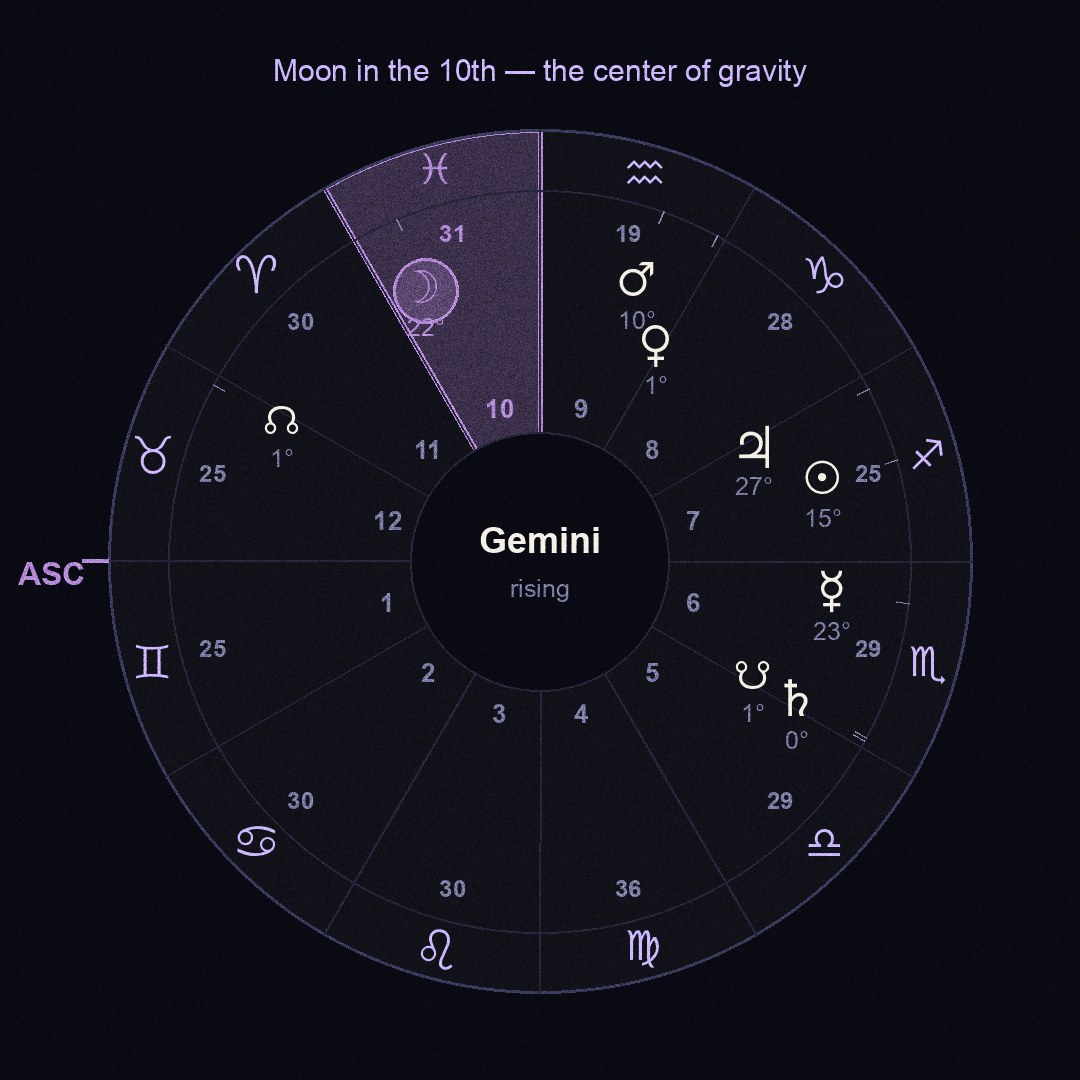
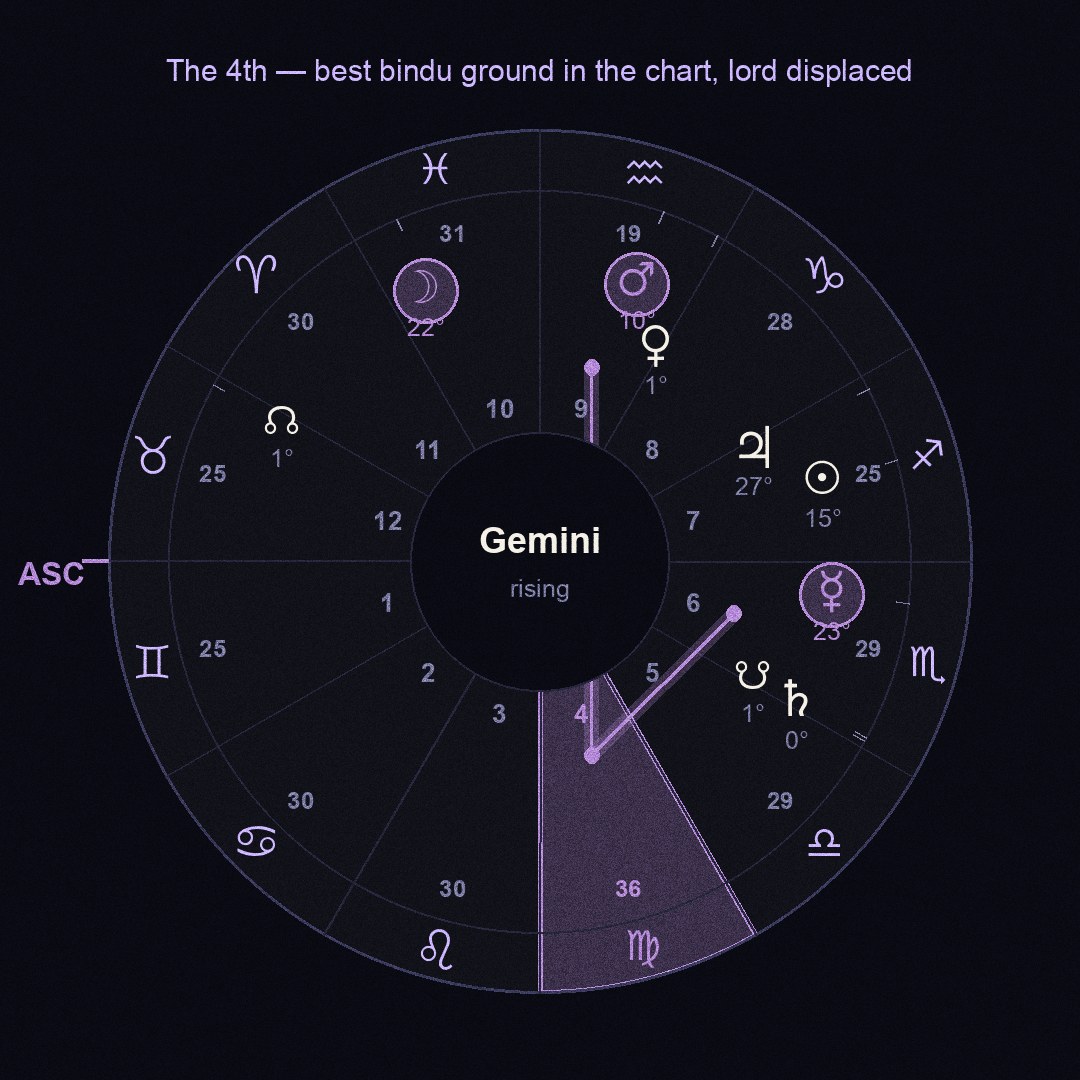
- SAV extremes: Virgo 36 (4th, empty — highest), Pisces 31 (10th, Moon), Scorpio 29 (6th), Sagittarius 25 (7th), Gemini 25 (lagna), Taurus 25 (12th), Aquarius 19 (9th — lowest of all twelve, holds Mars + Venus).
- Dignity / avastha: Jupiter own sign, vargottama, but mrita (5/5); Venus adhimitra and shadbala-strong but bala (1/5 — infant); Saturn mrita (1/5); Mercury in own nakshatra Jyeshtha.
- Dasha ownership: Sun runs the current MD (2021–2027) though it ranks only 4th by strength; the Moon — the center of gravity — does not get its own decade until 2027–2037.
So the chart is run by a cooperating set that is positionally strong but situationally awkward: the Moon carries visibility and mind; Mars, Saturn and Venus (ranks 1–3) all sit in the 6th or 9th — labour houses, none on a lagna angle; and the graha that should be the sturdy instrument, Mercury, is the weakest and exiled to the 6th. What looks decorative and is: the empty 2nd, 3rd, 8th and 11th — their lords' stories are told elsewhere, and no occupant-signal survives ranking there.
II.The life runs on the Moon, not the lagna lord
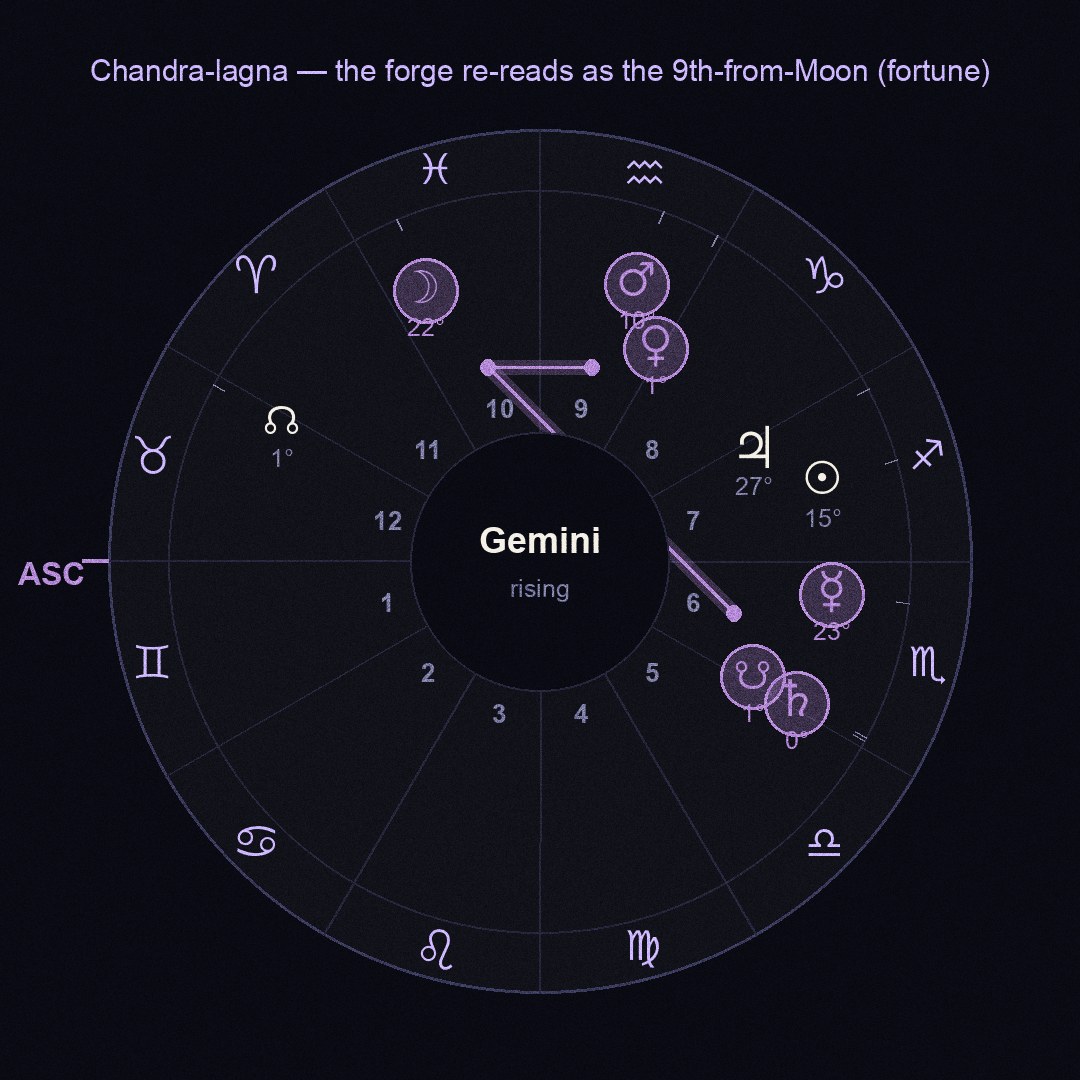
The decisive salience call is that the biography rides the Moon (22°45′ Pisces, 10th), not the lagna lord. Look at what converges: it holds the highest sthana bala of the seven (230.34), clears its minimum (shadbala 1.09), sits on the most public angle of the chart, anchors Gajakesari with Jupiter (Jupiter counts 10th from the Moon), and — the deciding fact — it is the hub of the Chandra-lagna, from which the other grahas cluster into just three occupied houses. That is why the chart reads so loud: almost everything is legible twice, once from the lagna and once from the Moon. The reading this produces is a mind-and-visibility engine — a life carried by mental and emotional intelligence made public (Revati pada 2, gentle/completing/safe-passage; Pisces, empathic and imaginative), not by a robust bodily-egoic "I." The one demur that stays in the claim rather than being averaged away: dig bala is low (14.81), so the Moon is not in its directional best — visibility comes with emotional exposure, a thin skin for how one is perceived.
III.The instrument is the weakest graha in the chart
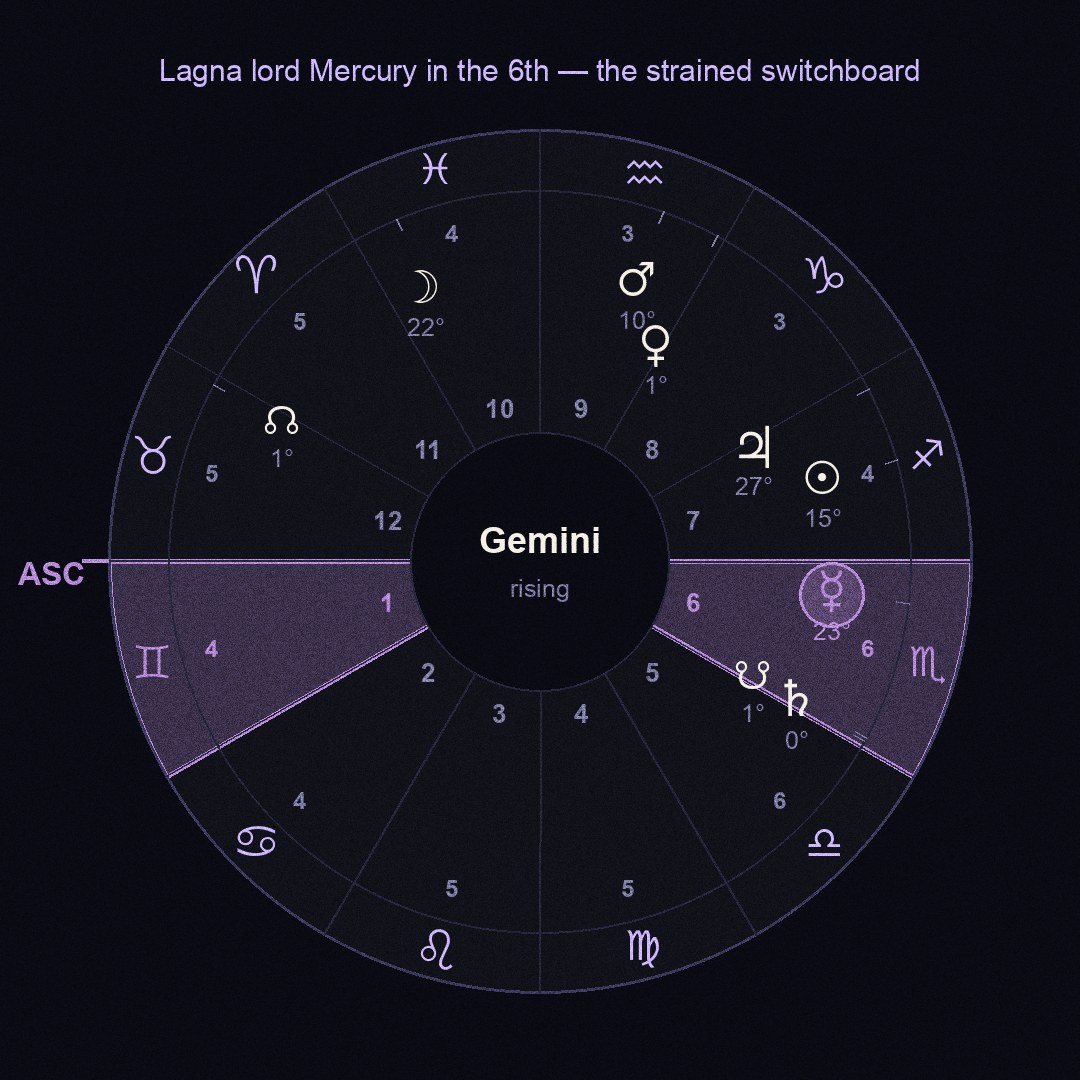
The counter-fact is committed alongside S1, not offered as an alternative to it. The lagna lord Mercury sits at 23°26′ Scorpio in the 6th, shadbala 0.90 — the only sub-minimum graha of the seven. It is the vehicle through which the Moon's gifts have to reach the world, and it is exiled to the dusthana of service, illness and adversary. But the resolution is not incompetence — it is over-commitment: Mercury is in its own nakshatra Jyeshtha (pada 3), it is the busiest graha in the chart (raja-yoga-forming, see below), and the lagna itself is well-witnessed even though its lord is not — both Jupiter and the Sun cast full drishti onto the 1st. The net call the dossier's own contradiction-ledger reaches: capable, senior, relied-upon in public; over-committed and chronically taxed in private — wins under load, frays under sustained load. The private cost (depletion, nerves, health-as-pressure-valve) is SENSITIVE and the chart leaves its dominance open (see the 6th-face fork below); it is loaded, not decreed.
IV.The 6th-house forge: adversity is the arena of the rise
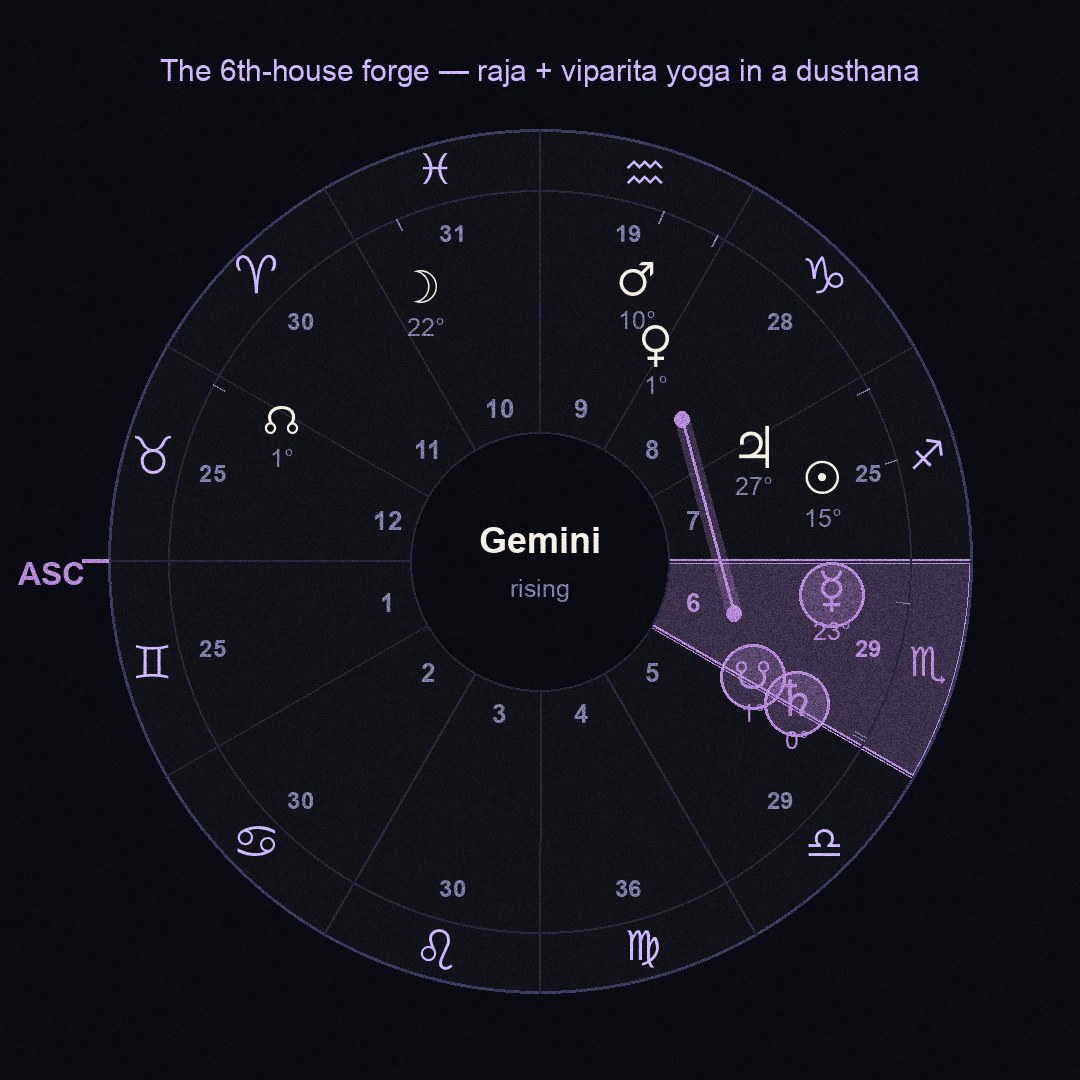
Here is the chart's most counter-intuitive structural fact, and it is where the salience ranking pays off. The single most loaded house is a dusthana — Scorpio 6th holds Ketu, Mercury (23°26′), and Saturn (0°59′) — and it is precisely where the raja-yoga sits. From this one house the dossier detects three independent figures: Kendra-Trikona Raja yoga (Mercury as 1st+4th lord conjunct Saturn as 9th lord — house pairs 1st+9th and 4th+9th, the classic kendra-trikona fusion); Sarala Viparita Raja yoga in its strict form (the 8th lord Saturn placed in the 6th, whose entire logic is that it inverts dusthana into gain); and a leg of the Mars↔Saturn parivartana. Saturn here is rank 2 by strength (1.29) and a functional benefic (8th+9th lord), and Mercury sits in its own Jyeshtha — the exact flavour is seniority earned, hidden mastery, the eldest/protector who carries responsibility others don't see. Ketu in the same sign (Vishakha pada 4) de-personalises and sharpens: the mastery can feel impersonal, driven by something the person can't fully name. The favoured net call — high confidence, because three classical figures plus the lagna-lord placement name the same house — is that this person converts difficulty into standing: crisis-work, forensic depth, service that becomes authority. The affliction-face and litigious-face alternatives are kept open at the biography level (the fork below); the mastery reading itself is committed.
V.The second witness upgrades the forge to fortune
The reason the reading treats the 6th cluster as luck rather than affliction is a genuine second-witness confirmation, not optimism. Reckoning houses from the Moon (Pisces), the same three clusters restack: the 6th-forge cluster (Ketu/Mercury/Saturn) becomes the 9th-from-Moon — dharma and fortune, so the raja-yoga now reads as fortune and Figure A's dusthana harshness softens; the 7th cluster (Jupiter/Sun) becomes the 10th-from-Moon — vocation; and the 9th cluster (Mars/Venus) becomes the 12th-from-Moon, forming Anapha (benefics flanking the Moon on the 12th side, none in the 2nd) — a self-contained, resourceful mind. The finding is that the lived experience of the hard 6th-house material is closer to "this is where my luck and my work are" than "this is where my troubles are." High confidence — it changes the emotional valence of the forge from a second, independent angle.
VI.Vargottama Jupiter: excellent significator, encumbered house-lord
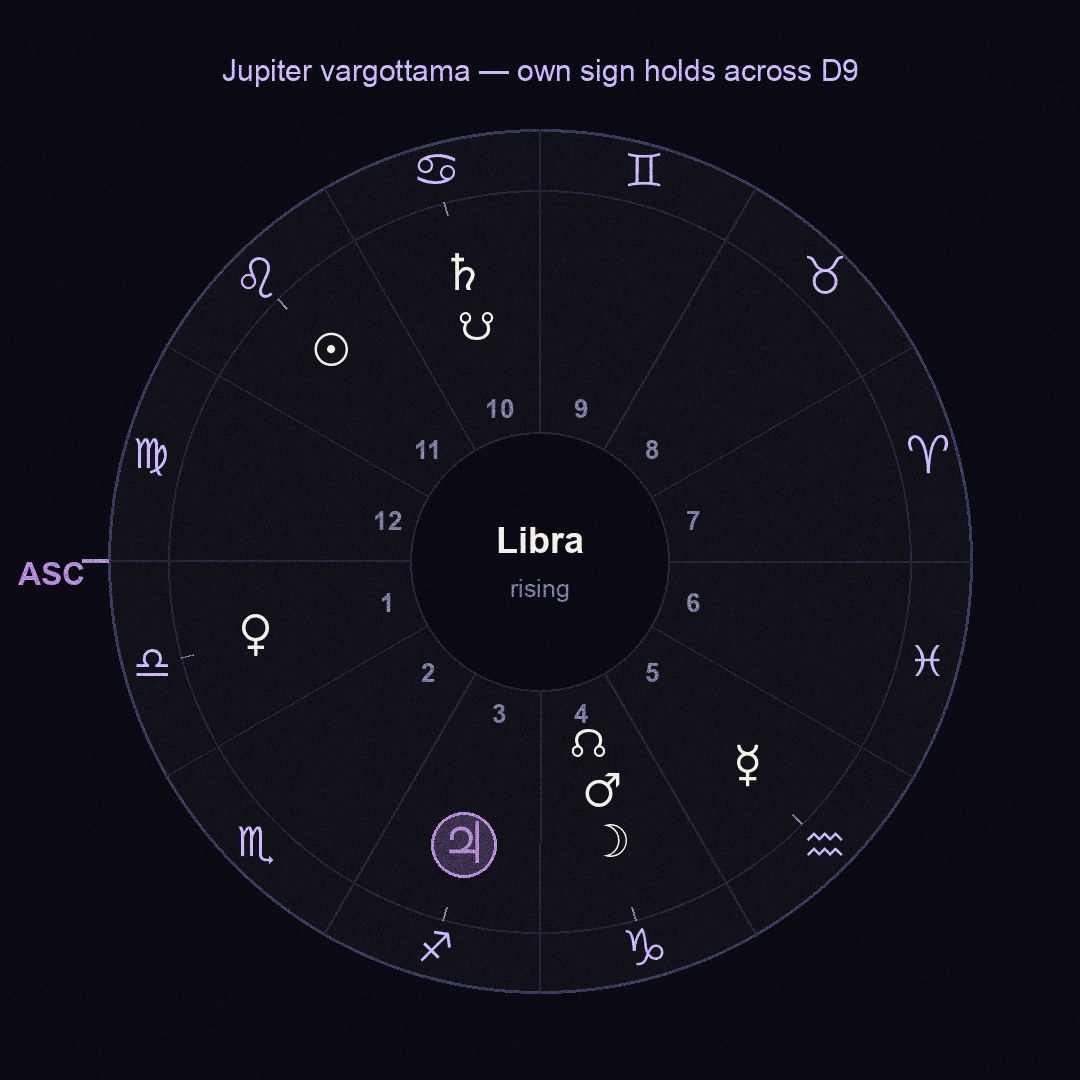
This is the sharpest contradiction in the chart and it lives inside one body — reconciled, not averaged. Jupiter (27°33′ Sagittarius, own sign, the only vargottama graha — D1 Sag = D9 Sag) forms both Hamsa (own sign in a kendra) and Gajakesari, and by dignity it is one of the best things in the chart. Simultaneously it carries kendradhipati dosha (owning two kendras, 7th and 10th, for Gemini lagna), it is a maraka-lord (7th), it sits in mrita avastha (band 5/5 — "dead/old"), and its dig bala is nearly floor (8.25). Both are true on different registers. The net call: wherever Jupiter acts as karaka — wisdom, faith, generosity, dharma, children, the teacher/mentor role — it delivers richly and deepens across the D9 (that is exactly what vargottama means: the promise survives magnification). Wherever it acts as lord of the 7th/10th mechanics — the logistics of marriage and career — it introduces the maraka/dosha drag seen below. The person is genuinely wise and good with those they mentor, whose institutional bonds cost more than their inner wisdom would predict. Because this is a vargottama claim, it is illustrated in the navamsha, not the rasi.
VII.Earned, not given: the Mars–Saturn engine
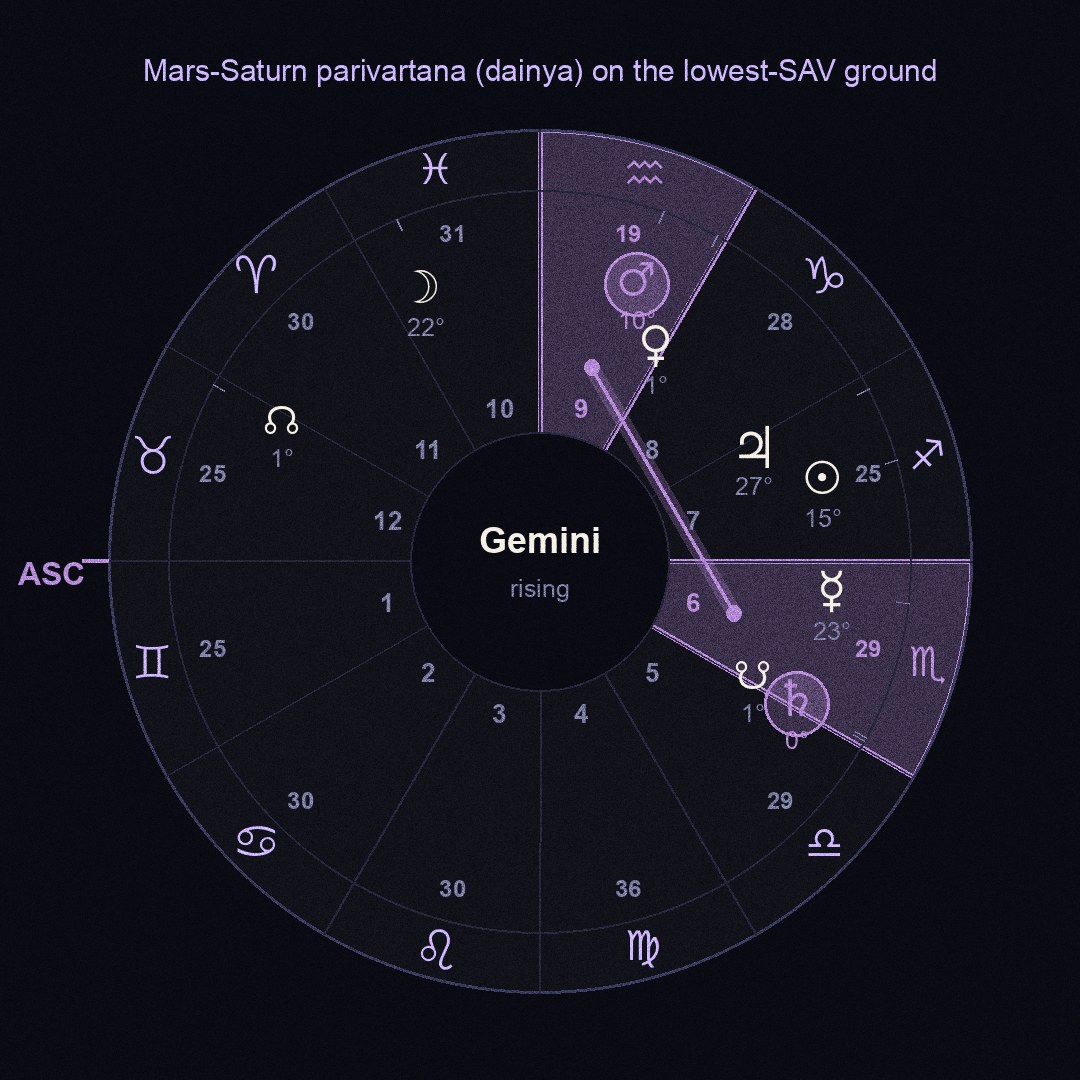
The wealth story is not a windfall story, and the mechanism is precise. The two most muscular grahas — Mars (10°38′ Aquarius, 9th, shadbala 1.36, rank 1) and Saturn (0°59′ Scorpio, 6th, 1.29, rank 2) — are in mutual sign exchange (Parivartana), so each disposits the other and they rise and fall together; the same pair is also a detected Dhana yoga (9th+11th lords). But the parivartana is classified dainya — a dusthana (the 6th) is involved — so its wealth current runs through struggle and obligation. And the ground is thin: Aquarius carries the chart's lowest SAV, 19, of all twelve signs, and Saturn contributes 0 bindus to Aquarius in its own row. So the Dhana yoga is structurally real but poorly resourced: earning power and drive are genuine and self-reinforcing, but express through effort, service and the long grind — money and status are made, repeatedly, from work, and never simply arrive. High confidence on the mechanism; moderate on the "under-resourced" gloss (the bindu-vs-yoga tie is genuine, resolved by weighing SAV as the tie-breaker it is meant to be).
VIII.The over-witnessed partnership 7th: high value, low ease
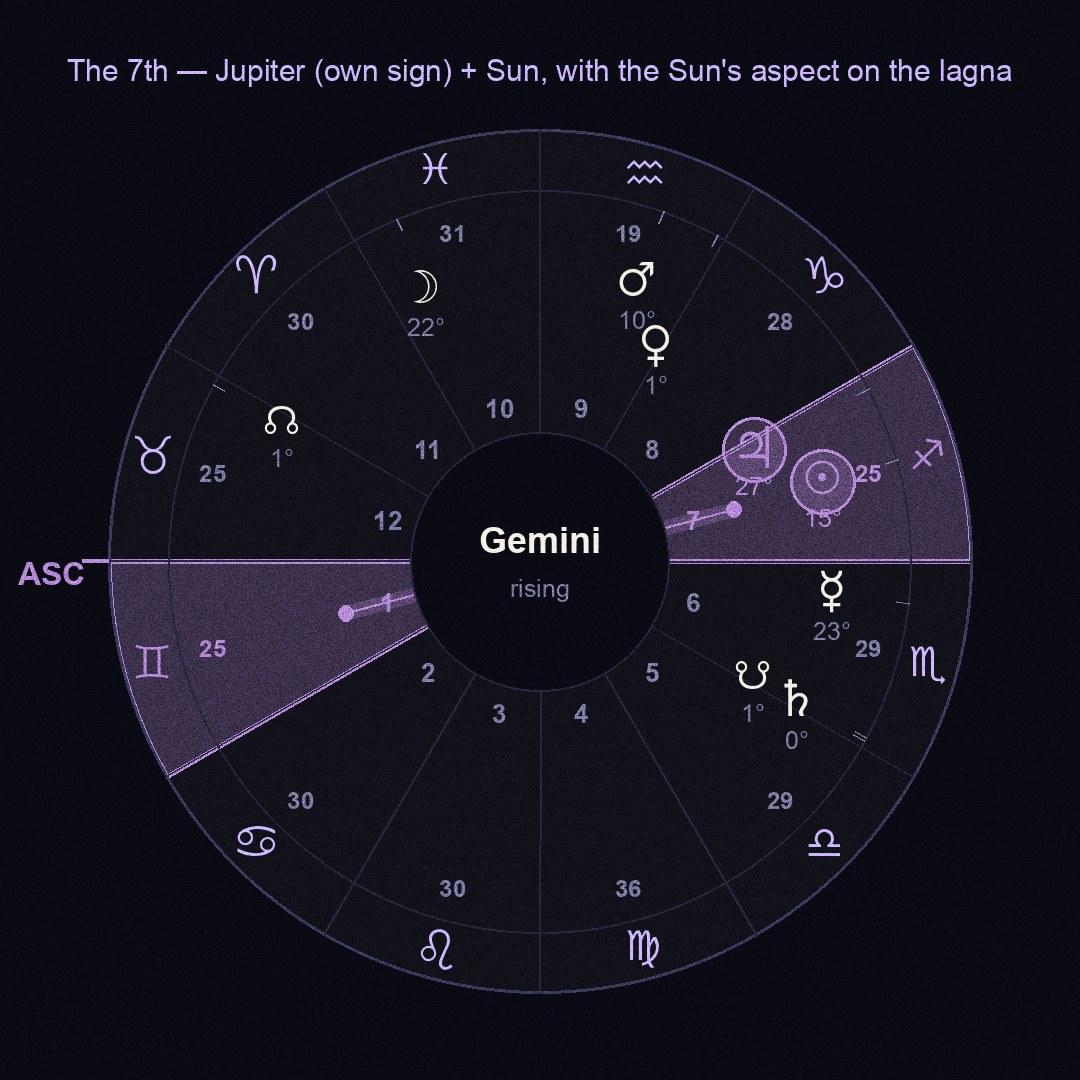
Partnership is testified three times and each fights the next — which is the finding, not a failure to reach one. The 7th (Sagittarius) holds Jupiter (27°33′, own sign, vargottama) and the Sun (15°44′). Jupiter as spouse-significator-in-the-7th is superb by dignity, but it is the same Jupiter carrying kendradhipati dosha + maraka-lordship + mrita avastha. The Sun is the 3rd lord (functional malefic) in the maraka 7th, adding ego, separateness and heat to close union — and it throws its full drishti back onto the lagna, keeping a self-vs-partner strain live. The natural karaka Venus (1°27′ Aquarius, 9th) is dignified and strong by shadbala (1.27, adhimitra) but in bala avastha (band 1/5 — infant) — great in kind, immature in timing. Sagittarius SAV 25 (below the 28 mean) quietly agrees the house is under-supported. The net call: one significant, philosophically-serious union that has to be chosen and maintained and ripens late, not one that simply arrives young. The quality is high and the ease is low — those are not contradictory; together they are the reading.
IX.Home: excellent base, tending pulled away
The 4th (Virgo) is empty but carries the highest SAV in the chart, 36 — the house-ground is excellent — yet its testimonies point elsewhere. Its lord is Mercury, exiled to the weak 6th; the karaka Moon is up in the 10th, out in public and away from home; and Mars aspects the 4th (its 4th-from-itself drishti — friction). So the latent capacity for home and property is genuinely there, but the home life is displaced by career and disturbed by Mars: the base is good, the tending of it is pulled away. Mother (Moon-karaka) reads as prominent and public-facing, with the Mars aspect adding tension. Significant, moderate confidence — this rests on karaka and drishti logic more than on a hard yoga.
X.The nodal axis (held as terrain, not decreed)
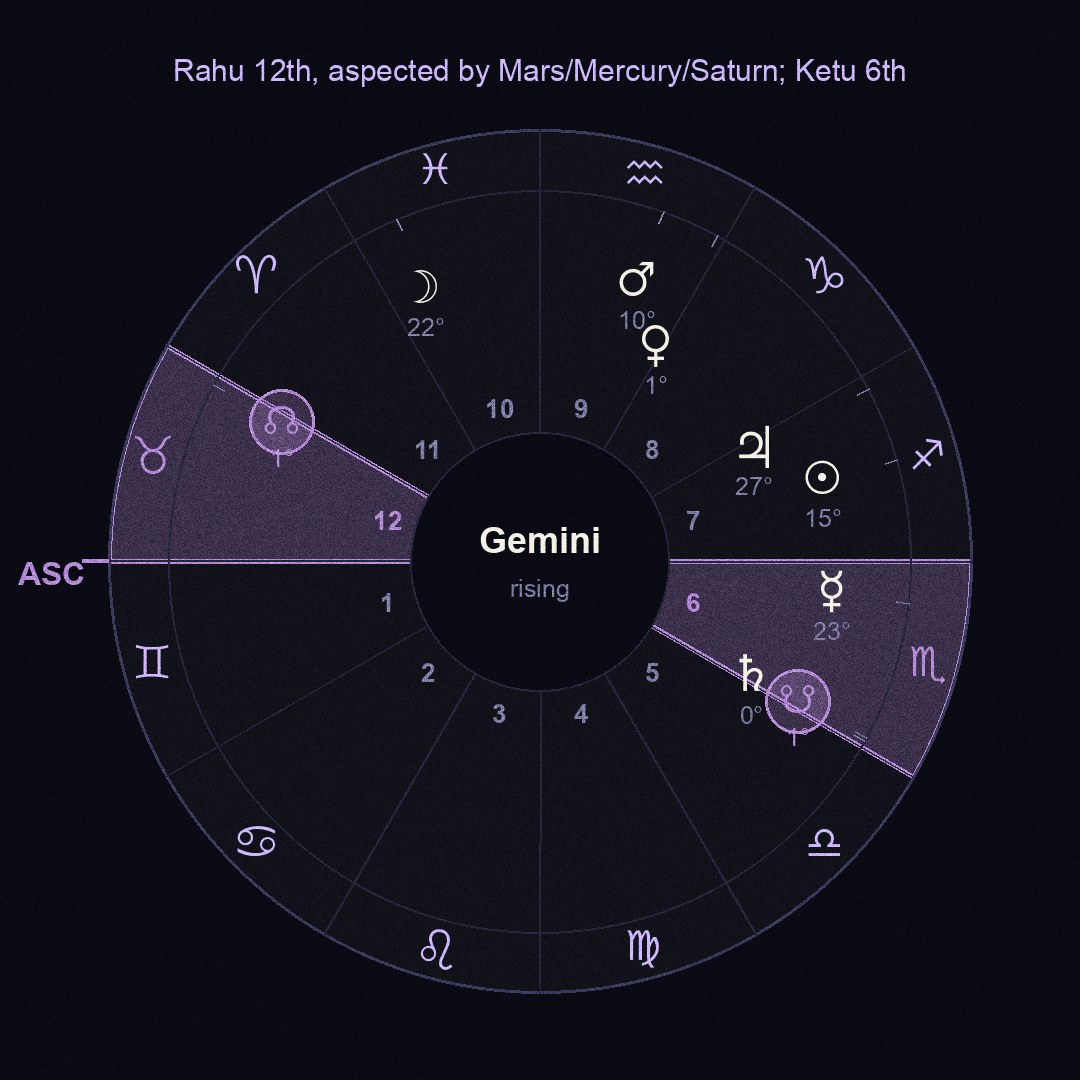
Under the locked conservative-BPHS posture the nodes carry placement, nakshatra and dasha-role only — no ownership, dignity or drishti — so this stays terrain. Rahu (1°34′ Taurus, 12th, retrograde, Krittika pada 2) sits in the house of expenditure, foreign lands, seclusion and moksha, and although it casts no drishti it receives three: Mars, Mercury AND Saturn all aspect Rahu. So the 12th-house appetites are constantly worked on — disciplined by Saturn, questioned by Mercury, energised by Mars — rather than left to run. Ketu (1°34′ Scorpio, 6th) refines the forge with a renunciate, "not-for-myself" edge in daily work. The detected Kala Sarpa is explicitly exploratory only, never a headline — it is absent from BPHS/Brihat Jataka/Saravali, and Mercury & Saturn share a node sign, breaking it in strict degree-based schools. Moderate confidence, deliberately fenced.
XI.How the timing layer reads on top of this
The detailed timing reading is among the inputs, so this section reads the dated machinery directly rather than reconstructing it.
The vimshottari sequence hands the life to a different figure each chapter, and the shape is specific: the chart delivers its power late. The Mercury MD (birth–1994-03-26, ages 0–9) ran the weakest graha, the switchboard, from inside the forge — and it never gets another turn in the working life. The Ketu MD (1994–2001, ages 9–16) ran the de-personalising node inside the 6th cluster. The Venus MD (2001–2021, ages 16–36) — twenty years — ran the marriage/pleasure/creative karaka that is dignified (shadbala 1.27) but bala avastha, so the prediction is that love, creativity and fortune-building (Venus in the 9th with Mars, Dhana) matured toward the tail of the span, not its opening — a first major partnership most plausibly stabilising in the late 20s / early-mid 30s, and the Venusian goods assembled slowly rather than handed over.
The current Sun MD (2021-03-26 – 2027-03-26, ages 36–42) is run by the 3rd lord (functional malefic) in the maraka 7th aspecting the lagna: a visibility-and-authority chapter bought with effort, self projected against the field of the other. Its late antardashas, which the reference window catches, activate the structural figures in turn: Sun/Saturn (2024-01-31 – 2025-01-12) lit the 6th-forge viparita "gain-through-difficulty" mechanism under sade sati's opening; Sun/Mercury (2025-01-12 – 2025-11-18) lit the switchboard itself — the competence/seniority payoff as its public face, the depletion/health risk as its private cost (SENSITIVE); Sun/Ketu (2025-11-18 – 2026-03-26) a short cutting close-off; and the current Sun/Venus (2026-03-26 – 2027-03-26) — the MD's final AD — lights the marriage karaka and the 9th-house fortune ground at once. At the reference date the chain sits in the Mars pratyantar (2026-07-14 – 2026-08-04), the Figure-6 engine, exactly on the window's edge.
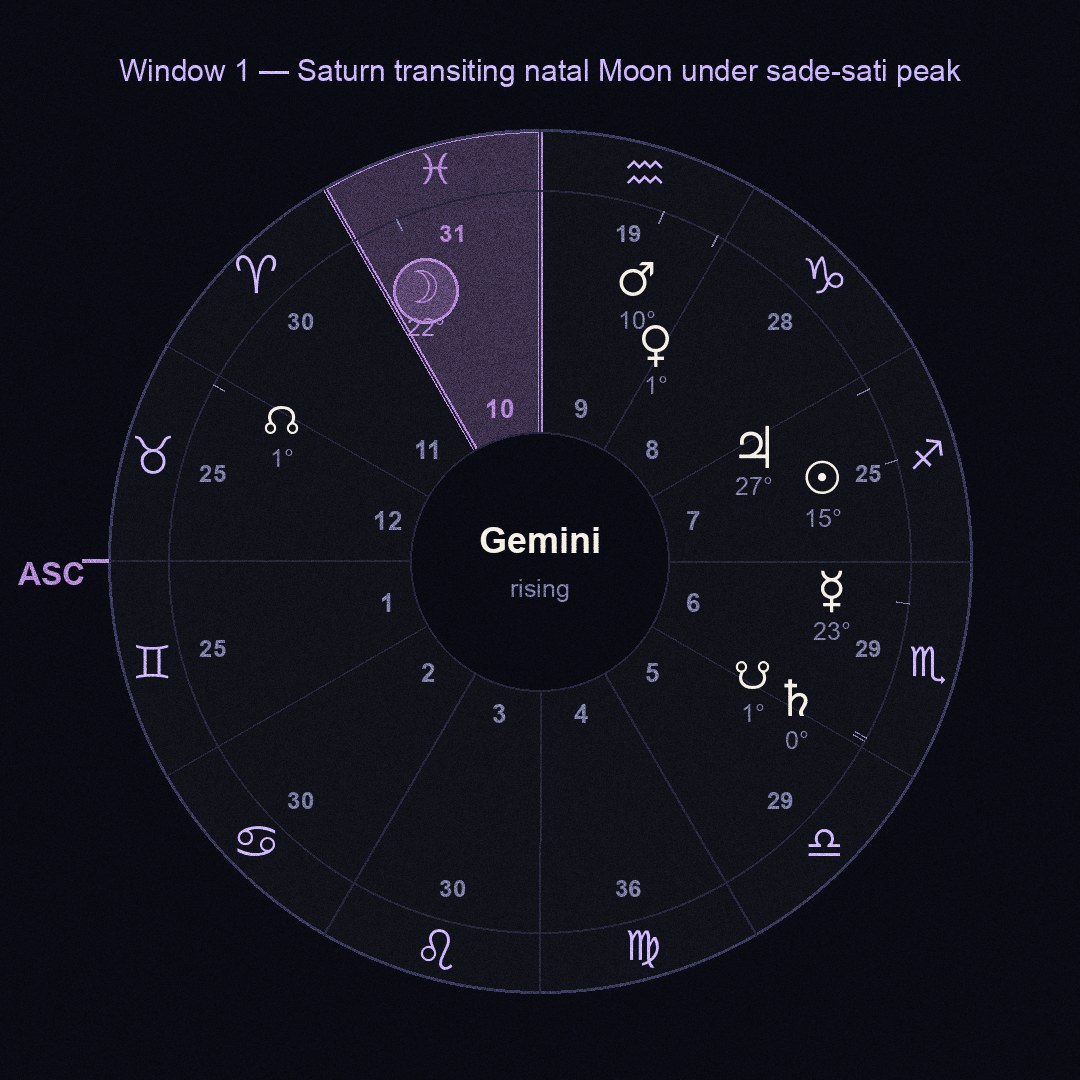
The transits activating this are the heaviest of the window. Sade sati is in its peak 1st-from-Moon phase (2025-03-29 – 2027-06-02), and Saturn transits conjunct the natal Moon (2026-06-26 – 2026-08-26) — Saturn bearing down on the center of gravity (Figure 1), the single heaviest transit here, but on supported ground (Pisces SAV 31), so it reads as a weight-bearing maturation pass, not a defeat. Saturn squares the natal Sun (exact 2026-05-08, second window 2026-09-12 – 2027-02-28), pressing the current MD lord through the whole back half of its chapter. Rahu conjunct / Ketu opposite natal Venus (2026-09-12 – 2027-01-03, exact 2026-11-08) falls inside Sun/Venus, amplifying the bala-avastha marriage karaka, while Jupiter opposes natal Venus (two passes, exact 2026-11-13 and 2027-01-11) — a benevolent-but-oppositional testimony stacking on the same axis. Jupiter transits the 5th-from-Moon (Cancer, 2026-06-01 – 2026-10-31), loading the children/creative-5th theme concurrently. The fast storm of late July–early September 2026 (Mars conjunct the lagna exact 2026-08-06, dense runs over the 6th cluster) is real structure but fast and local — texture, not a chapter-mover, and flagged so it is not over-weighted.
XII.Where the chart forks
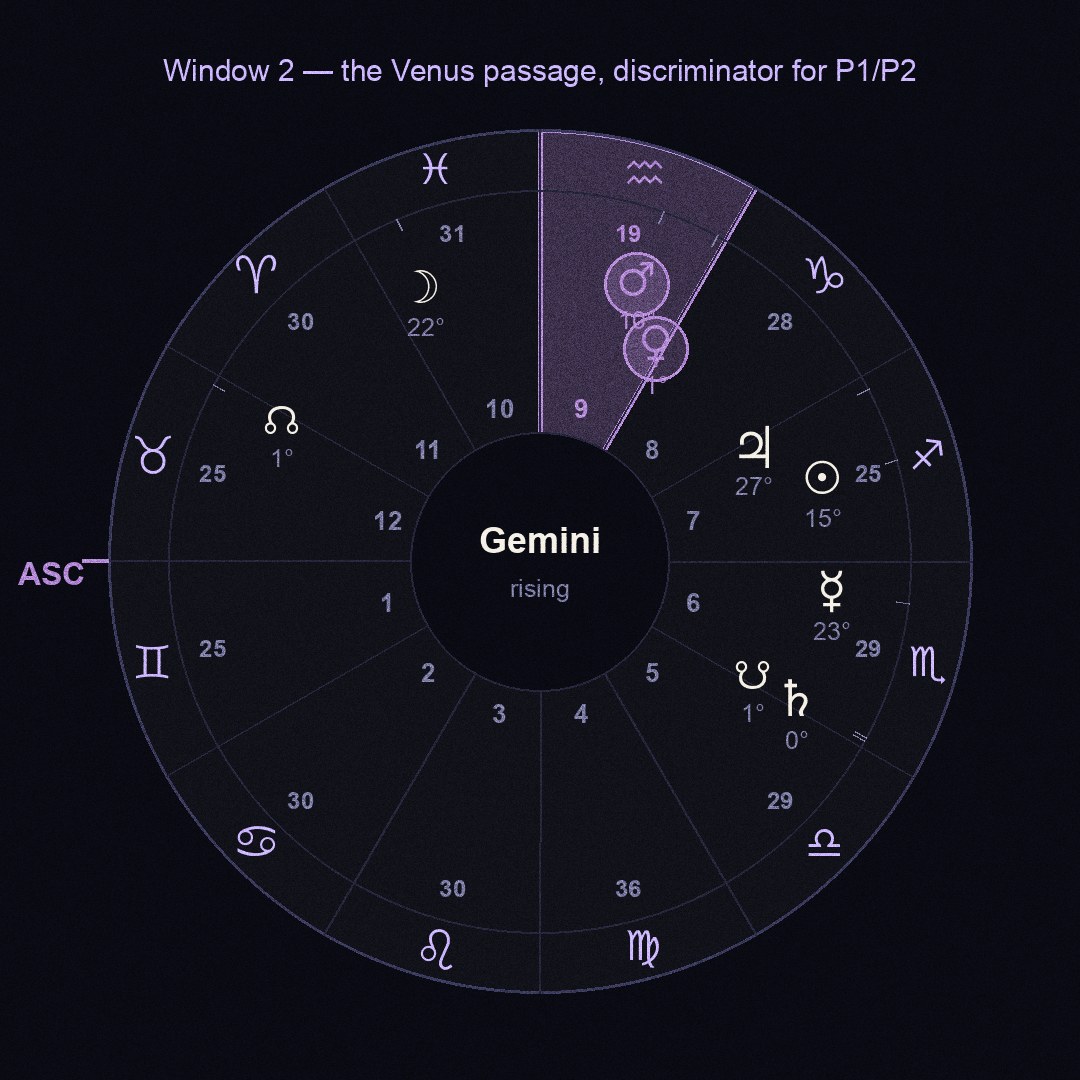
The beam carried four pivots; two are structural and genuinely open, and the report and timing reading route both to the same discriminator — Window 2, mid-September 2026 to early February 2027.
Pivot P1 — is the promised fortune delayed, or merely effortful? (structural, moderate confidence — a yoga-vs-SAV tie). Path A (most likely): fortune is real but chronically effortful — repeated cycles of hard-won accumulation, luck running cold precisely in the house of luck, "I have to keep making it"; witnesses are the Mars↔Saturn dainya parivartana, the strongest grahas all in labour houses, and the Dhana yoga's structural reality. Path B (plausible): not merely effortful but structurally delayed — the promise pays late, by years not months; witnesses are Aquarius SAV 19 read as the tie-breaker it is meant to be, and Venus's bala avastha as late-ripening. The degree is not settleable natally; the timing reading dates the discriminator to the 8 November 2026 amplification on Venus, inside Window 2, and leans toward deferral because that hit lands on the chart's most starved ground.
Pivot P2 — what is the shape of the significant partnership? (significant, moderate-high). Path A (very likely): one philosophically-serious union that must be chosen and maintained, ripening late — high value, low ease, most plausibly stabilised in the later Venus chapter. Path B (plausible): partnership becomes the organising axis of the coming decade rather than one strand among vocation — witnessed by the Sun-in-7th running the current MD and the Venus passage bringing the whole partnership finding to a head. Window 2 is the named discriminator; Path B here tilts the biography toward the partnership-defined shape.
Pivot P3 — which face of the 6th dominates? (structural, SENSITIVE). Path A (most likely): mastery-through-service ascendant, the health/obligation face staying background. Path B (possible): the affliction face extracts its price as chronic low-grade health/obligation friction — the switchboard's private cost, loaded (not decided) by the Sun/Mercury AD and sade sati through ~2029. Path C (possible): a litigious/combative "always a battle" texture. Discriminated only by lived timing.
Pivot P4 — children / the 5th (significant, SENSITIVE): the committed frame is "delayed or deliberate, not denied" — 5th lord Venus in bala avastha, karaka Jupiter vargottama-strong but mrita. Jupiter through the 5th-from-Moon and the nodes/Jupiter on Venus load the theme in late 2026 but attach no date; do not let the reading manufacture timing the synthesis withheld.
The three named windows the timing layer commits: Window 1 (2026-06-26 – 2026-08-26, the Saturn-on-Moon consolidation, Figure 10); Window 2 (2026-09-12 – 2027-02-06, the decide-and-commit Venus passage that resolves P1, P2 and thread T4 — with the benefic peak roughly 28 Sept – 31 Oct 2026, after which Jupiter changes signs and turns oppositional); and Window 3 (the 2027-03-26 handover into the Moon MD, ignition around 2027-04-02 under Saturn crossing the Moon again). The handover itself forks: elevation (the center-of-gravity engine finally gets its decade) vs attrition (it turns on frayed, under sade-sati weight), with the branch set by whether the 2024–2026 forge-work was converted into durable structure or merely endured.
XIII.Recurring keywords
- 6th-house loading — 3 grahas (Ketu, Mercury, Saturn), the chart's densest house
- labour-house concentration — ranks 1–3 (Mars, Saturn, Venus) all in 6th/9th, none on a lagna angle
- Mercury under strain — only sub-minimum graha (0.90), yet busiest and raja-yoga-forming
- Jupiter as dispositor/witness — disposits Sun & Moon, aspects lagna, vargottama, karaka-strong
- effort-over-luck — dainya parivartana + Dhana yoga + 9th at SAV 19 (lowest)
- late-ripening — Venus bala (1/5), Jupiter mrita (5/5), Saturn mrita (1/5)
- Saturn on the Moon — sade-sati peak 2025–2027, transit conj natal Moon twice
- mind-made-public — Moon 10th (SAV 31) + Gajakesari + Chandra-lagna hub
- self-vs-partner — Sun (3rd malefic) in 7th aspecting lagna, current MD lord
- nodes worked-on — Rahu (12th) receives Mars + Mercury + Saturn drishti
- empty-but-supported — 4th at SAV 36 (highest), lord displaced to 6th
- chapters arrive late — engine (Moon) MD 2027–2037; strongest graha (Mars) MD 2037–2044