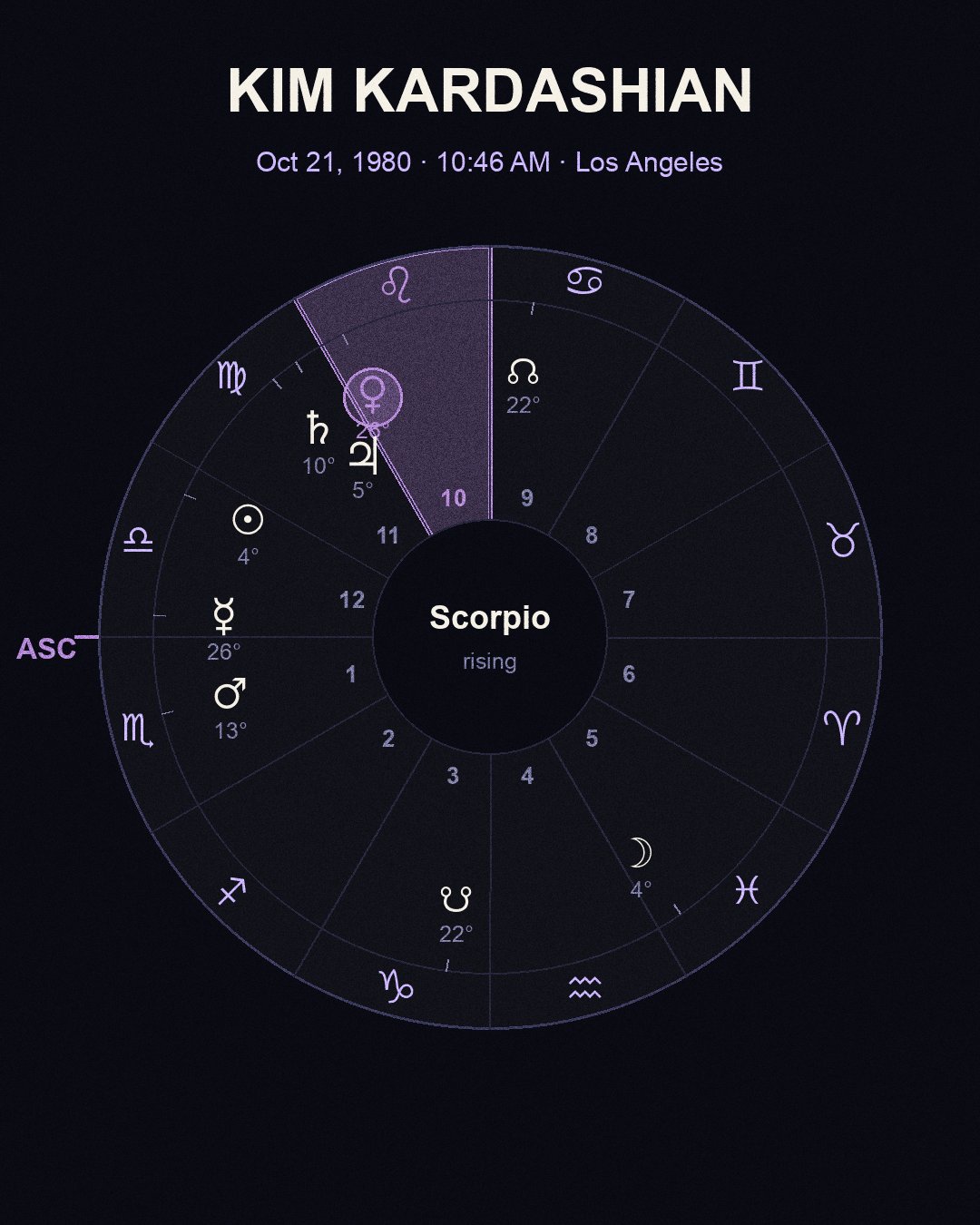
This chart is unusually easy to read at the top and unusually tangled underneath. One placement runs everything you see on the surface — Mars in its own sign Scorpio, on the ascendant, forming Ruchaka mahapurusha yoga (shadbala ratio 1.34, joint-highest, yuva avastha, own-sign, in a kendra: strong on every axis at once). That is the body and the will, and it is clean. Everything that carries strain routes through two places instead: the 12th house (debilitated Sun + Mercury, the chart's lowest SAV at 18 bindus) and the weight Saturn puts on the Moon (the single strongest graha by raw shadbala, 8.03 rupas / 1.34, but in mrita avastha, drik bala −1.48, Kemadruma, Saturn-aspected). So the shape is a strong body carrying a strong-but-bruised mind, with the self-worth significator submerged in the house of loss.
Birth data · birth-time quality: 1980-10-21 10:46 America/Los_Angeles (17:46 UTC), Los Angeles; stated, from a birth certificate (Rodden AA). Time is clean, so the lagna (Scorpio 20°09′), the whole-sign houses, and the D9/D10 divisional claims below are all on firm ground — no fence needed for house- or varga-dependent statements.
I.What actually carries weight here
Ranked by the dossier's own numbers, not impression:
- Mars — ratio 1.34 (joint rank 1 by ratio), own sign, 1st house, Ruchaka, yuva. The one over-determined placement, and it repeats in D10 (own-sign Scorpio again). This runs the chart.
- The Moon — highest raw shadbala (8.03 rupas), holds the janma nakshatra (Uttara Bhadrapada) that seeds the whole vimshottari clock — but mrita, drik bala −1.48, dispositor Jupiter a satru, Kemadruma, Saturn on it. Powerful instrument, wounded condition.
- Venus — ratio 1.30, the current mahadasha lord (2022–2042), Amala in the 10th, and the up-going half of the Sun↔Venus parivartana. Everything happening now is Venus.
- The 12th — SAV 18, the chart's lowest, holding the debilitated Sun and Mercury (8th lord → Sarala Viparita). Center of pressure and workshop at once.
- Saturn — ratio 1.22, functional malefic here (3rd+4th lord), sits on Jupiter in the 11th, aspects the lagna, Mars and the Moon. The chart's main source of friction, and the graha that opens the life by dasha.
Decorative by comparison: the 2nd and 6th houses (empty, carried entirely by their lords elsewhere), and the fine Moon/Venus bindu weighing (school-dependent — the rival ashtakavarga lineage shifts four cells). Graha yuddha: none. Vargottama: none.
II.The Ruchaka engine
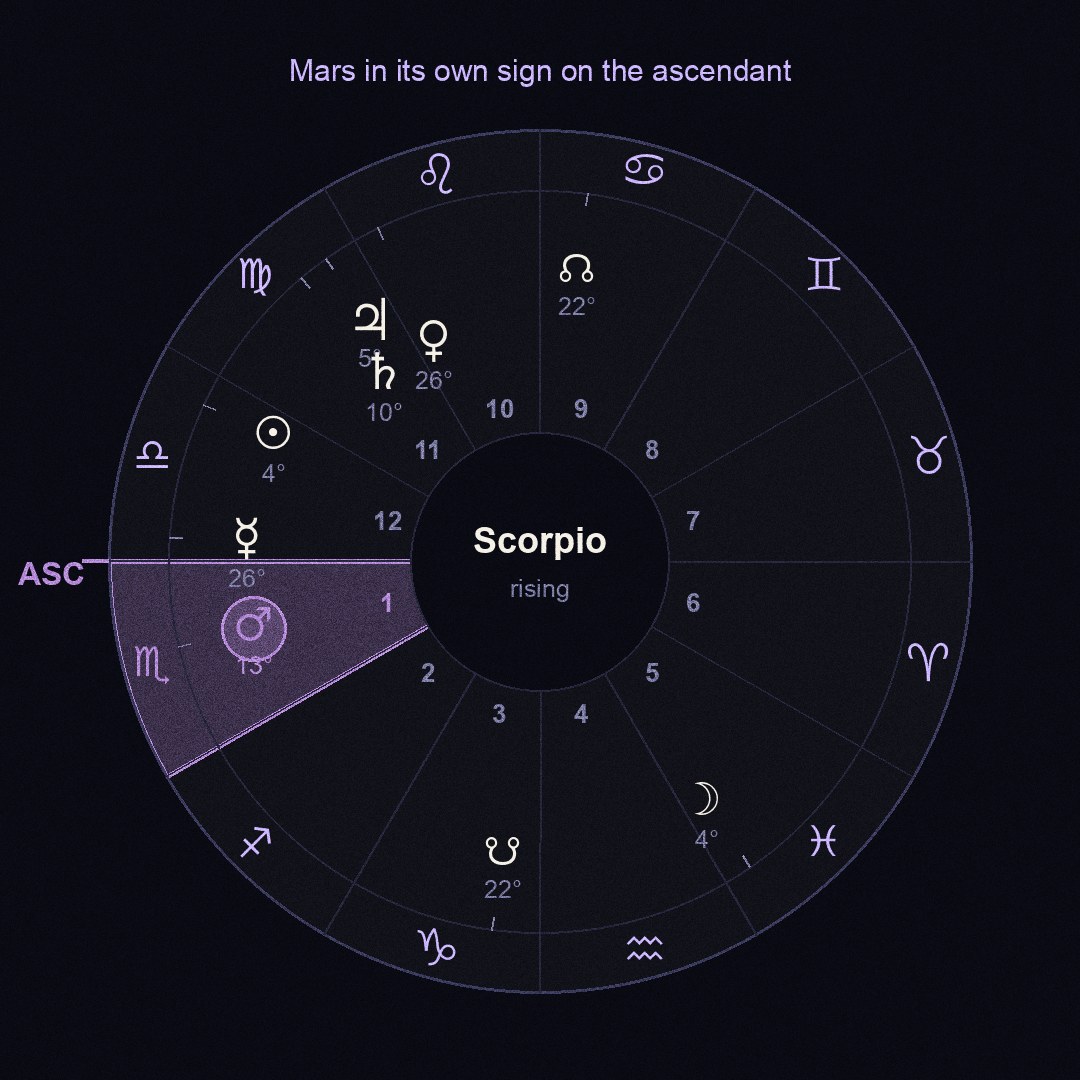
Mars at 13°13′ Scorpio is in its own sign, in the 1st, in a kendra — the exact definition of Ruchaka mahapurusha yoga, and it is not a paper yoga: ratio 1.34, not combust (38.31° from the Sun), not retrograde, yuva avastha (band 3/5), dispositor is itself. This is the single testimony strong on dignity, house, yoga, shadbala and avastha simultaneously. The body leads from the front.
III.The engine carries a 6th-lord tax
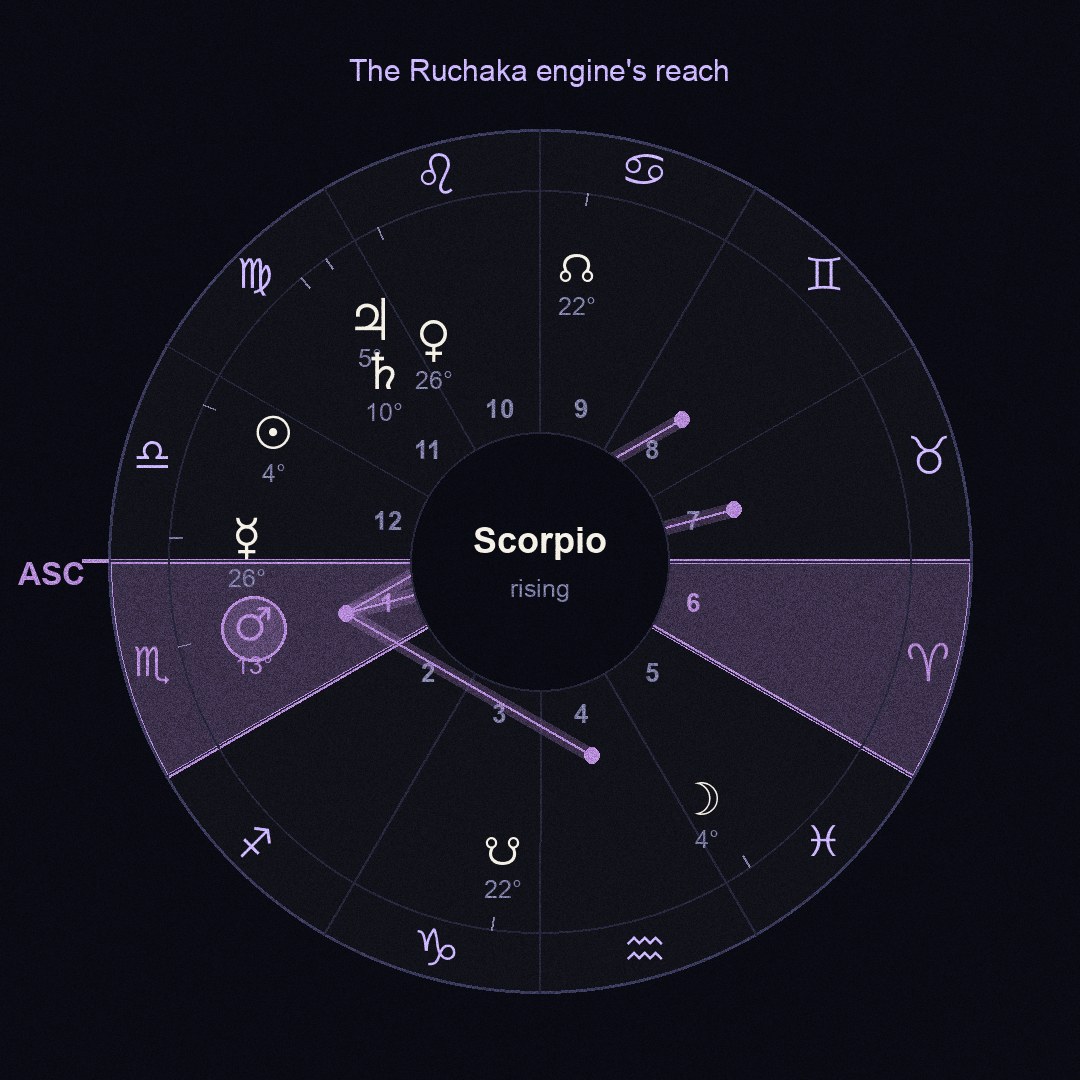
The same Mars is also the 6th lord (Aries), so the graha that builds the body imports the 6th's themes — conflict, enemies, disease, service, debt — straight into the identity. And by drishti Mars throws its full aspects onto the 4th, 7th and 8th (its 4th, 7th and 8th aspects from the 1st), which is why the martial edge falls directly on the partnership house (7th). Anuradha pada 3 (Saturn-ruled) plus Saturn's own 3rd-aspect back onto Mars is the schooling that turns raw Mars into strategy and endurance rather than pure aggression.
IV.The mind, pulled between Jupiter and Saturn
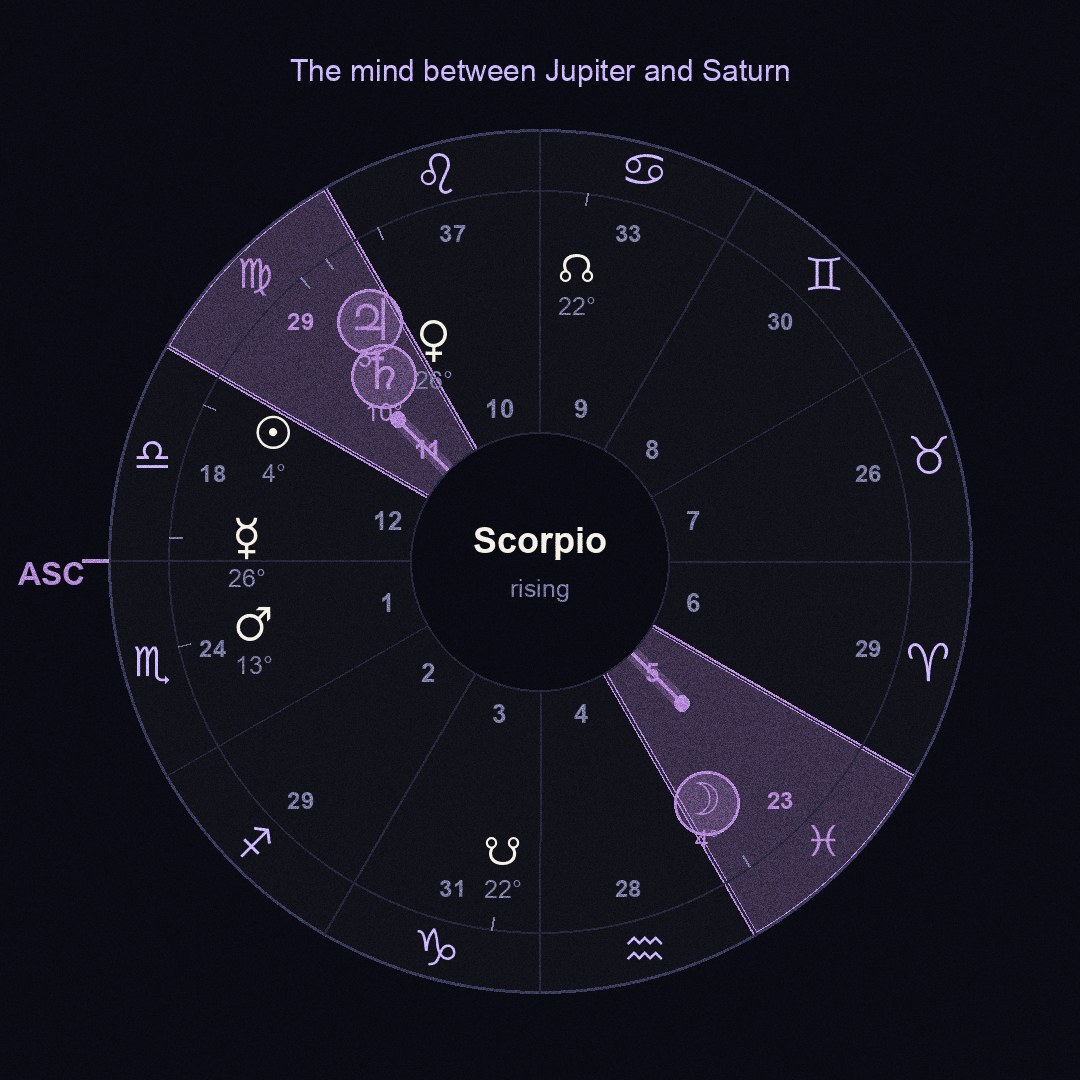
The Moon at 4°34′ Pisces sits in the 5th, in its own janma nakshatra Uttara Bhadrapada. By raw shadbala it is the strongest graha in the chart (8.03 rupas), but its condition contradicts that at every turn: dignity none, mrita avastha (band 1/5), drik bala a net −1.48, dispositor Jupiter a temporal enemy (satru). It stands in Kemadruma — no graha in the 2nd or 12th from it, none conjunct — and it is aspected by both Jupiter and Saturn from the 7th-from-Moon (Virgo, the 11th house). That double aspect is exactly the Kemadruma mitigation flag (grahas in a kendra from the Moon): the isolation is real but not absolute — it fills with elders, mentors and structure rather than spontaneous support. The heavy end of it is Saturn.
V.The loaded 12th — wound and workshop
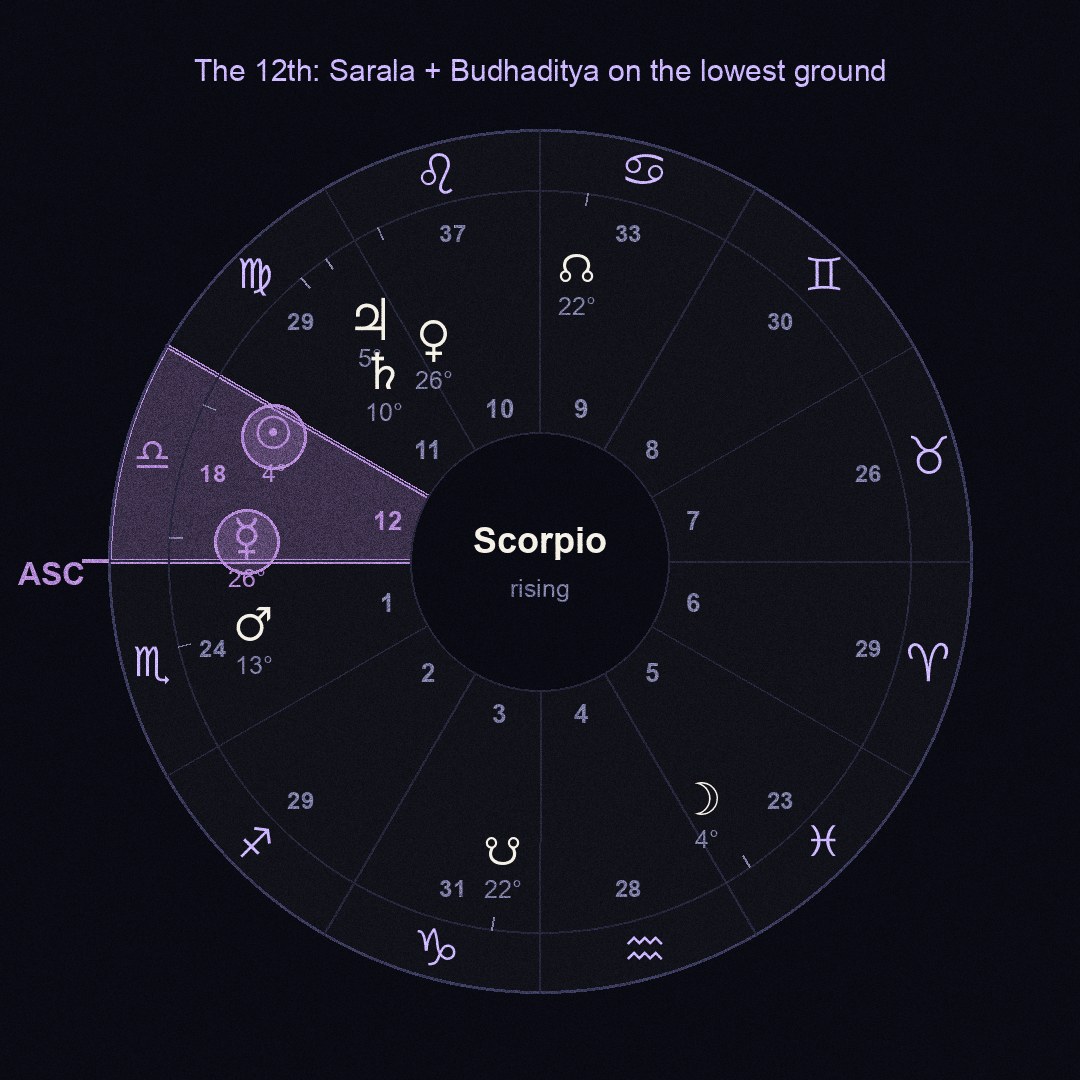
The 12th house (Libra) is the chart's weakest ground by bindus — SAV 18, the lowest of all twelve signs — and simultaneously the seat of two assets. Sarala Viparita Raja yoga: Mercury, lord of the 8th, placed in the 12th (strict form) — strength that surfaces precisely when things break down. Budhaditya: Sun and Mercury in the same sign, Mercury not combust (21.32° separation). But the same house drowns the Sun (debilitated, below) and Mercury sits in mrita avastha (band 5/5). Brilliance that hides, on thin ground.
VI.The rescued fall — the debilitated Sun and its neecha-bhanga
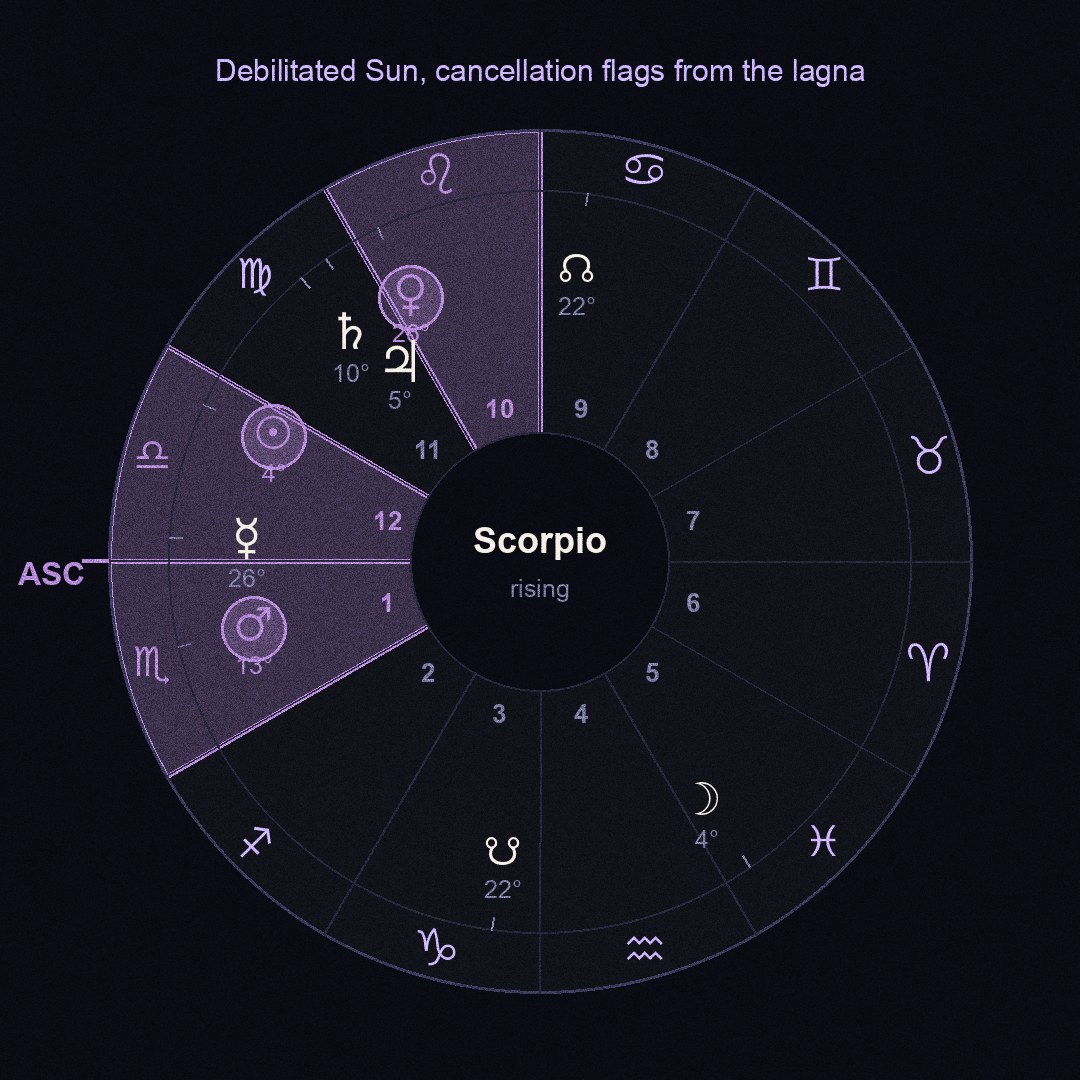
The Sun is debilitated in Libra in the 12th, at 4°54′ — only 5.10° off its deep-debilitation point (10° Libra) — in bala avastha. Two of the most-cited cancellation conditions both fire, and both fire from the lagna: the dispositor Venus sits in a kendra from the lagna (the 10th), and Mars, lord of the Sun's exaltation sign (Aries), sits in a kendra from the lagna (the 1st). Neither fires from the Moon, and the dispositor does not aspect the Sun — so the fall is genuinely buffered but only halfway. This is a debility climbed out of, repeatedly, through career and effort, rather than one that dissolves.
VII.The parivartana that ties the fall to the career
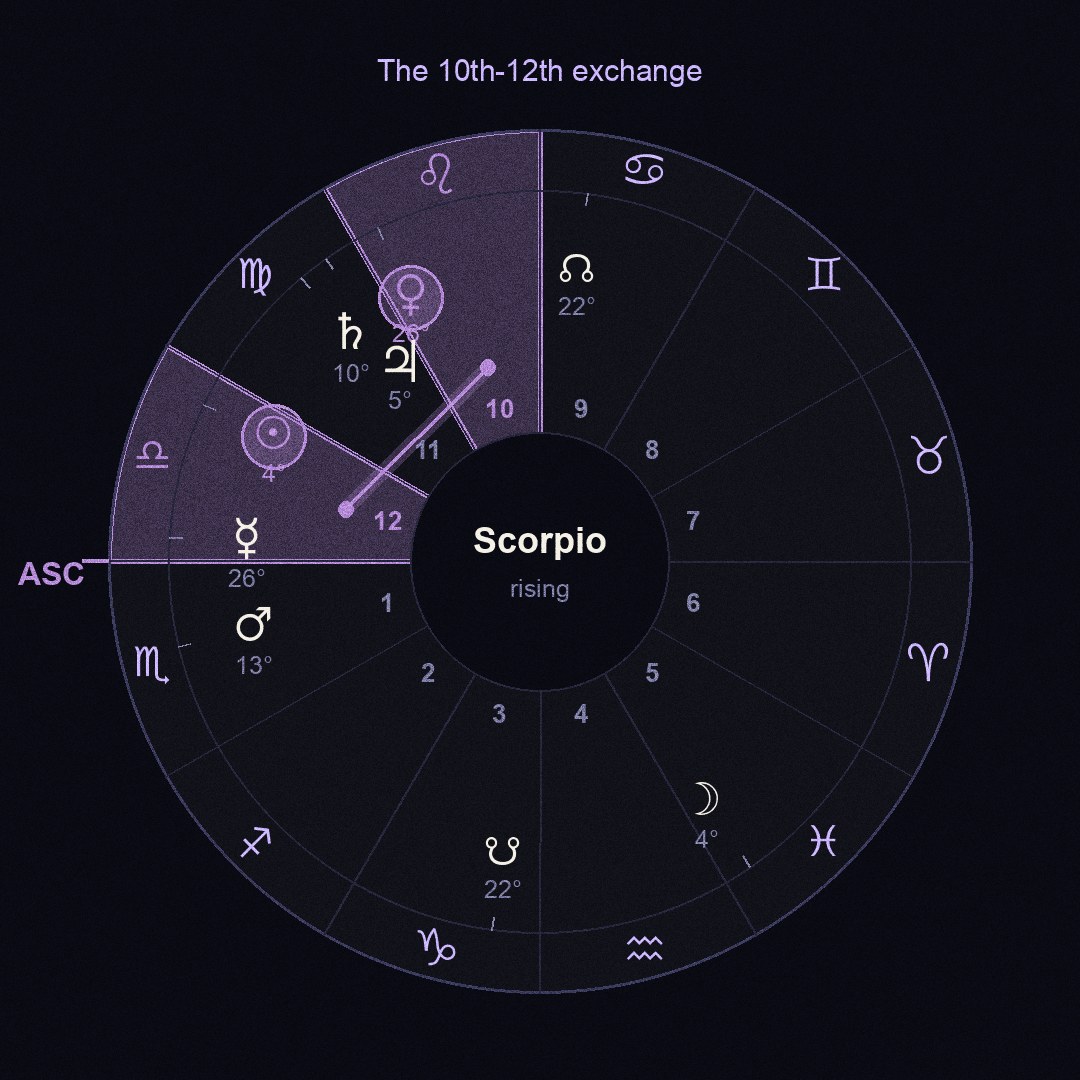
The 10th lord (Sun) and the 12th lord (Venus) have traded houses — a mutual sign exchange classified dainya because the 12th is involved. The fallen Sun goes down into loss and seclusion; Venus rises into the career house. This is the knot the whole current Venus mahadasha (2022–2042) activates: the exchange is the mechanism by which the submerged self-worth axis gets worked through public standing.
VIII.Career — a bright house on a dim lord
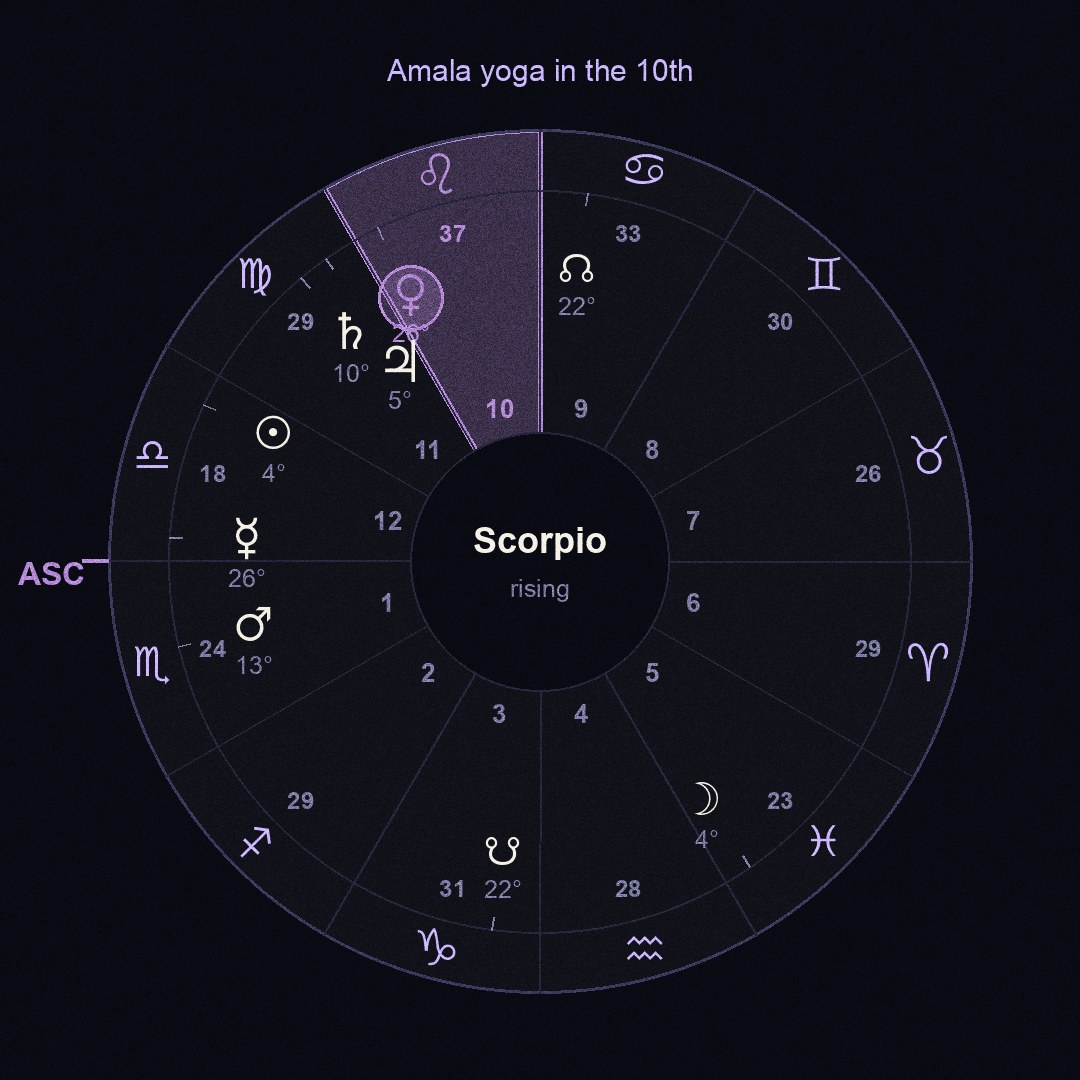
The 10th house is superbly equipped: Venus alone in the 10th (Leo) at 26°01′, in Purva Phalguni pada 4 (its own nakshatra) → Amala yoga, and Leo carries the chart's highest SAV, 37 bindus. But the 10th lord is that fallen Sun in the 12th, and Venus's dig bala is nearly nil (2.95) even while its total shadbala is strong (1.30). A clean, admired name — while the engine of authority behind it lags. This is the chart's single most useful tension: more esteemed than she feels.
IX.The career varga argues back
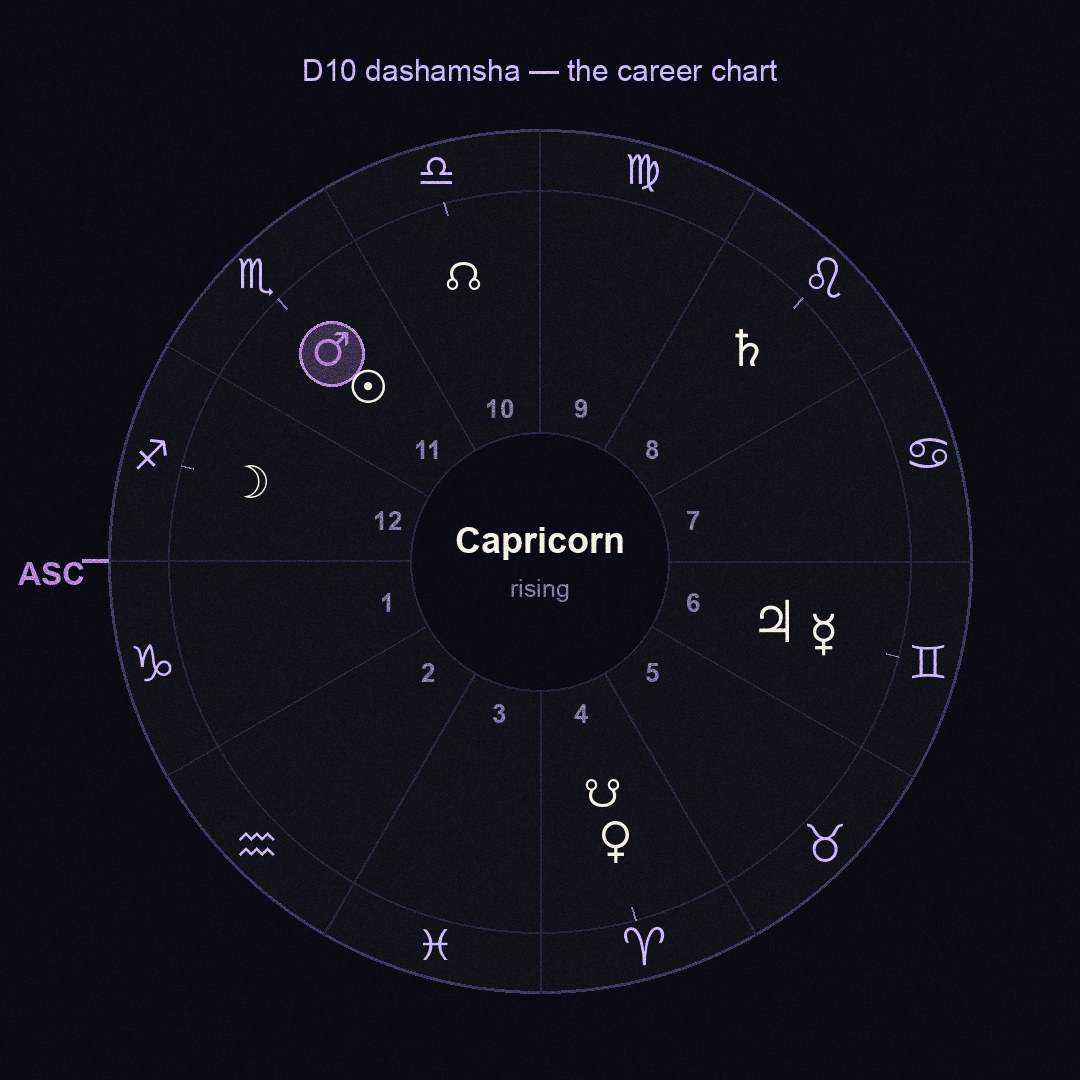
The D1 says the lord of career is damaged; the D10 (dashamsha, the career-specific division) says the competence is not in question — Mars returns to its own sign, Scorpio, in D10, with a Capricorn D10 lagna adding structure and endurance. This is a navamsha-family claim about a divisional chart, so it must be shown in that chart, not the rasi.
X.Yoga-rich, avastha-poor
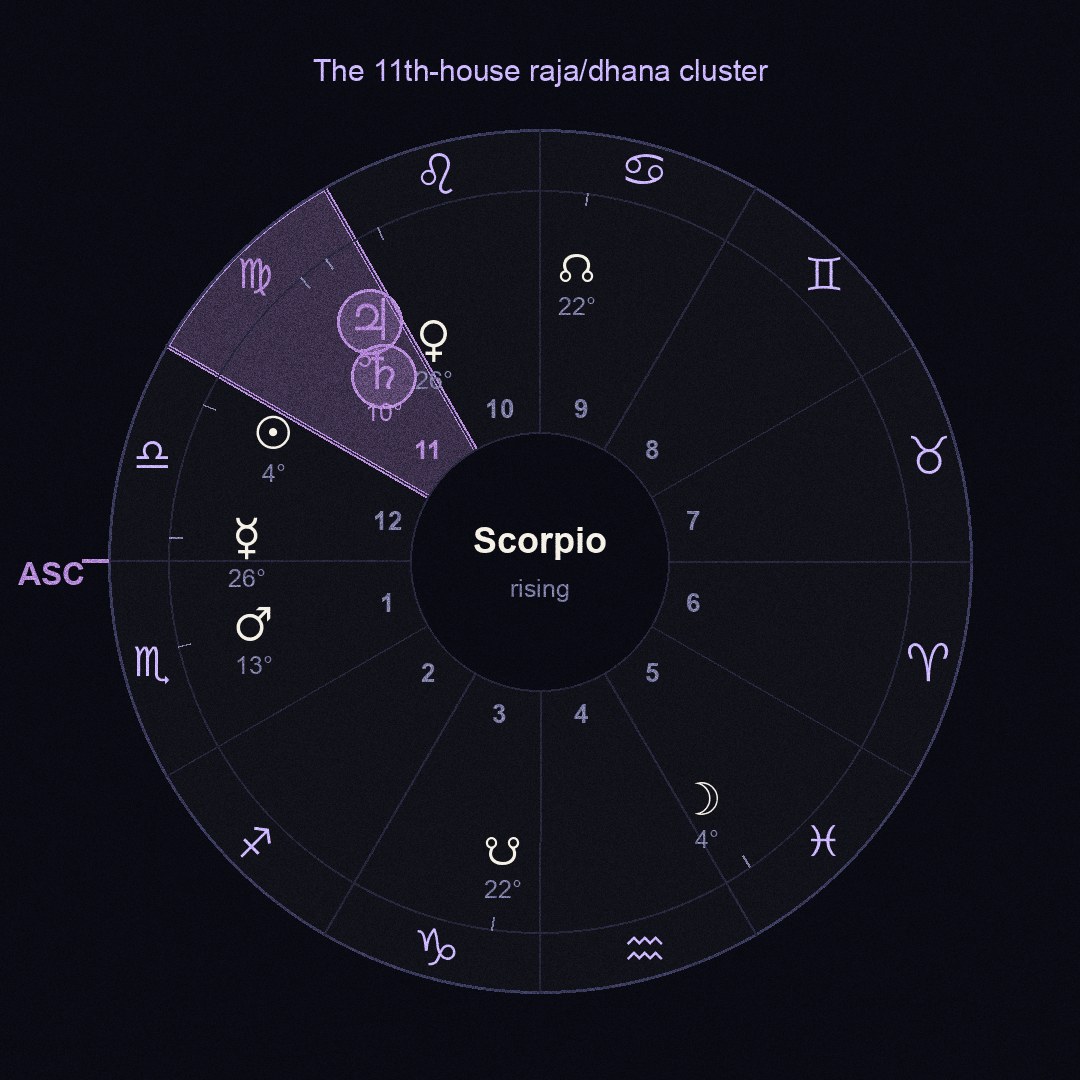
The 11th (Virgo) holds Jupiter (5°17′) and Saturn (10°06′) conjunct → Kendra-Trikona Raja yoga (Jupiter the trikona lord, Saturn the kendra lord). There is a second Kendra-Trikona Raja from the Moon-Saturn mutual aspect, a Dhana yoga (Jupiter-Moon), Gajakesari and Adhi on top. The chart is genuinely yoga-dense. The uniform catch: almost every forming graha is in mrita avastha (Jupiter, Moon, Mercury) or vriddha (Saturn) — real capacity, delivered late and slowly, and one of the raja partners (Saturn) is a functional malefic sitting on the benefic.
XI.The receipt for the lagna's slice of that gain
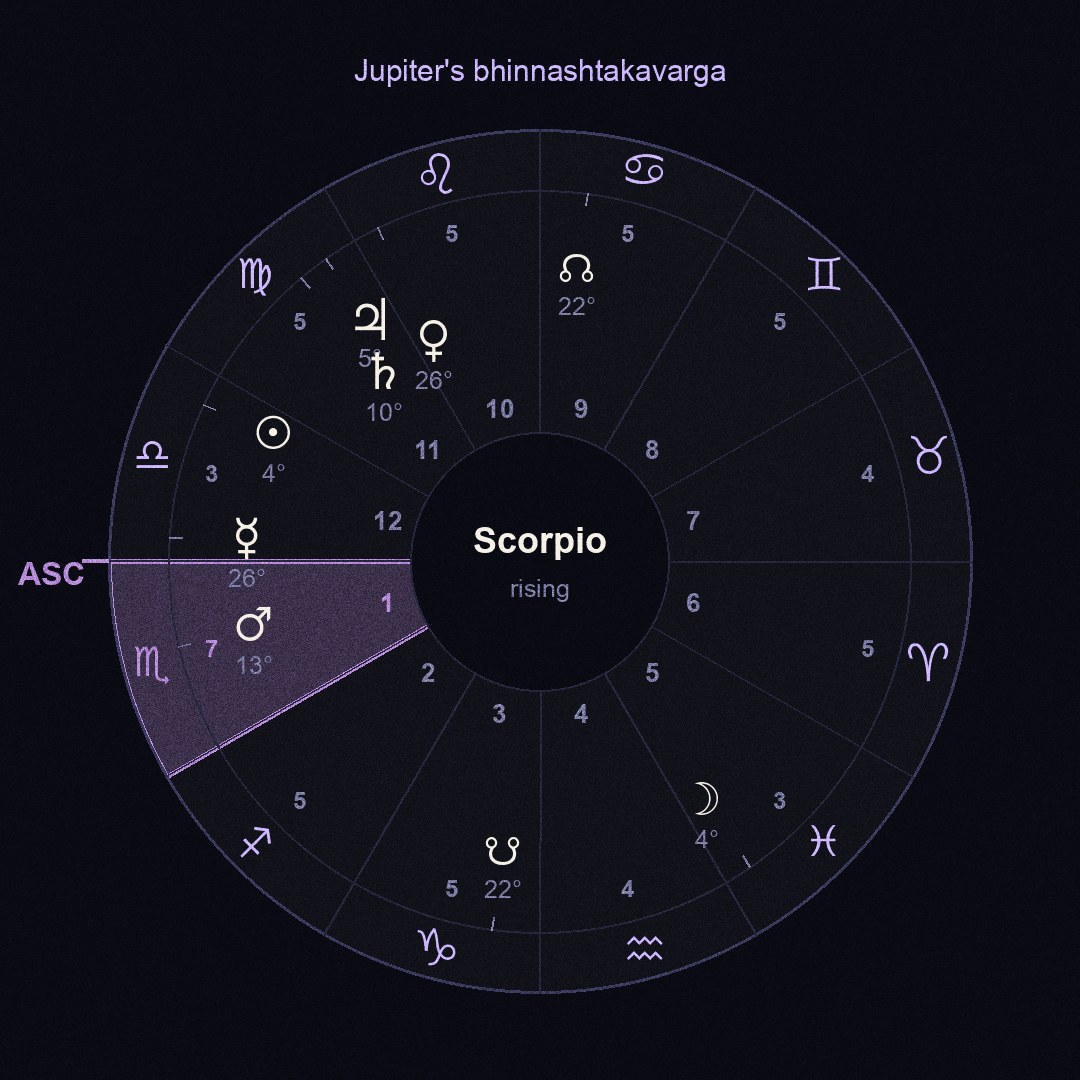
The mrita-tempo qualifier is real, but the 11th cluster does feed the lagna: Jupiter's own bhinnashtakavarga gives Scorpio-lagna 7 bindus, the strongest single-graha support the ascendant sign receives. Worth showing, because the number is the receipt.
XII.The nodal axis — borrowed dharma, released courage
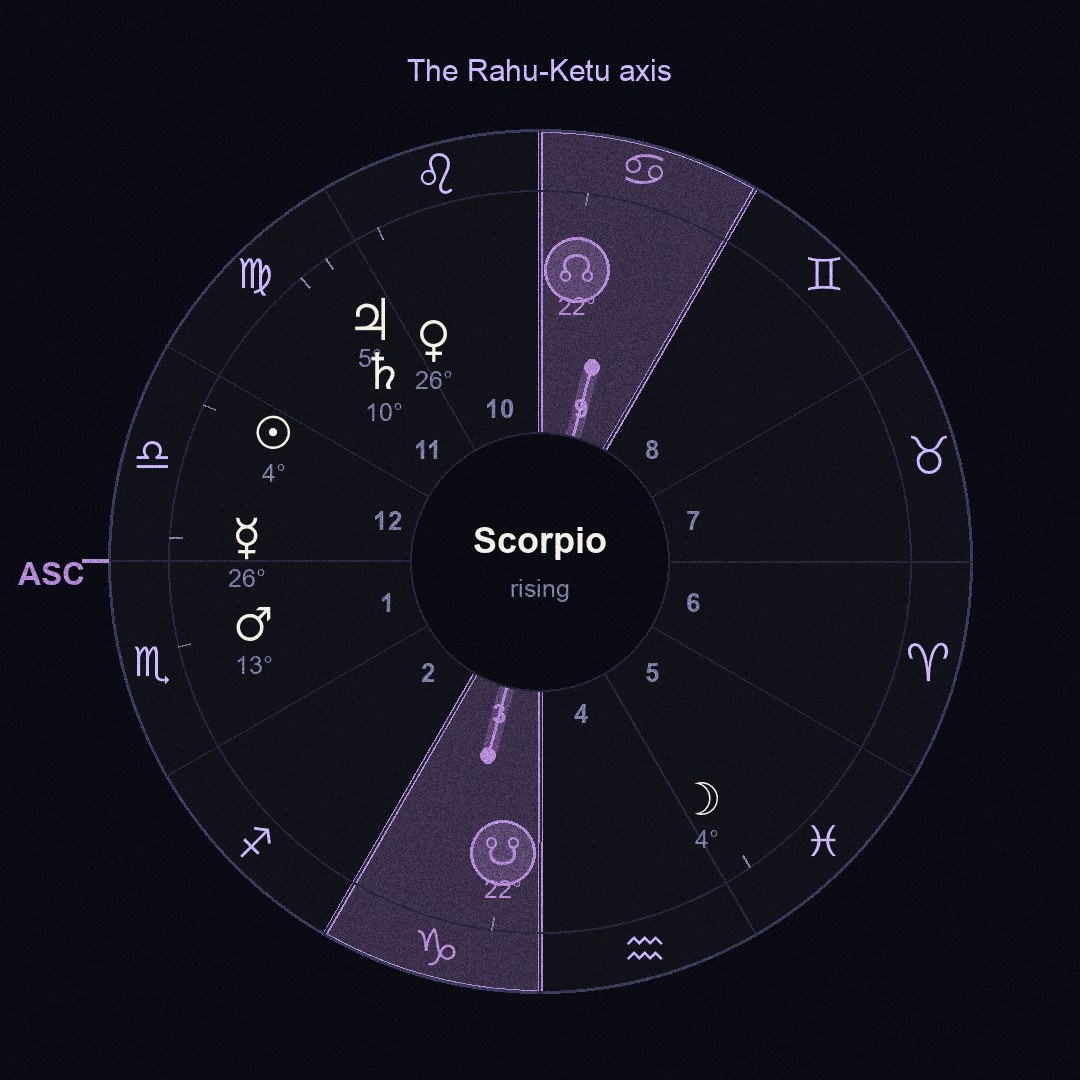
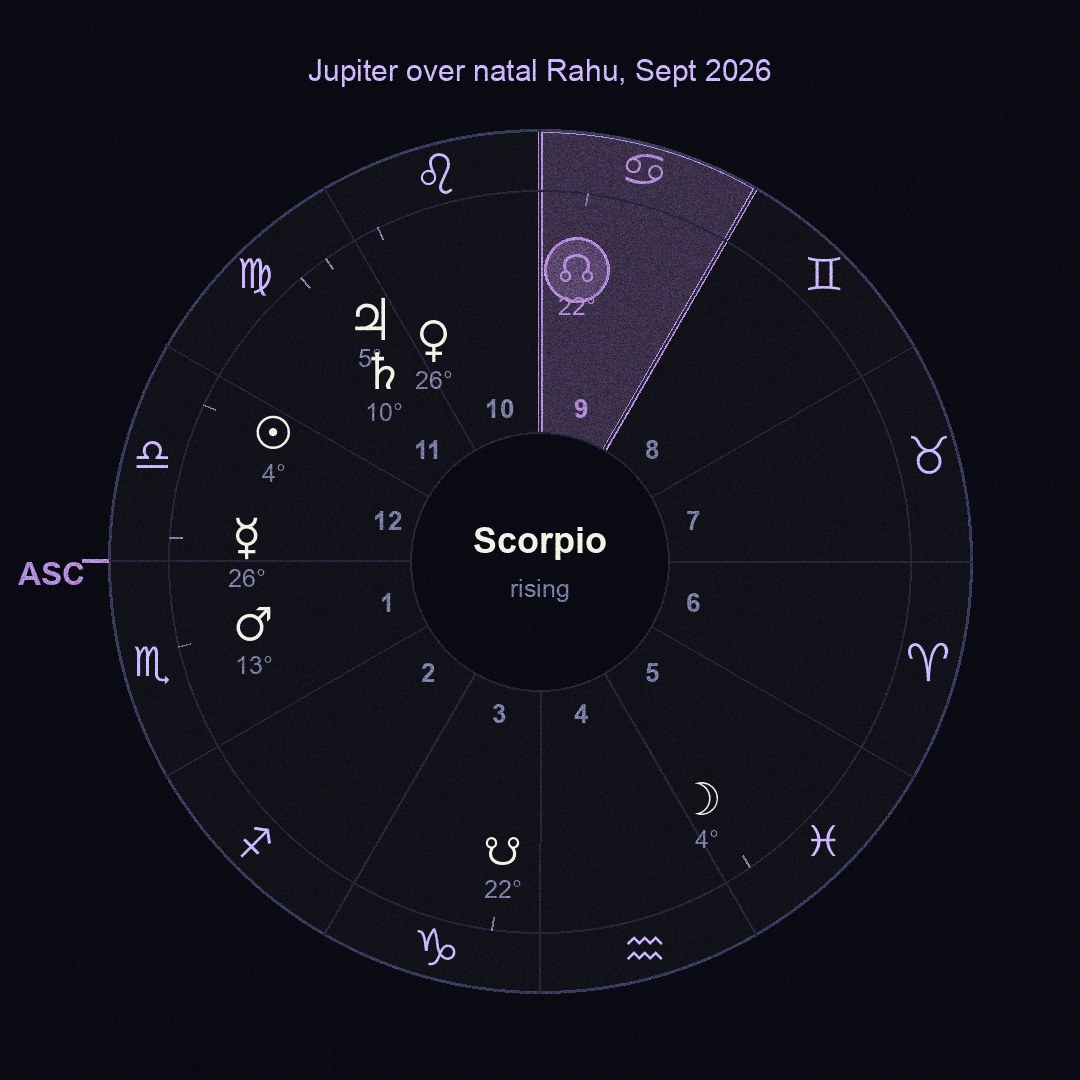
Under the locked conservative posture the nodes own nothing, cast no drishti and hold no dignity — they act by house, sign, nakshatra and dispositor only. Rahu 22°42′ Cancer, 9th, Ashlesha pada 2 (dispositor Moon in the 5th): an unconventional, hungry, possibly foreign relationship to meaning and to the father/teacher — belief sought, not inherited. Ketu 22°42′ Capricorn, 3rd, Shravana pada 4 (dispositor Saturn in the 11th): a native, already-mastered facility with skill and voice that the person under-owns.
XIII.Partnership — aspected, exchanged, undercut in the varga
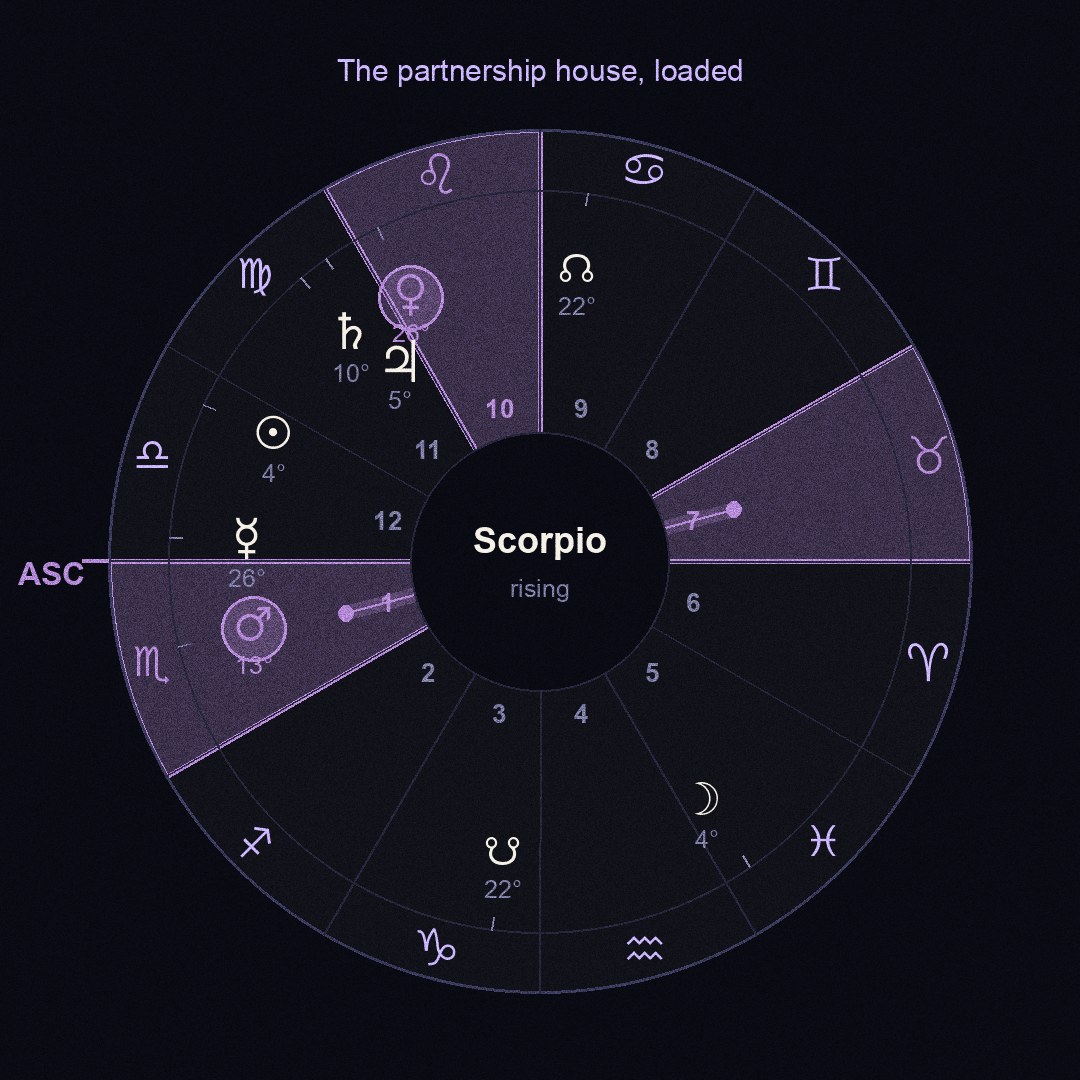
The 7th (Taurus) is empty; its lord Venus sits in the 10th, strong-by-shadbala but dig-bala-weak (2.95) and mrita, tangled by exchange with the fallen Sun. Mars aspects the 7th by its 8th-house drishti, laying the martial/6th-lord edge on the partnership house. And the D9 undercuts whatever the D1 promises — so this claim gets two figures: the D1 loading, then the navamsha.
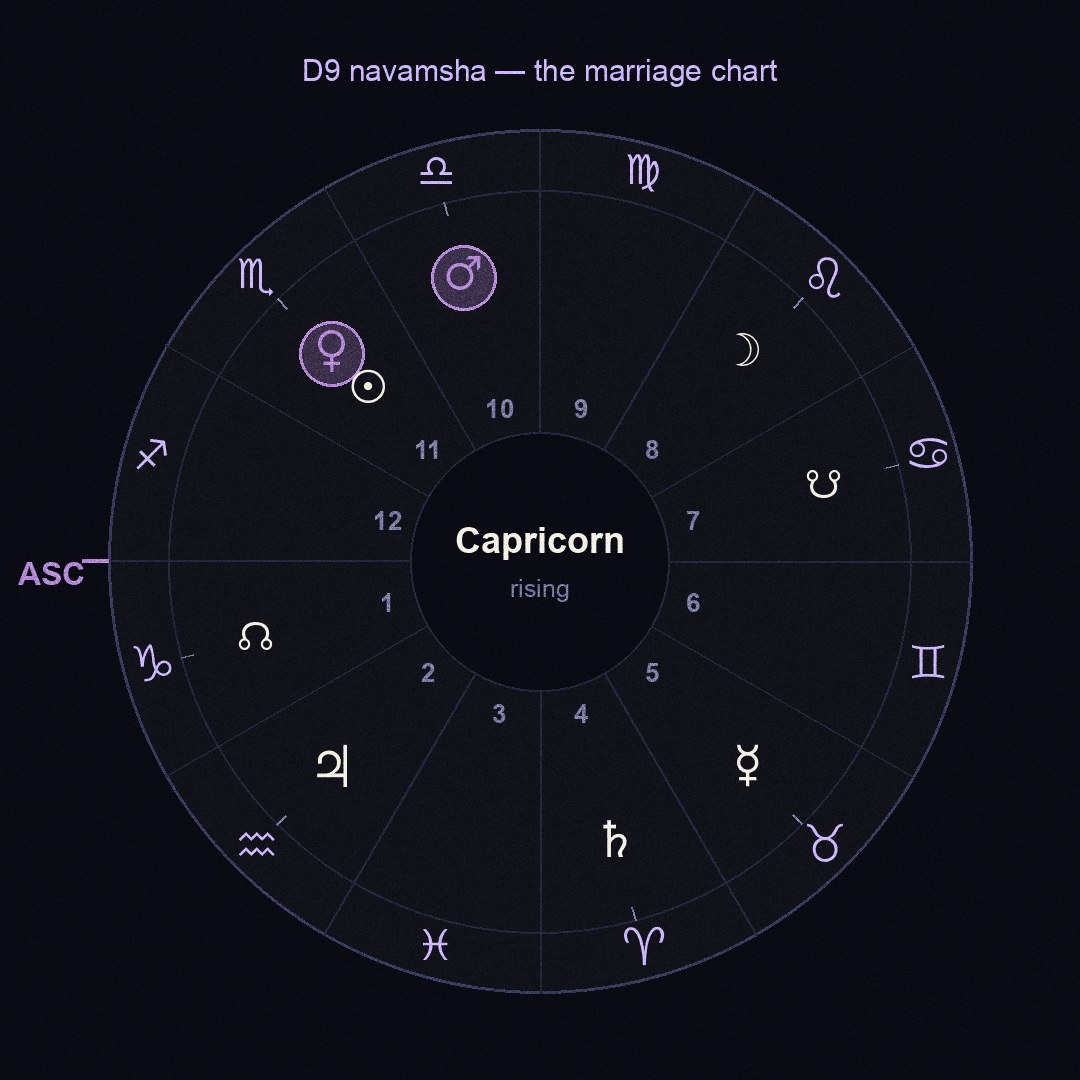
The navamsha is the honest complication behind Contradiction 1: in D9, Venus falls to an enemy sign (Scorpio) and Mars is debilitated (Libra) — the inner foundation of union is harder than its outer presentation.
XIV.How the timing layer reads on top of this
(The detailed timing reading — Layer 2b and the beam — is present, so this is written from it, not from the dossier tables alone.)
The vimshottari clock is seeded by the Moon's own janma nakshatra, so Saturn opens the life (birth → 1998-01-16) — the chart's heaviest graha runs the first chapter. Then Mercury MD 1998–2015 (the Sarala/Budhaditya 12th-house seat: the hidden-workshop chapter) and Ketu MD 2015–2022 (detachment from the native skill). The current chapter is Venus MD 2022-01-16 → 2042-01-16 — and Venus is the 7th+12th lord, the Amala graha, and the up-going half of the parivartana, so the entire twenty-year period is built from Figures 5, 6 and 7 at once: career-reputation, partnership, and the fallen-Sun exchange all belong to the dasha lord. Inside it, the current antardasha Venus/Moon (2026-05-18 → 2028-01-17) lights the chart's most vulnerable figure (the Moon) exactly while sade-sati's Moon-peak presses on it — a footing sub-plot, not a summit one.
The dominant transit is sade sati, 2023-01-17 → 2029-08-08, Moon-peak 2025-03-29 → 2027-06-02, landing Saturn on the natal Moon (exact 2025-05-10, 2025-09-17 retro, 2026-02-02) — and it lands on thin ground, because Pisces carries only 23 SAV. The bindus do not cushion it.
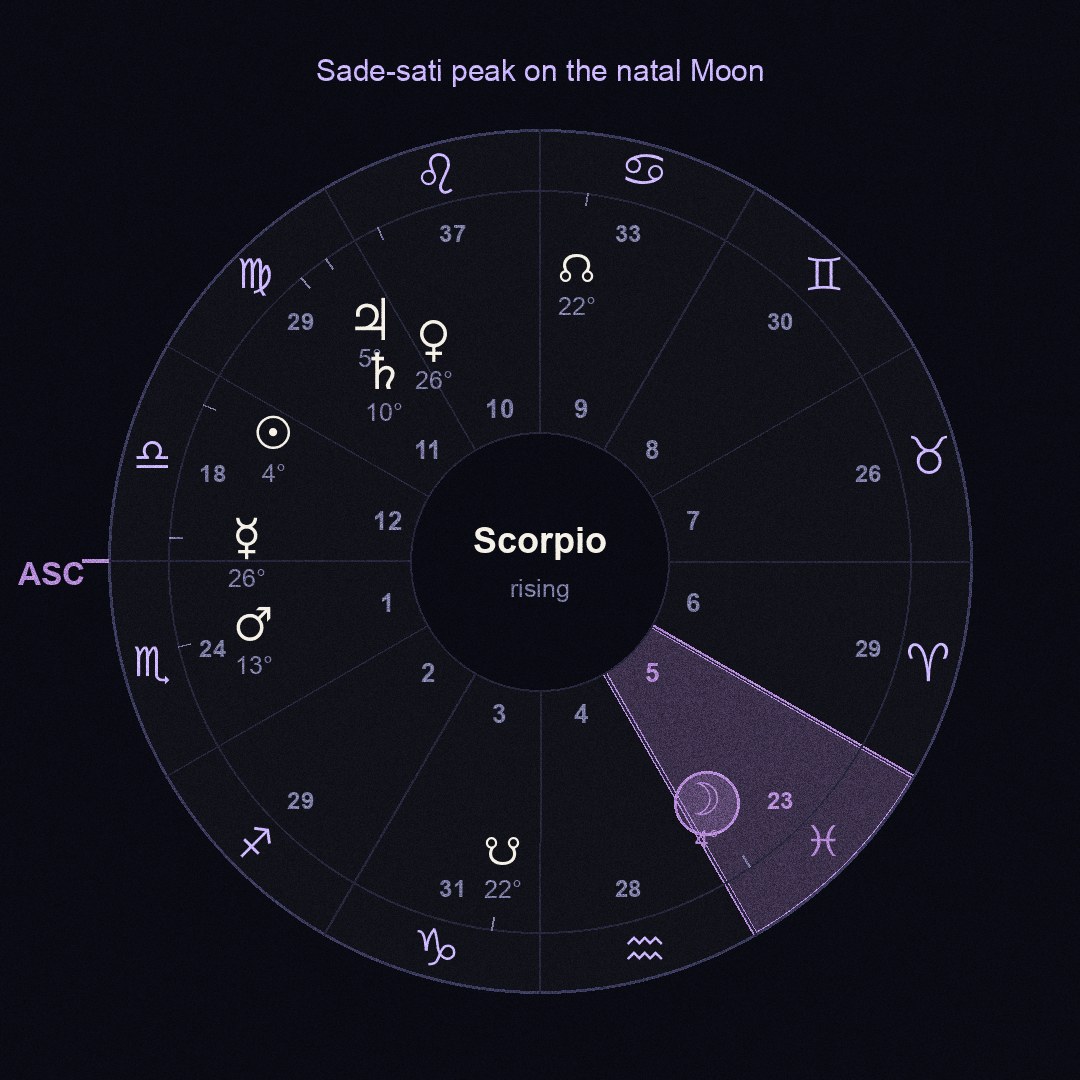
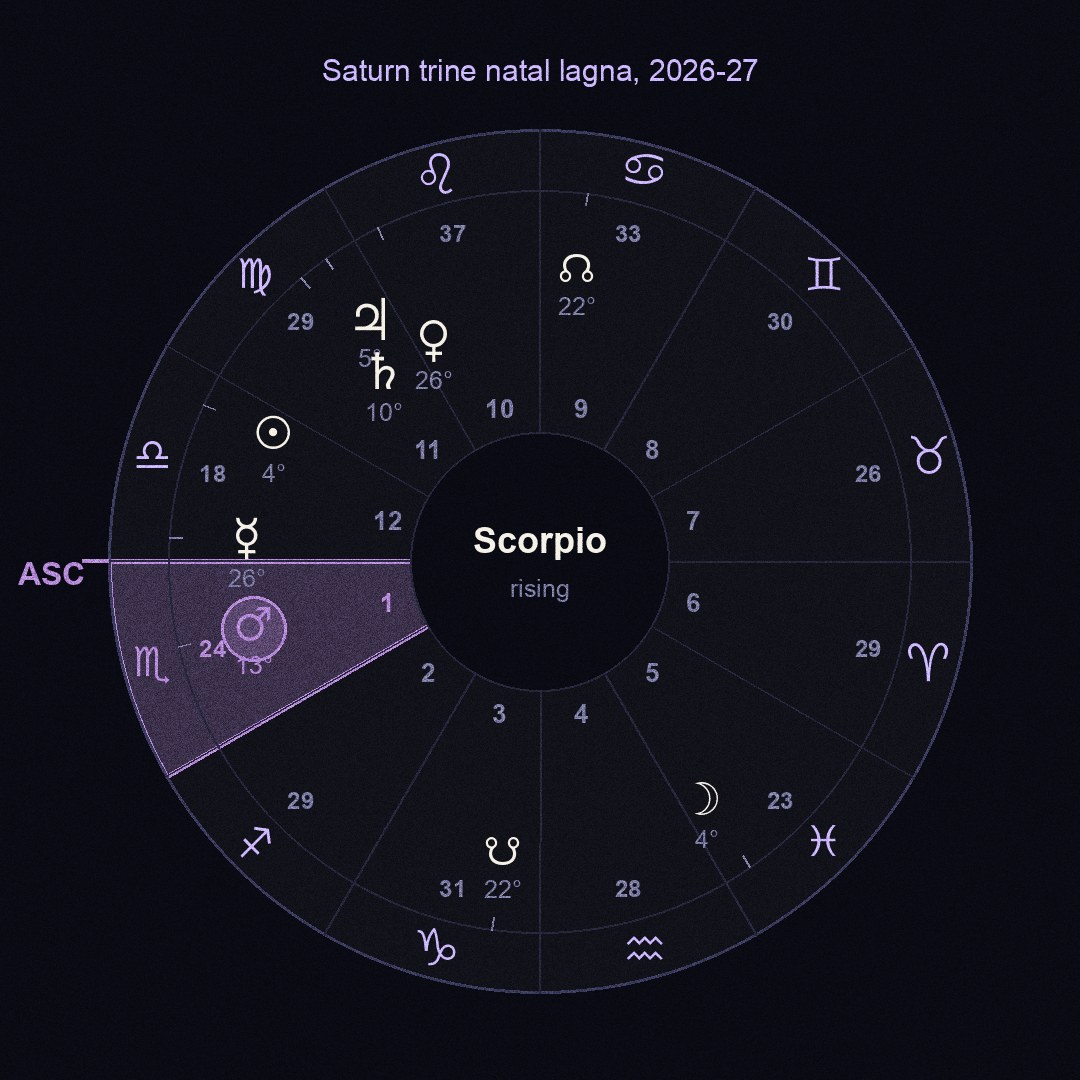
But the same Saturn that presses the Moon supports the lagna/Mars axis by trine — Saturn trine natal lagna 2026-05-22 → 2026-10-03 (exact 2026-07-05, 2026-08-16 retro) and Saturn trine natal Mars 2026-10-15 → 2027-02-03. Scorpio-lagna SAV is 24, modest, but a Saturn trine to the body/will figure is steadying discipline, not friction. This is the two-toned signature of the near field: Saturn hard on the mind, helpful to the will.
The one clearly benevolent transit is Jupiter conjunct natal Rahu / opposite natal Ketu, 2026-09-02 → 2026-10-02, exact 2026-09-16 — Jupiter crossing the 9th-house Rahu, re-opening the dharma/father/meaning axis that Figure 11 flagged as stressed.
XV.Where the chart forks
The beam carried three pivots; each stays ranked with its own band words.
- P-1 — how fully the submerged authority/self-worth axis rebuilds (structural; high on terrain, medium on how fully the fall lifts). Path A — repeatedly climbs out through career and effort, standing rises but recognition always feels earned rather than owed — most likely. Path B — the Venus chapter converts hidden competence into fully-owned, named authority; the Sun MD (2042+) completes it — plausible. Path C — remains the admired operator who fronts through others and never claims the chair; the 12th keeps draining the 11th — plausible. Distinguisher: whether the current Venus chapter is spent taking authored authority or delivering it for others. (Figures 4, 5, 6, 7.)
- P-2 — which face of the martial drive runs live (structural; open on expression). Path A — the disciplined competitor pointing the edge at a demanding arena — very likely (Anuradha schooling + own-sign Mars in D10). Path B — lacking an opponent, the edge turns on the body or intimates — plausible. P-2 Path B ⇒ P-3 Path B. (Figures 1, 2, 8.)
- P-3 — is the inner foundation of partnership as solid as its surface (significant; medium-high). Path A — a deliberately-worked, private domain steadied by a weighty-wise partner — very likely. Path B — the D9 collects its due at home; friction and private insecurity inside the domain the drive powers — plausible. (Figures 12, 13.)
XVI.Recurring keywords
- 12th house — center of pressure, four witnesses (Sun deb., Mercury/Sarala, Budhaditya, SAV 18 lowest)
- mrita avastha — four yoga-forming grahas dead (Moon, Jupiter, Mercury; Saturn vriddha)
- Mars own-sign — twice (D1 Scorpio 1st, D10 Scorpio)
- Saturn on the Moon — aspect + sade-sati transit + opens the dasha clock
- father/authority axis — three witnesses (Sun fallen 12th, Rahu 9th, 9th-lord Moon mrita)
- SAV extremes — Leo 37 (10th, high) vs Libra 18 (12th, low), Pisces 23 (Moon)
- Venus everywhere now — MD lord, Amala 10th, 7th+12th lord, parivartana partner
- whole chart on a slow clock — shadbala spread narrow (1.10–1.34), gains late
- dispositor Moon — both Rahu (9th) and, by nakshatra, the janma sequence route through it
- kendra from the Moon — Jupiter + Saturn, the Kemadruma mitigation